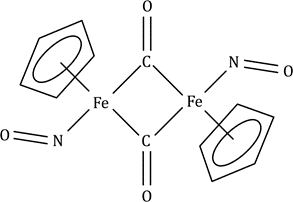
Correct option is B
The 18-electron rule is a chemical rule of thumb used primarily for predicting and rationalizing formulas for stable transition metal complexes, especially organometallic compounds. The rule is based on the fact that the valence orbitals in the electron configuration of transition metals consist of five (n−1)d orbitals, one ns orbital, and three np orbitals, where n is the principal quantum number. These orbitals can collectively accommodate 18 electrons as either bonding or non-bonding electron pairs. This means that the combination of these nine atomic orbitals with ligand orbitals creates nine molecular orbitals that are either metal-ligand bonding or non-bonding. When a metal complex has 18 valence electrons, it is said to have achieved the same electron configuration as the noble gas in the period, lending stability to the complex. Transition metal complexes that deviate from the rule are often interesting or useful because they tend to be more reactive.
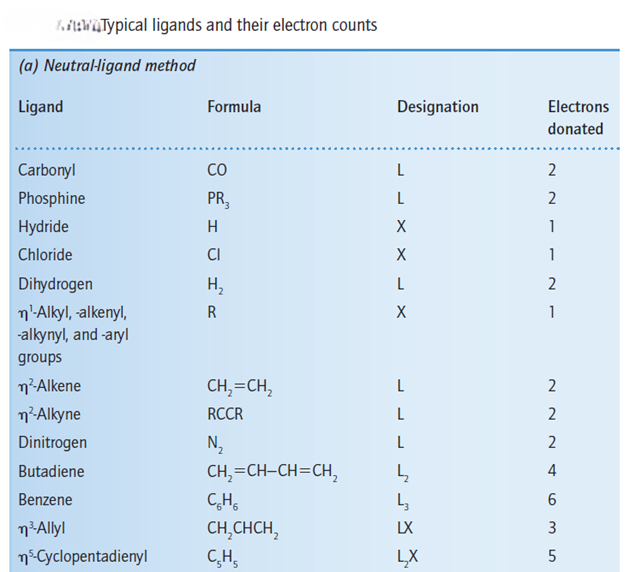
Two models are routinely used to count electrons, the so-called neutral-ligand method (sometimes called the covalent method) and the donor-pair method (sometimes known as the ionic method).
Neutral-ligand method: For the sake of counting electrons, each metal atom and ligand is treated as neutral. We include in the count all valence electrons of the metal atom and all the electrons donated by the ligands. If the complex is charged, we simply add or subtract the appropriate number of electrons to the total. The advantage of the neutral-ligand method is that, it is trivial to establish the electron count. The disadvantage, however, is that the method overestimates the degree of covalence and thus underestimates the charge at the metal. Moreover, it becomes confusing to assign an oxidation number to a metal, and meaningful information on some ligands is lost.
CO contributes two electrons in terminal and bridging form.
Metal cluster compounds are a molecular ion or neutral compound composed of three or more metals and featuring significant metal-metal interactions.
Metal nitrosyl complexes are complexes that contain nitric oxide, NO, bonded to a transition metal. Many kinds of nitrosyl complexes are known, which vary both in structure and coligand.
The NO molecule can bind to a low oxidation state metal atom, and once coordinated NO is known as a nitrosyl ligand. Terminally bound NO can adopt two different bonding modes: linear or bent. In the linear mode, NO donates three electrons to the metal centre. Experimentally, a ‘linear’ MNO unit may have M–N–O bond angles in the range 165–180°, and in the IR spectrum, the vibrational wavenumber for the νNO mode lies in the approximate range 1650–1900 cm-1. In the bent mode, NO donates one electron to the metal centre. Bent nitrosyl ligands are characterized by having M–N–O bond angles in the range 120–140°, and in the IR spectrum, the νNO absorption typically lies between 1525and 1690cm-1.

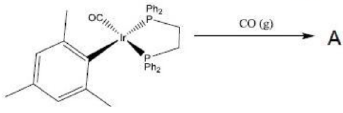
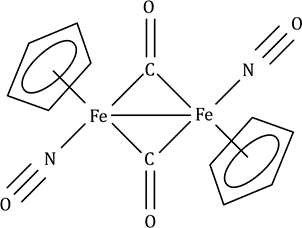
In structure a, total electron count at one metal centre=

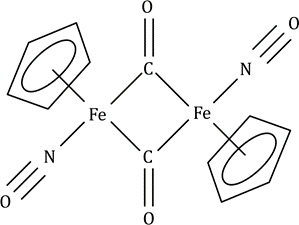
In structure b, total electron count at one metal centre=

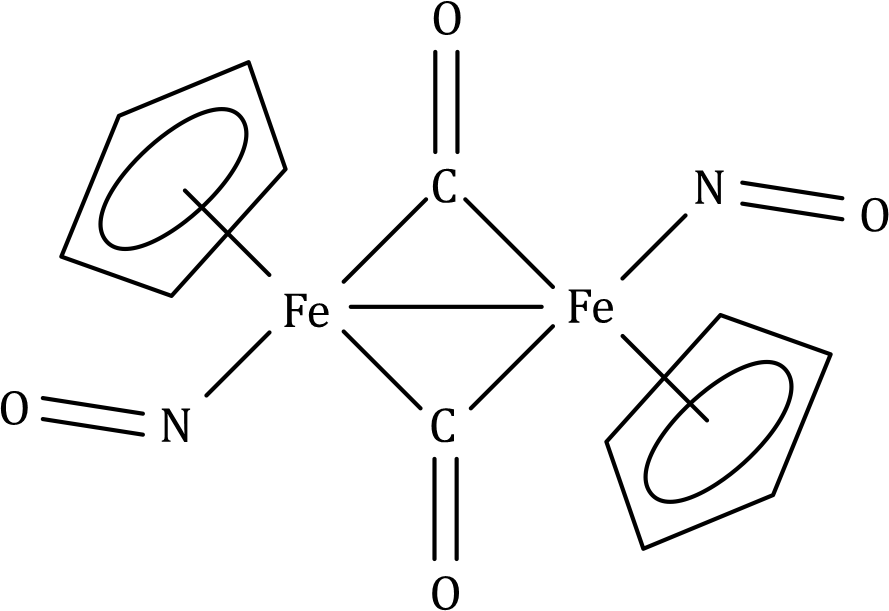
In structure c, total electron count at one metal centre=

In structure d, total electron count at one metal centre=