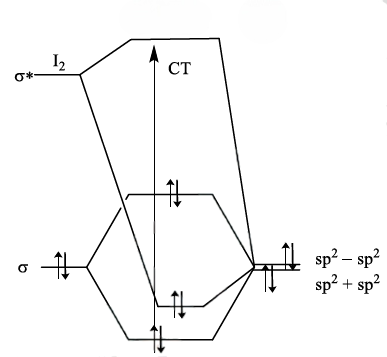
Correct option is D
Charge-transfer bands are a characteristic feature of the optical spectra of many compounds. CT absorptions bands are intense and often lie in the ultraviolet or visible portion of the spectrum. For coordination complexes, charge-transfer bands often exhibit molar absorptivities, ε, of about 50000 L mol-1 cm-1. Charge-transfer bands of transition metal complexes result from shift of charge density between molecular orbitals (MO) that are predominantly metal in character and those that are predominantly ligand in character. If the transfer occurs from the MO with ligand-like character to the metal-like one, the transition is called a ligand-to-metal charge-transfer (LMCT). If the electronic charge shifts from the MO with metal-like character to the ligand-like one, the band is called a metal-to-ligand charge-transfer (MLCT).