Correct option is D
Detailed Explanation:
Let's break down each renal tubule segment and the corresponding sodium transporter in the apical membrane:
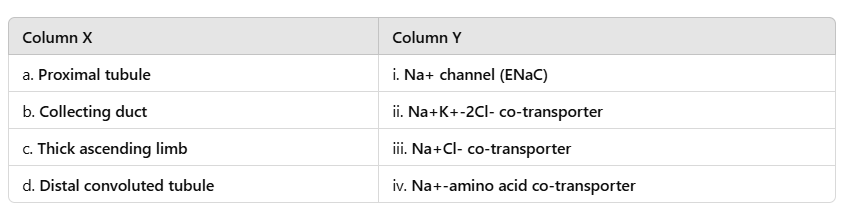
Proximal Tubule (a) -iv. The Na+-amino acid co-transporter is responsible for sodium and amino acid reabsorption in the proximal tubule.
- Function: The proximal tubule is responsible for the bulk reabsorption of sodium, water, and nutrients like amino acids.
- Transporter: The main transporter here is the Na+-amino acid co-transporter (iv), which allows for the co-transport of sodium (Na+) and amino acids from the filtrate into the tubular cells.
Collecting Duct (b) -i. The Na+ channel (ENaC)is crucial for sodium reabsorption in the collecting duct.
- Function: The collecting duct plays a critical role in fine-tuning the reabsorption of sodium and water, especially under the regulation of aldosterone.
- Transporter: The Na+ channel (ENaC) is found in the collecting duct, where it facilitates sodium reabsorption. This is regulated by aldosterone, and the channel's activity is a key determinant of sodium balance in the body.
Thick Ascending Limb (c) -ii. The Na+ K+-2Cl- co-transporter plays a crucial role in the reabsorption of sodium, potassium, and chloride in the thick ascending limb.
- Function: The thick ascending limb (TAL) of the loop of Henle is impermeable to water but is involved in the active reabsorption of sodium, potassium, and chloride ions.
- Transporter: The Na+ K+-2Cl- co-transporter (ii) is expressed in the thick ascending limb and is responsible for co-transporting sodium (Na+), potassium (K+), and chloride (Cl-) ions across the apical membrane into the tubular cells. This is an energy-dependent process that helps maintain the medullary osmotic gradient.
Distal Convoluted Tubule (d) -iii. The Na+ Cl- co-transporter is the key sodium transporter in the distal convoluted tubule.
- Function: The distal convoluted tubule is involved in the fine-tuning of sodium reabsorption and calcium balance, as well as acid-base regulation.
- Transporter: The Na+ Cl- co-transporter (iii) is located in the distal convoluted tubule. It reabsorbs sodium (Na+) and chloride (Cl-) ions, and it is regulated by aldosterone and other factors.