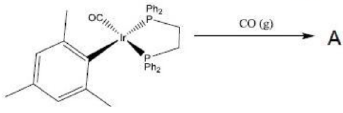
Correct option is B
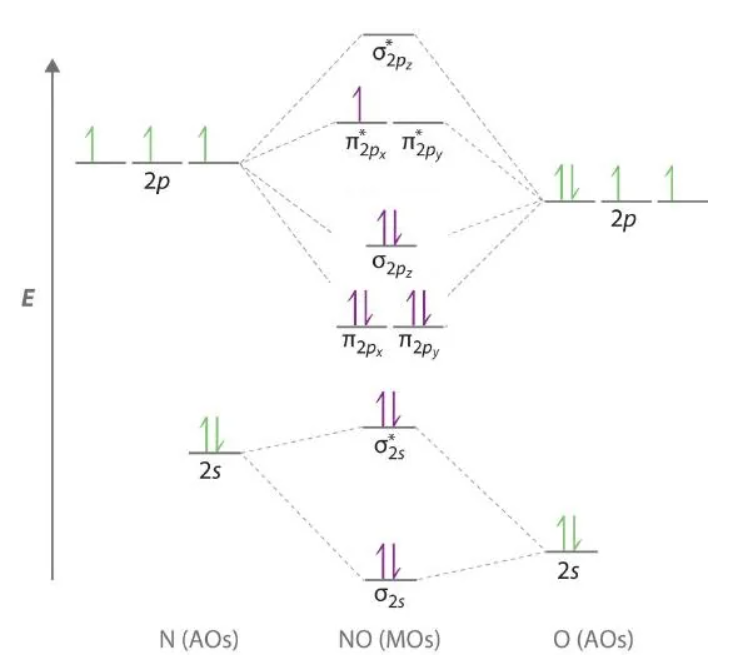
Metal nitrosyl complexes are complexes that contain nitric oxide, NO, bonded to a transition metal. Many kinds of nitrosyl complexes are known, which vary both in structure and coligand.
The NO molecule can bind to a low oxidation state metal atom, and once coordinated NO is known as a nitrosyl ligand. Terminally bound NO can adopt two different bonding modes: linear or bent. In the linear mode, NO donates three electrons to the metal centre. Experimentally, a ‘linear’ MNO unit may have M–N–O bond angles in the range 165–180°, and in the IR spectrum, the vibrational wavenumber for the νNO mode lies in the approximate range 1650–1900 cm-1. In the bent mode, NO donates one electron to the metal centre. Bent nitrosyl ligands are characterized by having M–N–O bond angles in the range 120–140°, and in the IR spectrum, the νNO absorption typically lies between 1525and 1690cm-1.

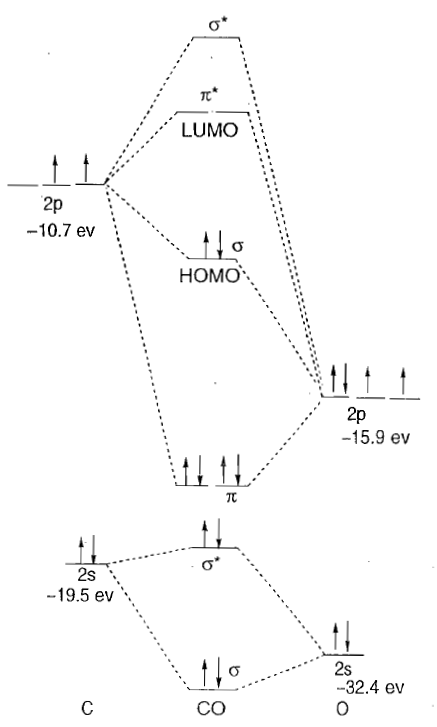
The HOMO of CO is a σ orbital having a higher amplitude on the carbon atom than the oxygen atom and is therefore considered as a carbon based orbital which is also slightly antibonding in nature with respect to the oxygen atomic orbitals. The π* antibonding orbitals which are the LUMOs are closer in energy to the carbon atomic orbitals than the oxygen atomic orbitals and thus have a greater amplitude on carbon. This explains why CO binds through the carbon atom and also why it is good σ-donor and a good π-acceptor. There exists a strong back bonding or π overlap of metal electrons to the π* antibonding orbitals of CO.
The HOMO of NO ligand is π* orbital.