






Correct option is A
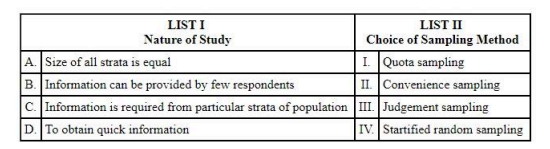
The correct matching of List-I (Nature of Study) with List-II (Choice of Sampling Method) is:
A-IV (Size of all strata is equal → Stratified random sampling):
In stratified random sampling, the population is divided into strata (groups) of equal size, and random sampling is performed within each stratum. This ensures fair representation from all strata.B-III (Information can be provided by few respondents → Judgement sampling):
Judgement sampling involves selecting respondents who are most likely to provide the required information, based on the researcher’s judgment. It is often used when only a few respondents have the necessary expertise.C-I (Information is required from particular strata of population → Quota sampling):
In quota sampling, specific strata or groups are identified, and a fixed quota of respondents is chosen from each group to ensure representation of that stratum.D-II (To obtain quick information → Convenience sampling):
Convenience sampling involves selecting respondents based on their availability and accessibility, making it a fast and cost-effective method for obtaining quick information.
Information Booster
- Stratified Random Sampling: Ensures fair representation across all strata. It is used when strata sizes are equal or need to be proportionally represented.
- Judgement Sampling: Relies on expert knowledge to select participants, often used in specialized studies.
- Quota Sampling: Targets specific groups with fixed quotas, ensuring diversity and representation of key segments.
- Convenience Sampling: Prioritizes speed and accessibility, often used in exploratory research or when resources are limited.
 English
 10 Questions
 20 Marks
 12 Mins


