






Correct option is A
Karl Pearson's coefficient of variation (CV) is a standardized measure of dispersion of a probability distribution or frequency distribution. It is defined as the ratio of the standard deviation (σ) to the mean (μ), usually expressed as a percentage:
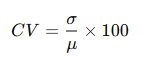
The CV measures the extent of variability in relation to the mean of the population. It helps in understanding the degree of homogeneity or uniformity of data. A smaller CV indicates data points are closely clustered around the mean, implying higher homogeneity or consistency in the data set. Conversely, a higher CV indicates more variability or heterogeneity.
Thus, the coefficient of variation is a relative measure of dispersion and is primarily used to compare the degree of variation from one data series to another, even if the means are drastically different.
Information Booster:
Coefficient of Variation (CV) measures homogeneity by assessing relative variability.
It is a dimensionless number useful for comparing variability between different datasets.
CV is widely used in fields such as finance, quality control, and meteorology.
It normalizes standard deviation relative to the mean, making comparisons meaningful.
A lower CV indicates more uniformity or homogeneity.
CV is especially useful when the mean values differ significantly.
It is sensitive to the mean, so it is undefined or meaningless when the mean is zero or close to zero.
Additional Knowledge:
Unbiasedness (Option b):
Unbiasedness refers to an estimator whose expected value equals the true parameter value. It is a property of estimators/statistics ensuring no systematic over or underestimation. CV does not measure unbiasedness.Consistency (Option c):
Consistency refers to an estimator that converges in probability to the true parameter value as the sample size increases. CV is not a measure of consistency.Efficiency (Option d):
Efficiency relates to the variance of an estimator among all unbiased estimators — the estimator with the smallest variance is considered most efficient. CV does not measure efficiency.
 English
 10 Questions
 20 Marks
 12 Mins


