






Correct option is A
Statement I is correct because it is a well-known identity in regression analysis:
bxy × byx = r2
where rrr is the correlation coefficient between variables X and Y. Since r2>1, the product of the regression coefficients cannot exceed 1.
Statement II is also considered correct in the context where the regression coefficients are positive or when the variables are positively correlated. The average of the two regression coefficients

is always greater than or equal to the correlation coefficient rrr. This is because each regression coefficient can be written as:
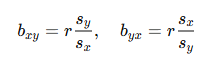
and by the AM–GM inequality (Arithmetic Mean - Geometric Mean inequality), the average of bxy and byx is always greater than or equal to r (except when sx = sy, where it equals r).
Thus, both statements hold true.
Information Booster:
The regression coefficients show how one variable changes in response to another.
The product of both regression coefficients always gives the square of the correlation, which is always less than or equal to 1.
The correlation coefficient measures the strength and direction of a linear relationship between two variables.
The average of the two regression coefficients is usually greater than or equal to the correlation when both coefficients are positive.
The regression coefficients are affected by how spread out the variables are (i.e., their variability).
These relationships are useful to understand how closely two variables move together and how one can be predicted using the other.
 English
 10 Questions
 20 Marks
 12 Mins


