






Correct option is A
The Karl Pearson Coefficient of Variation (CV) is a widely used relative measure of dispersion, helping to understand how much variability exists in proportion to the mean of the data set. It is calculated as:
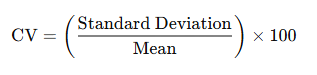
It gives insights into three key aspects:
Disparity (A): CV directly measures relative disparity or variability. A higher CV means greater disparity in the data.
Consistency (B): A lower CV implies greater consistency or stability in the data set.
Uniformity (C): While not a formal statistical term, uniformity in context of data spread can be inferred through the degree of variation. A low CV may suggest more uniform or regular values.
Therefore, CV helps in analyzing disparity, consistency, and to some extent uniformity.
Information Booster:
CV is expressed in percentage, making it useful for comparing variability across different units or magnitudes.
It is highly applicable in fields like economics, manufacturing, investments, and quality control.
A lower CV is preferred in production or finance, where stability is critical.
CV enables cross-comparison of data sets that differ in units, such as height (cm) and weight (kg).
In investment analysis, CV helps determine which asset offers better return per unit of risk.
It highlights relative risk, helping managers or researchers select more consistent outcomes.
Unlike standard deviation, CV allows comparisons even when mean values vary significantly.
Additional Knowledge:
D. Homogeneity:
Homogeneity implies uniformity in type, nature, or composition of elements, particularly in qualitative data. It’s not directly measured by CV, which is a measure of quantitative dispersion. Instead, tests like Chi-square or Levene’s test assess homogeneity.E. Unbiasedness:
Unbiasedness is a statistical property of an estimator, such as the sample mean or variance, being equal to the population parameter on average. CV is not an estimator, but a measure of variability, and it doesn't indicate whether data or estimators are biased or unbiased.
 English
 10 Questions
 20 Marks
 12 Mins


