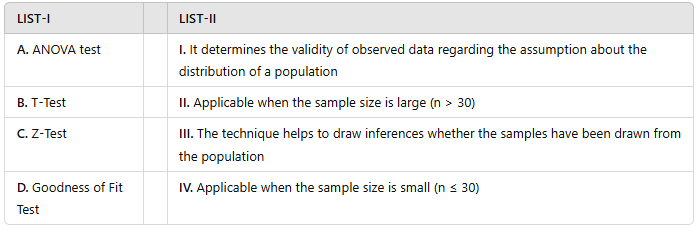
Correct option is C
The chi-square (χ²) test should not be applied when more than 20% of the cells have expected frequencies less than 5, especially in contingency tables with more than two cells. This condition violates a core assumption of the chi-square test — that the approximation of the sampling distribution to the chi-square distribution is valid. If a significant portion of the expected frequencies are too small (i.e., <5), the test may yield inaccurate or misleading p-values.
In such cases, alternative methods such as Fisher's Exact Test (for 2x2 tables) or Monte Carlo simulations are preferred. Ensuring that this assumption is met is crucial for maintaining the validity of inference from the test.
Information Booster:
The chi-square test compares observed vs expected frequencies in categorical data.
For accurate results, no more than 20% of expected frequencies should be below 5.
If this threshold is exceeded, the test statistic becomes unreliable, increasing Type I and Type II errors.
The assumption is more critical in larger contingency tables (e.g., 3x3, 4x4).
One solution is to merge categories to increase expected frequencies.
Alternatives include Yates’ continuity correction (for small 2x2 tables) or exact tests like Fisher's test.
Chi-square assumes independent random sampling and categorical-level data.
 English
 10 Questions
 20 Marks
 12 Mins