Correct option is A
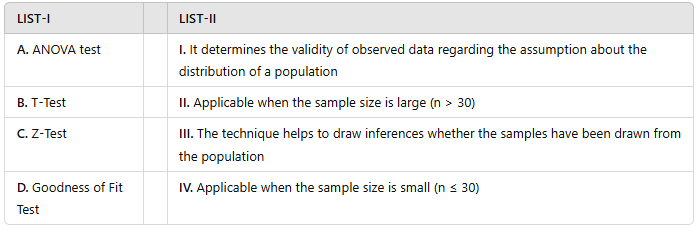
The χ2\chi^2χ2-test (Chi-Square test) is a non-parametric test used to determine if there is a significant association between categorical variables or to test the goodness of fit. Non-parametric tests do not assume any specific distribution of the data (e.g., normal distribution), making them suitable for analyzing nominal or ordinal data.
- t-test, z-test, and F-test are parametric tests, meaning they rely on specific assumptions about the population distribution, such as normality or homogeneity of variances.
Key Reasons:
- The χ2\chi^2χ2-test is applied to frequency data or observed vs. expected data.
- It does not require assumptions about the population distribution (non-parametric).
- Common applications include testing independence in contingency tables or goodness-of-fit for categorical data.
Information Booster
Parametric vs. Non-Parametric Tests
Parametric Tests:
- Assume a specific distribution (usually normal).
- Examples: t-test, z-test, F-test.
- Applied when data are measured on an interval or ratio scale.
Non-Parametric Tests:
- No distributional assumptions.
- Suitable for nominal or ordinal data.
- Examples: χ2\chi^2χ2-test, Mann-Whitney U test, Kruskal-Wallis test.
Additional Knowledge
- t-test: Compares means of two groups under the assumption of normality.
- z-test: Used for comparing proportions or means with a large sample size.
- F-test: Compares variances of two or more groups, often used in ANOVA.
- Why Non-Parametric Tests?
- Useful when assumptions of parametric tests (normality, equal variances) are violated.
- Robust for small sample sizes or skewed data.
Thus, the χ2\chi^2χ2-test is the correct answer as it is a prominent non-parametric test.
 English
 10 Questions
 20 Marks
 12 Mins