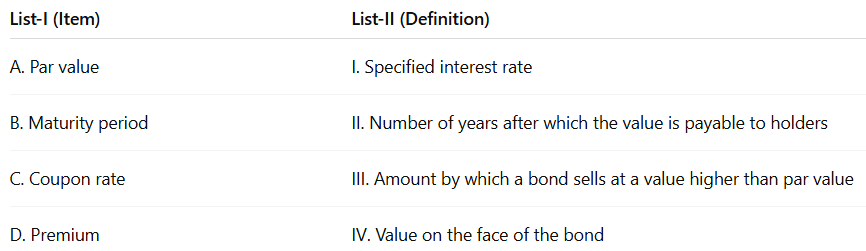
Correct option is C
To calculate the present value of a growing perpetuity, we use the formula:
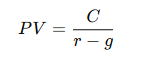
Where:
C = First payment = ₹3,000
r = Discount rate
g = Growth rate
Now, calculate each:
A → PV = 3000 / (0.10 - 0.08) = ₹1,50,000
B → PV = 3000 / (0.09 - 0.03) = ₹50,000
C → PV = 3000 / (0.11 - 0.06) = ₹60,000
D → PV = 3000 / (0.06 - 0.05) = ₹3,00,000
E → PV = 3000 / (0.04 - 0.01) = ₹1,00,000
Now arranging in descending order:
D = ₹3,00,000
A = ₹1,50,000
E = ₹1,00,000
C = ₹60,000
B = ₹50,000
So, the correct order is D, A, E, C, B.
Information Booster:
The smaller the difference between discount rate (r) and growth rate (g), the larger the PV.
In D, (r - g) = 1%, so PV = ₹3,00,000 (the highest).
A and E have closer gaps than B and C, so they rank next.
This formula assumes perpetual and growing cash flows, starting one year from now.
Present Value increases non-linearly as (r - g) becomes smaller.
Applicable only when r > g; otherwise, the formula becomes invalid or infinite.
 English
 10 Questions
 20 Marks
 12 Mins