Correct option is D
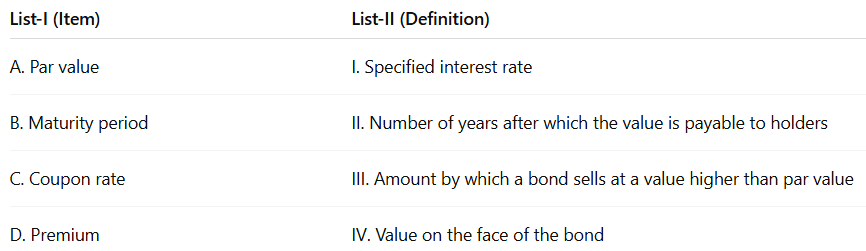
The correct match is: A-IV, B-II, C-I, D-III
A. Par Value → IV. Value on the face of the bond
Par value is the face value of a bond, typically ₹1000, and is the amount repaid at maturity.B. Maturity Period → II. Number of years after which the value is payable to holders
The maturity period refers to the duration after which the bond’s face value is paid back to the investor.C. Coupon Rate → I. Specified interest rate
The coupon rate is the fixed annual interest rate stated on the bond, paid to bondholders.D. Premium → III. Amount by which a bond sells at a value higher than par value
A bond is said to be sold at a premium if its price exceeds the par value.
Information Booster:
Par Value is also known as the face value or nominal value. It remains constant throughout the bond's life.
Maturity Period helps investors know the investment horizon and assess interest rate risks.
Coupon Rate determines interest payments made periodically to bondholders.
Premium Bonds occur when interest rates in the market fall and existing bonds with higher rates become more attractive.
A bond priced above par value is considered to be sold at a premium; below par, it is at a discount.
Bonds can be redeemable at maturity or callable (redeemable before maturity).
The yield to maturity (YTM) takes into account the coupon payments, time to maturity, and any premium/discount in pricing.
 English
 10 Questions
 20 Marks
 12 Mins