
Correct option is B
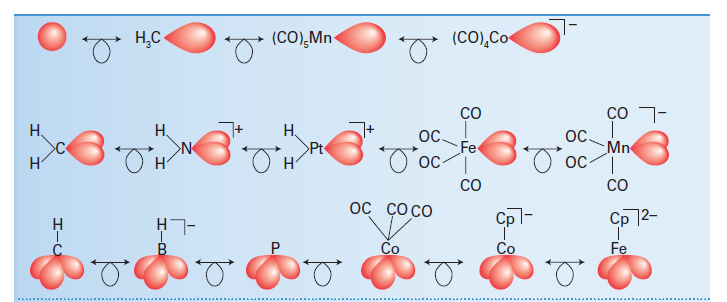
In current terminology, the structurally analogous fragments are said to be isolobal, and the relationship is expressed by the symbol

.The origin of the name is the lobe-like shape of a hybrid orbital in a molecular fragment. Two fragments are isolobal if their highest energy orbitals have the same symmetry (such as the σ symmetry of the H1s and a Csp3 hybrid orbital), similar energies, and the same electron occupation (one in each case in H1s and Csp3).Table lists some selected isolobal fragments and the first line shows isolobal fragments with a single frontier orbital. The recognition of this family permits us to anticipate by analogy with H−H that molecules such as H3C−CH3 and (OC)5Mn−CH3 can be formed. The second line of Table lists some isolobal fragments with two frontier orbitals, and the third line lists some with three.
In,

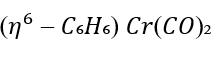
donates six electrons, Cr ([Ar] 3d⁵4s¹) gives six electrons and each CO ligand donates two electrons. The total electron count of the given complex is sixteen. The coordination number of Cr is five. Transition metals generally form complexes of coordination number six.
Option 1: Fe ([Ar]3d⁶4s²) donates eight electrons and each CO ligand donates two electrons. The total electron count is sixteen. The coordination number of iron is four. In order to acquire a coordination number six, iron requires two more ligands.
Option 2: The electron count is six. Maximum covalency of carbon is four.
Option 3:

donates five electrons, Mn ([Ar] 3d54s2 ) gives seven electrons and each CO ligand donates two electrons. The total electron count is 18.
Option 4: The electron count is seven.