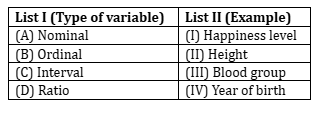
Correct option is B
A
Ratio scale is a quantitative scale that not only has equal intervals between values, but also includes a
true zero point, meaning that zero on the scale indicates the absence of the variable being measured. Examples of ratio scales include measurements like height, weight, distance, and time, where zero means "none" of that quantity.
·
Nominal scale (a): This is a qualitative scale used for categorizing variables without any quantitative value or order. Examples include gender, nationality, and color.
·
Interval scale (c): This scale has equal intervals between values, but
no true zero point. Temperature in Celsius or Fahrenheit is an example, as 0 degrees does not represent "no temperature."
·
Ordinal scale (d): This scale involves ranking or ordering items, but the intervals between the ranks are not necessarily equal. An example is a ranking of favorite movies.
Information Booster 1.
Ratio scale allows for the measurement of quantities and permits a wide range of mathematical operations, such as multiplication and division.
2.
True zero on a ratio scale means that zero represents a total absence of the quantity being measured, unlike interval scales where zero can be arbitrary.
3.
Nominal scales are used purely for labeling or categorizing without any implied rank or order.
4.
Interval scales can tell you the distance between values but cannot make comparisons in terms of ratios because they lack a true zero.
5.
Ordinal scales rank data but do not allow you to infer the difference between ranks in a meaningful way.
6.
Ratio scales are considered the most informative of all measurement scales because they combine the properties of all the other scales (nominal, ordinal, and interval) and add a true zero point.
 English
 10 Questions
 20 Marks
 12 Mins