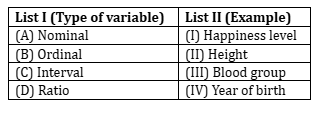
Correct option is C
The correct answer is
(c) Active deception.
Active deception involves intentionally providing participants with false information or misleading them about specific aspects of the research to influence their behavior or responses. This technique is sometimes used in psychological and social research to prevent participants from altering their responses based on the true purpose of the study. However, active deception must be handled ethically, and researchers are required to thoroughly debrief participants afterward to explain the actual study purpose and correct any misconceptions.
Explanation of Other Options: ·
Naturalistic observation (a): Involves observing participants in their natural environment without interference or manipulation, with no deception involved.
·
Role-playing (b): Requires participants to assume certain roles or act out scenarios, typically without misleading information about the research purpose.
·
Debriefing (d): Conducted after a study, particularly if deception was used, to inform participants about the study’s true purpose and any deception involved.
Information Booster: 1.
Active Deception: Used to conceal aspects of the study to maintain authentic responses.
2.
Ethical Considerations: Ethical guidelines mandate thorough debriefing and consent where deception is used.
3.
Debriefing: Essential after deceptive practices to ensure participants understand the study's real intentions.
4.
Informed Consent: Researchers must still ensure that participants give informed consent to the study’s procedures, even if all details are not disclosed initially.
5.
Role of Deception: Common in studies where knowing the true aim might bias participant responses, such as in behavioral experiments.
 English
 10 Questions
 20 Marks
 12 Mins