
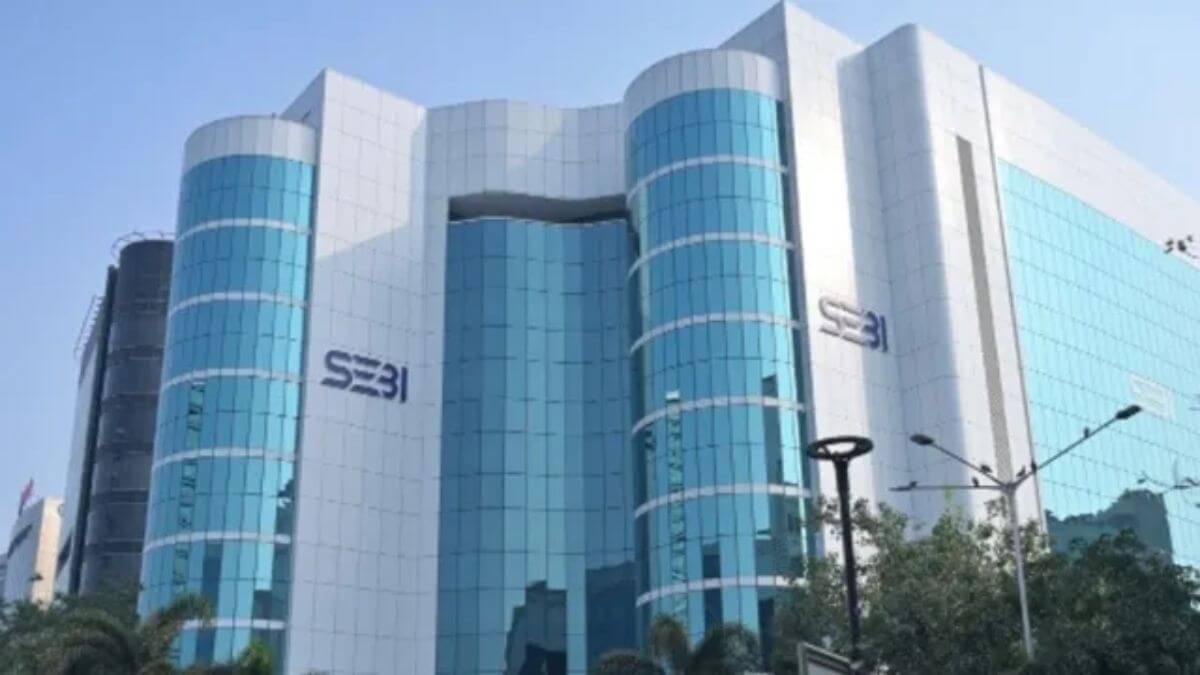
The SEBI Grade A Exam 2026 is one of the most prestigious regulatory body examinations in India, conducted to recruit Assistant Managers in various streams. Candidates aiming to crack the SEBI Grade A Exam must focus on conceptual clarity, general financial awareness, and consistent practice. With SEBI Grade A Phase 2 scheduled for 21st February 2026, candidates need to focus on Phase 2 preparation, which includes an objective, as well as, a descriptive paper. Read here for more details.
SEBI Grade A Preparation 2026
SEBI Grade A Recruitment 2026 is a golden opportunity for aspirants wanting to work in India’s financial regulatory domain. The SEBI Grade A Exam Phase 2 is scheduled for 21st February 2026. Before we dive into the SEBI Grade A Preparation 2026 , let’s take a glance at the key updates:
| Particulars | Details |
|---|---|
| Organization Name | Securities and Exchange Board of India (SEBI) |
| Post Name | Officer Grade A (Assistant Manager) |
| Category | Government/Regulatory Body Exam |
| Exam Stages |
|
| Mode of Examination | Online (Computer-Based) |
| Selection Weightage | Phase 2 – 85%, Interview – 15% |
| Official Website | www.sebi.gov.in |
| Vacancy | 110 |
| Salary | Rs. 1,84,000/- |
SEBI Grade A Result 2026- Click to Check
SEBI Grade A 2026 Exam Pattern
Before beginning your preparation, it’s crucial to have a clear understanding of the exam structure. The SEBI Grade A selection process consists of three stages: Phase 1, Phase 2, and a Personal Interview. Below is the detailed breakdown of the SEBI Grade A 2026 Exam Pattern to help you plan your preparation effectively.
SEBI Grade A 2026 Phase 1
The SEBI Grade A 2026 Phase 1 exam consists of two Papers and is qualifying in nature. That means the marks scored in this Phase 1 exam do not go to the final scores of the merit list. There is a negative marking of 1/4th or 0.25 for every wrong attempt.
| SEBI Grade A Phase 1 Exam Pattern 2026 | ||||
| Papers | Streams | Subjects | Maximum Marks | Duration |
| Paper 1 | All Streams | General Awareness (including some questions related to the Financial Sector of easy to moderate difficulty level), English Language, Quantitative Aptitude and Test of Reasoning. | 100 | 60 minutes |
| Paper 2 | General Stream | Multiple choice questions on subjects Commerce, Accountancy, Management, Finance, Costing, Companies Act and Economics. | 100 | 40 minutes |
| Legal, Information Technology & Official Language stream | Multiple choice questions on Specialized subjects related to the stream. | 100 | 40 minutes | |
| Research Stream | Multiple-choice questions on subjects of Economics, Econometrics, Statistics, Finance and Commerce | 100 | 40 minutes | |
SEBI Grade A 2026 Phase 2
The SEBI Grade A 2026 Phase 2 exam also consists of 2 Papers. Paper 1 is descriptive in nature with a total time of 1 hour or 60 minutes. Paper 2 will be MCQs, and each section is 40 minutes. The same negative marking applies to this exam as well. Phase 2 is the most important stage and requires in-depth preparation.
| SEBI Grade A Phase 2 Exam Pattern 2026 | ||||
| Papers | Streams | Subjects | Maximum Marks | Duration |
| Paper 1 | All Streams | English (Descriptive Test) to test the drafting skills | 100 | 60 minutes |
| Paper 2 | General Stream | Multiple choice questions on subjects Commerce, Accountancy, Management, Finance, Costing, Companies Act and Economics. | 100 | 40 minutes |
| Legal & Official Language stream | Multiple choice questions on Specialized subject related to stream | 100 | 40 minutes | |
| Research Stream | Multiple choice questions on subjects Economics, Econometrics, Statistics, Finance and Commerce. | 100 | 40 minutes | |
| Information Technology | Coding Test (Languages: C++/JAVA/Python) | 100 | 180 minutes | |
Study Plan: Roadmap for SEBI Grade A Preparation 2026
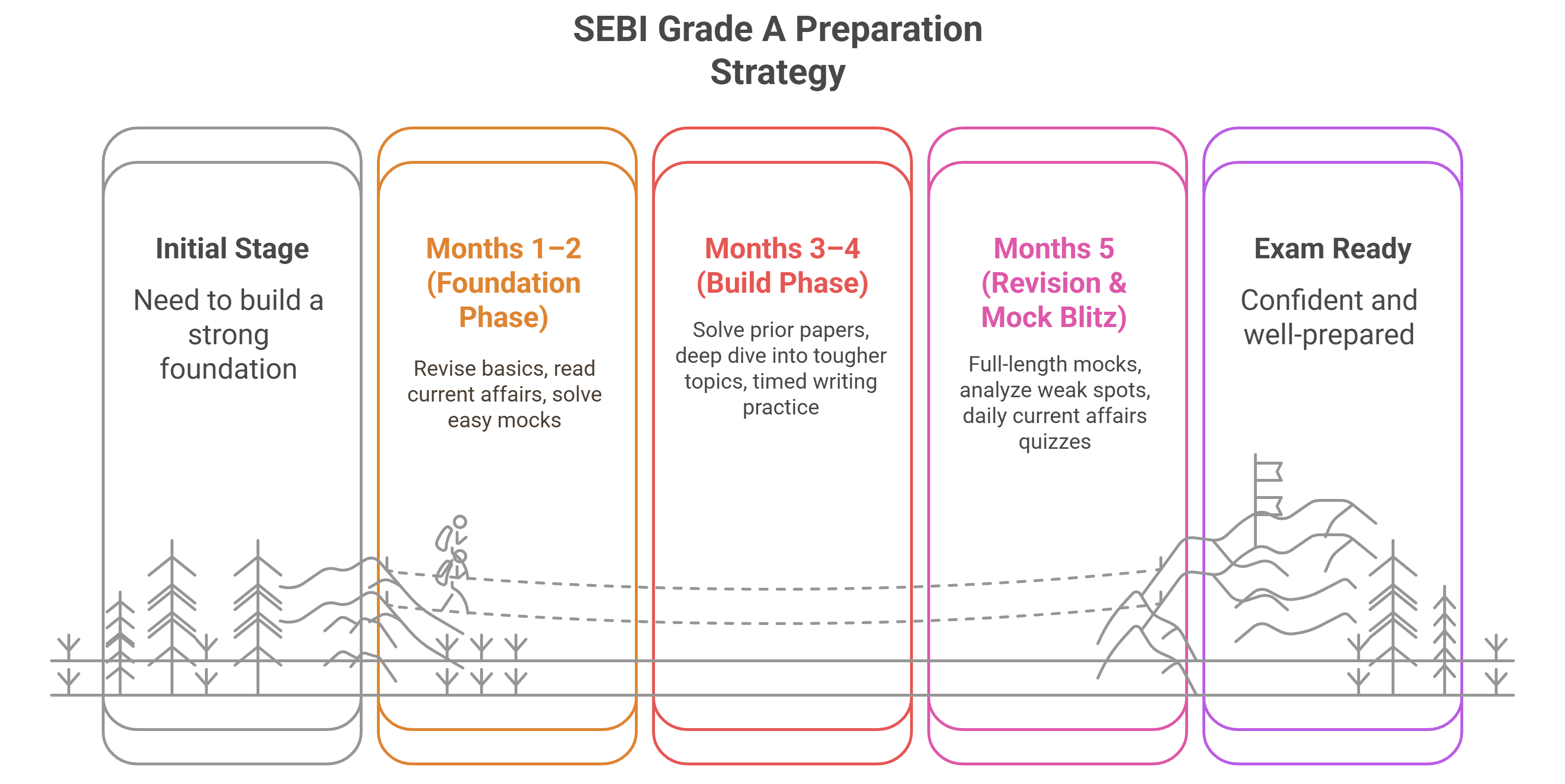
Preparing for the SEBI Grade A exam can be overwhelming, but with the right approach, you can tackle it confidently. Thus, it is important to have a study plan, which you can customise according to your strengths and weaknesses. With Phase 2 scheduled for 21st February 2026, candidates should now fine-tune their preparation and focus on exam-specific practice to secure success in the SEBI Grade A Exam 2026. Here is a breakdown for a SEBI Grade A Preparation 2026 study plan:
| Month | Key Tasks |
|---|---|
| Months 1–2 | Revise Quant, Reasoning, English, and core Commerce/Finance; read daily current affairs; take weekly easy mocks. |
| Months 3–4 | Solve previous year papers; practice sectional tests; cover tough topics like Costing and Companies Act; start essay and précis writing. |
| Month 5 | Attempt full-length mocks for Phase 1 & 2; revise weak areas; take daily current affairs quizzes. |
| Month 6 | Focus on revision, light mocks, and descriptive writing; review formulas and definitions; stay calm and maintain exam stamina. |
Daily Time Allocation
Based on the above study plan, you need to follow a daily study routine for your SEBI Grade A preparation 2026. Make sure to allocate study time based on the difficulty and weightage of each subject. Stay consistent, whether you’re working or preparing full-time.
| Slot | Activity | Focus |
|---|---|---|
| Morning (1–1.5 hrs) | Current affairs + GA | Stay updated consistently |
| Late morning | Quant/Reasoning/DI | Practice & speed |
| Afternoon | Commerce/Finance Theory | Build depth |
| Evening | English writing practice/reading | Descriptive prep |
| Night | Mock/Revision of that day’s weak topics | Consolidation |
Important Topics for SEBI Grade A Preparation 2026
Here are the most important topics to focus on for the SEBI Grade A Phase 1 Paper 1 exam. Covering these well will help you build a strong base and boost your chances of clearing the exam:
SEBI Grade A Preparation Phase 1: Paper 1 (GA, English, Quant, Reasoning)
- General Awareness/Finance & Economy: Banking & finance news, SEBI regulations, government schemes, economic surveys, global markets.
- English: Grammar, error spotting, cloze test, para jumbles, vocabulary (synonyms/antonyms), reading comprehension.
- Quantitative Aptitude: DI, averages, ratio-proportion, time & work, percentages, inequalities, series, simplification.
- Reasoning: Seating arrangement, puzzles, syllogism, direction, blood relations, input-output, logical reasoning.
SEBI Grade A Preparation Phase 1: Paper 2 (Commerce/Finance/Economics)
- Commerce & Accountancy: Basics of accounting, journals, ledgers, trial balance, financial statements, accounting concepts.
- Management/Finance/Economics: Financial markets, instruments, micro & macro economics, demand-supply, budget, fiscal policy, capital market concepts.
- Costing, Companies Act: Costing methods, overheads, company law basics, share capital, boards.
SEBI Grade A Preparation Phase 2: Paper 1 (Descriptive English)
This paper tests your writing, comprehension, and clarity of thought. It includes Essay Writing, Precis Writing, and Reading Comprehension.
| Section | Important Topics | Preparation Tips |
|---|---|---|
| Essay Writing | – Economic growth & development in India – Financial inclusion & digital payments – Role of SEBI in protecting investors – Corporate governance & ethics – Impact of technology in financial markets | Practice 1–2 essays weekly; structure essays in intro–body–conclusion format; use facts & examples from current affairs. |
| Precis Writing | – Summarizing financial/economic articles – Budget or policy analysis summaries | Read editorials daily (The Hindu, Mint); practice condensing paragraphs without losing meaning. |
| Reading Comprehension | – Passages from business, finance, economy, or social issues | Focus on understanding tone, theme, and key message; avoid over-guessing. |
| Grammar & Vocabulary | – Synonyms/antonyms, connectors, punctuation | Revise grammar rules regularly; build a word list for common financial terms. |
SEBI Grade A Preparation Phase 2: Paper 2 (Objective; Specialized Subjects)
This paper is the most crucial since it carries higher weightage (⅔ in Phase 2 merit). It tests your understanding of Commerce, Accountancy, Management, Finance, Costing, Companies Act, and Economics.
| Subject | Important Topics | Focus Areas & Tips |
|---|---|---|
| Commerce & Accountancy | – Accounting Principles & Concepts – Journal Entries, Ledger, Trial Balance – Financial Statements (P&L, Balance Sheet, Cash Flow) – Accounting Standards (AS 1–29) – Ratio Analysis & Depreciation | Focus on fundamentals; practice numerical questions daily; revise important formulas and standards. |
| Management | – Principles of Management (Fayol, Taylor) – Motivation & Leadership Theories – Planning, Organizing, Controlling – HR & Organizational Behaviour | Make short notes of key theories and thinkers; understand the real-life application of management concepts. |
| Finance | – Financial Markets & Instruments – Time Value of Money, NPV, IRR, CAPM – Cost of Capital, Leverage, Capital Structure – Risk & Return, Portfolio Management | Solve formula-based questions; understand market-linked examples; stay updated with financial news. |
| Costing | – Cost Concepts & Classification – Cost Sheet, Marginal & Standard Costing – Budgetary Control, Variance Analysis – Break-even Analysis | Practice numerical questions; focus on interpretation and logic behind formulas. |
| Companies Act, 2013 | – Incorporation of Companies – Memorandum & Articles of Association – Board of Directors, Meetings, Powers – Share Capital, Dividend, Audit & Accounts | Read summary notes; focus on sections that are frequently tested; relate provisions to real-life company examples. |
| Economics | – Microeconomics: Demand & Supply, Elasticity, Market Structures – Macroeconomics: GDP, Inflation, Fiscal & Monetary Policy – Balance of Payments, Economic Growth Models | Link concepts to current Indian economy; revise definitions and graphs. |
| Current Financial & Economic Affairs | – Union Budget, Economic Survey Highlights – RBI Monetary Policy updates – SEBI circulars & financial market reforms | Revise last 6 months of current affairs focused on economy, banking, and finance. |
Recommended Books for SEBI Grade A Preparation 2026
Below is a curated list of books widely used for SEBI Grade A Preparation 2026:
| Subject | Book / Author |
|---|---|
| General Awareness & Economy | “Indian Economy” by Ramesh Singh; daily current affairs magazines (e.g., Economic Times, The Hindu) |
| Quantitative Aptitude | “Quantitative Aptitude for Competitive Exams” by R.S. Aggarwal; “Data Interpretation & Data Sufficiency” by Arun Sharma |
| Reasoning | “A Modern Approach to Verbal & Non-verbal Reasoning” by R.S. Aggarwal; “Analytical Reasoning” by M.K. Pandey |
| English | “High School English Grammar & Composition” by Wren & Martin; “Objective General English” by S.P. Bakshi |
| Accounting & Commerce | “Accountancy Vol 1 & 2” by T.S. Grewal; “Fundamentals of Corporate Accounting” by S.N. Maheshwari |
| Management/Finance/Economics | “Principles of Economics” by N. Gregory Mankiw; “Managerial Economics” by D.N. Dwivedi; “Fundamentals of Financial Management” by Brigham & Houston |
| Companies Act/Costing | “Company Law” by Avtar Singh; “Cost Accounting” by S.P. Jain & K.L. Narang |
| Important links: | |
| SEBI Grade A Cut Off 2026 | SEBI Grade A Previous Year Question Papers |
| SEBI Grade A Notification 2025 | SEBI Grade A Salary 2026 |


 SSC GD 2026 Exam Date (Latest Updates), ...
 Bihar Vidhan Parishad PA & Stenograp...
 NVS Staff Nurse Syllabus 2026 and Latest...


 Adda247 Job portal has complete information about all Sarkari Jobs and Naukri Alerts, its latest recruitment notifications, from all state and national level jobs and their updates.