

Table of Contents
The IIT Guwahati will release the official GATE Qualifying Marks 2026 along with the GATE Result 2026 on 19 March 2026 at gate2026.iitg.ac.in. The qualifying marks will be released paper-wise and category-wise for all 30 GATE 2026 papers. GATE 2026 Exam was conducted by IIT Guwahati on 7, 8, 14 and 15 February 2026.
GATE Qualifying Marks 2026
The qualifying marks for the GATE 2026 Exam are very important for candidates who took the test. The GATE qualifying marks are the minimum marks a candidate must score in the GATE exam to be declared GATE qualified and receive a valid GATE scorecard. Candidates who score at or above the qualifying marks in their paper are eligible to receive a GATE scorecard, which is required for M.Tech and Ph.D. admissions as well as PSU recruitment through GATE 2026.
GATE Qualifying Marks 2026 (Expected)
The GATE qualifying marks will be announced after the results & released separately for each course and category. These cutoff marks are decided by considering several factors, such as the total number of candidates who appeared, the previous year’s cutoff trends, and the difficulty level of the exam. This expected range can help candidates understand how well they need to score and plan their next steps in the selection process.
| S.No. | Paper Name | Code | Expected General | Expected OBC/EWS | Expected SC/ST/PwD |
|---|---|---|---|---|---|
| 1 | Aerospace Engineering | AE | 29 – 33 | 26 – 30 | 19 – 22 |
| 2 | Agricultural Engineering | AG | 25 – 27 | 22 – 25 | 16 – 18 |
| 3 | Architecture and Planning | AR | 40 – 42 | 36 – 38 | 26 – 28 |
| 4 | Biomedical Engineering | BM | 28 – 31 | 25 – 28 | 18 – 21 |
| 5 | Biotechnology | BT | 28 – 34 | 25 – 31 | 18 – 23 |
| 6 | Civil Engineering | CE | 28 – 32 | 25 – 29 | 18 – 22 |
| 7 | Chemical Engineering | CH | 25 – 29 | 22 – 26 | 16 – 19 |
| 8 | Computer Science and IT | CS | 29 – 33 | 26 – 30 | 19 – 22 |
| 9 | Chemistry | CY | 25 – 28 | 22 – 25 | 16 – 18 |
| 10 | Data Science and AI | DA | 29 – 37 | 26 – 33 | 19 – 25 |
| 11 | Electronics and Communication | EC | 25 – 28 | 22 – 25 | 16 – 18 |
| 12 | Electrical Engineering | EE | 25 – 28 | 22 – 25 | 16 – 18 |
| 13 | Environmental Science | ES | 26 – 30 | 23 – 27 | 17 – 20 |
| 14 | Ecology and Evolution | EY | 38 – 42 | 34 – 38 | 25 – 28 |
| 15 | Geomatics Engineering | GE | 25 – 30 | 22 – 27 | 16 – 19 |
| 16 | Geology and Geophysics (Geology) | GG | 38 – 42 | 34 – 38 | 25 – 28 |
| 17 | Geology and Geophysics (Geophysics) | GP | 40 – 45 | 36 – 40 | 26 – 30 |
| 18 | Instrumentation Engineering | IN | 25 – 29 | 22 – 26 | 16 – 19 |
| 19 | Mathematics | MA | 25 – 28 | 22 – 25 | 16 – 18 |
| 20 | Mechanical Engineering | ME | 35 – 39 | 31 – 35 | 23 – 26 |
| 21 | Mining Engineering | MN | 29 – 33 | 26 – 30 | 19 – 22 |
| 22 | Metallurgical Engineering | MT | 39 – 42 | 35 – 38 | 26 – 28 |
| 23 | Naval Architecture | NM | 25 – 27 | 22 – 25 | 16 – 18 |
| 24 | Petroleum Engineering | PE | 31 – 37 | 27 – 33 | 20 – 25 |
| 25 | Physics | PH | 26 – 30 | 23 – 27 | 17 – 20 |
| 26 | Production and Industrial Engineering | PI | 34 – 37 | 30 – 33 | 22 – 25 |
| 27 | Statistics | ST | 29 – 32 | 26 – 29 | 19 – 22 |
| 28 | Textile Engineering | TF | 33 – 36 | 29 – 32 | 22 – 24 |
| 29 | Engineering Sciences | XE | 34 – 37 | 30 – 33 | 22 – 25 |
| 30 | Life Sciences | XL | 30 – 33 | 27 – 30 | 20 – 22 |
| 31 | Humanities and Social Sciences | XH | 40 – 45 | 36 – 40 | 26 – 30 |
GATE 2026 Score Card – Click Here to Check
GATE 2026 Result Out – Click Here to Check
GATE Previous Year Qualifying Marks
The Official GATE 2026 Qualifying Marks will be released on 19 March 2026. Until then, candidates can check the official GATE 2025, 2024 and 2023 qualifying marks. It is important to understand that the qualifying marks and the admission qualifying marks are different. The qualifying marks are the minimum marks required to clear the exam, while the admission cutoff is usually higher and is used during the admission process. To understand your chances of selection and to estimate a safe score, you can check the previous years’ GATE qualifying marks from the table given below.
GATE 2025 Qualifying Marks
IIT Roorkee released the official GATE 2025 qualifying marks on 19 March 2025. Below are the verified official qualifying marks for all papers:
| Paper Code | Test Paper | General | OBC-NCL/EWS | SC/ST/PwD |
|---|---|---|---|---|
| AE | Aerospace Engineering | 28.9 | 26 | 19.2 |
| AG | Agricultural Engineering | 25 | 22.5 | 16.6 |
| AR | Architecture and Planning | 40 | 36 | 26.6 |
| BM | Biomedical Engineering | 29.2 | 26.2 | 19.4 |
| BT | Biotechnology | 28 | 25.2 | 18.6 |
| CE | Civil Engineering | 29.2 | 26.2 | 19.4 |
| CH | Chemical Engineering | 27.7 | 24.9 | 18.4 |
| CS | Computer Science and Information Technology | 29.2 | 26.2 | 19.4 |
| CY | Chemistry | 25 | 22.5 | 16.6 |
| DA | Data Science and Artificial Intelligence | 29 | 26.1 | 19.3 |
| EC | Electronics and Communication Engineering | 25 | 23 | 17 |
| EE | Electrical Engineering | 25 | 23 | 17 |
| ES | Environmental Science and Engineering | 26 | 23 | 17 |
| EY | Ecology and Evolution | 39.5 | 35.5 | 26.3 |
| GE | Geomatics Engineering | 26 | 23 | 17.1 |
| GG1 | Geology and Geophysics (Geology) | 38.4 | 34.5 | 25.5 |
| GG2 | Geology and Geophysics (Geophysics) | 40 | 36 | 26.6 |
| IN | Instrumentation Engineering | 25.6 | 23 | 17 |
| MA | Mathematics | 25 | 22.5 | 16.6 |
| ME | Mechanical Engineering | 35.8 | 32.2 | 23.8 |
| MN | Mining Engineering | 30.6 | 27.5 | 20.4 |
| MT | Metallurgical Engineering | 40 | 36 | 26.6 |
| NM | Naval Architecture and Marine Engineering | 25.1 | 22.5 | 16.7 |
| PE | Petroleum Engineering | 31.1 | 27.9 | 20.7 |
| PH | Physics | 26.8 | 24.1 | 17.8 |
| PI | Production and Industrial Engineering | 35.6 | 32 | 23.7 |
| ST | Statistics | 30.2 | 27.1 | 20.1 |
| TF | Textile Engineering and Fibre Science | 34.7 | 31.2 | 23.1 |
| XE | Engineering Sciences | 35.4 | 31.8 | 23.5 |
| XH-C1 | Humanities and Social Sciences (Economics) | 40 | 36 | 26.6 |
| XH-C2 | Humanities and Social Sciences (English) | 40 | 30 | 20.6 |
| XH-C3 | Humanities and Social Sciences (Linguistics) | 40 | 36 | 26.6 |
| XH-C4 | Humanities and Social Sciences (Philosophy) | 40 | 36 | 26.6 |
| XH-C5 | Humanities and Social Sciences (Psychology) | 40 | 36 | 26.6 |
| XH-C6 | Humanities and Social Sciences (Sociology) | 40 | 36 | 26.6 |
| XL | Life Sciences | 31.3 | 28.1 | 20.8 |
GATE 2024 Qualifying Marks
IISc Bangalore conducted GATE 2024. Below are the official GATE 2024 qualifying marks:
| S.No. | Paper Name | Code | General | OBC/EWS | SC/ST/PwD |
|---|---|---|---|---|---|
| 1 | Aerospace Engineering | AE | 33.3 | 29.9 | 22.1 |
| 2 | Agricultural Engineering | AG | 25.0 | 22.5 | 16.6 |
| 3 | Architecture and Planning | AR | 41.5 | 37.3 | 27.6 |
| 4 | Biomedical Engineering | BM | 25.0 | 22.5 | 16.6 |
| 5 | Biotechnology | BT | 38.9 | 35.0 | 25.9 |
| 6 | Civil Engineering | CE | 28.3 | 25.4 | 18.8 |
| 7 | Chemical Engineering | CH | 25.0 | 22.5 | 16.6 |
| 8 | Computer Science and IT | CS | 27.6 | 24.8 | 18.4 |
| 9 | Chemistry | CY | 25.2 | 22.6 | 16.7 |
| 10 | Data Science and AI | DA | 37.1 | 33.3 | 24.7 |
| 11 | Electronics and Communication | EC | 25.0 | 22.5 | 16.6 |
| 12 | Electrical Engineering | EE | 25.7 | 23.1 | 17.1 |
| 13 | Environmental Science | ES | 37.9 | 34.1 | 25.2 |
| 14 | Ecology and Evolution | EY | 35.8 | 32.2 | 23.8 |
| 15 | Geomatics Engineering | GE | 41.1 | 36.9 | 27.4 |
| 16 | Geology and Geophysics (Geology) | GG | 42.0 | 37.8 | 28.0 |
| 17 | Geology and Geophysics (Geophysics) | GP | 49.0 | 44.1 | 32.6 |
| 18 | Instrumentation Engineering | IN | 32.7 | 29.4 | 21.8 |
| 19 | Mathematics | MA | 25.0 | 22.5 | 16.6 |
| 20 | Mechanical Engineering | ME | 28.6 | 25.7 | 19.0 |
| 21 | Mining Engineering | MN | 25.0 | 22.5 | 16.6 |
| 22 | Metallurgical Engineering | MT | 41.0 | 36.9 | 27.3 |
| 23 | Naval Architecture | NM | 25.1 | 22.5 | 16.7 |
| 24 | Petroleum Engineering | PE | 42.6 | 38.3 | 28.4 |
| 25 | Physics | PH | 32.0 | 28.8 | 21.3 |
| 26 | Production and Industrial Engineering | PI | 30.5 | 27.4 | 20.3 |
| 27 | Statistics | ST | 26.6 | 23.9 | 17.7 |
| 28 | Textile Engineering | TF | 28.1 | 25.2 | 18.7 |
| 29 | Engineering Sciences | XE | 36.2 | 32.5 | 24.1 |
| 30 | Life Sciences | XL | 29.3 | 26.3 | 19.5 |
| 31 | Humanities (Economics) | XH-C1 | 37.0 | 33.3 | 24.6 |
| 32 | Humanities (English) | XH-C2 | 48.0 | 43.2 | 32.0 |
| 33 | Humanities (Linguistics) | XH-C3 | 49.7 | 44.7 | 33.1 |
| 34 | Humanities (Philosophy) | XH-C4 | 39.3 | 35.3 | 26.1 |
| 35 | Humanities (Psychology) | XH-C5 | 52.7 | 47.4 | 35.1 |
| 36 | Humanities (Sociology) | XH-C6 | 36.0 | 32.4 | 24.0 |
GATE 2023 Qualifying Marks
IIT Kanpur conducted GATE 2023. Below are the official GATE 2023 qualifying marks:
| S.No. | Paper Name | Code | General | OBC/EWS | SC/ST/PwD |
|---|---|---|---|---|---|
| 1 | Aerospace Engineering | AE | 35.5 | 31.9 | 23.6 |
| 2 | Agricultural Engineering | AG | 25.0 | 22.5 | 16.6 |
| 3 | Architecture and Planning | AR | 38.2 | 34.3 | 25.4 |
| 4 | Biomedical Engineering | BM | 25.0 | 22.5 | 16.6 |
| 5 | Biotechnology | BT | 26.1 | 23.4 | 17.4 |
| 6 | Civil Engineering | CE | 25.5 | 22.9 | 17.0 |
| 7 | Chemical Engineering | CH | 30.6 | 27.5 | 20.4 |
| 8 | Computer Science and IT | CS | 40.0 | 36.0 | 26.6 |
| 9 | Chemistry | CY | 27.0 | 24.3 | 18.0 |
| 10 | Data Science and AI | DA | 25.0 | 22.5 | 16.6 |
| 11 | Electronics and Communication | EC | 25.0 | 22.5 | 16.6 |
| 12 | Electrical Engineering | EE | 29.7 | 26.7 | 19.8 |
| 13 | Environmental Science | ES | 33.5 | 30.1 | 22.3 |
| 14 | Ecology and Evolution | EY | 37.0 | 33.3 | 24.6 |
| 15 | Geomatics Engineering | GE | 30.4 | 27.3 | 20.2 |
| 16 | Geology and Geophysics (Geology) | GG | 37.8 | 34.0 | 25.2 |
| 17 | Geology and Geophysics (Geophysics) | GP | 44.2 | 39.7 | 29.4 |
| 18 | Instrumentation Engineering | IN | 30.5 | 27.4 | 20.3 |
| 19 | Mathematics | MA | 25.0 | 22.5 | 16.6 |
| 20 | Mechanical Engineering | ME | 33.3 | 29.9 | 22.2 |
| 21 | Mining Engineering | MN | 36.2 | 32.5 | 24.1 |
| 22 | Metallurgical Engineering | MT | 32.6 | 29.3 | 21.7 |
| 23 | Naval Architecture | NM | 25.0 | 22.5 | 16.6 |
| 24 | Petroleum Engineering | PE | 35.2 | 31.6 | 23.4 |
| 25 | Physics | PH | 33.8 | 30.4 | 22.5 |
| 26 | Production and Industrial Engineering | PI | 38.7 | 34.8 | 25.8 |
| 27 | Statistics | ST | 29.5 | 26.5 | 19.6 |
| 28 | Textile Engineering | TF | 30.1 | 27.0 | 20.0 |
| 29 | Engineering Sciences | XE | 26.5 | 23.8 | 17.6 |
| 30 | Life Sciences | XL | 30.8 | 27.7 | 20.5 |
| 31 | Humanities and Social Sciences | XH | 40.0 | 36.0 | 26.6 |
How to Calculate GATE Qualifying Marks 2026
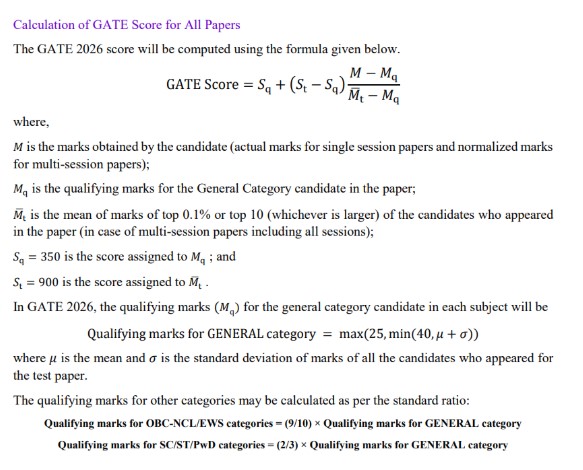
To find the GATE 2026 qualifying marks, different factors are considered. These include the marks secured by candidates, the qualifying marks decided by the authority, the average (mean) marks of the top-performing candidates, and some other important criteria. All these elements together help in deciding the final qualifying score.
It is important to understand that the calculation method is not the same for every category. The formula for reserved categories is slightly different from that of the general category. Therefore, candidates should carefully check the official guidelines before calculating their qualifying marks.
Factors Affecting GATE Qualifying Marks 2026
The factors affecting the GATE Qualifying Marks 2026 are given below:
- Total Number of Vacancies: The number of available positions plays a crucial role in determining the GATE Qualifying Marks 2026. Fewer vacancies might lead to a higher cut-off, whereas a larger number of openings could result in a comparatively lower cut-off.
- Number of Candidates: The total number of applicants appearing for the GATE 2026 examination impacts the qualifying marks. Higher competition might raise the qualifying marks due to increased performance standards.
- Difficulty Level of the Exam: The complexity and difficulty of the examination paper influence the qualifying marks. A more challenging paper could lead to a lower average score among candidates, affecting the qualifying marks.
- Reservation Categories: Category-specific GATE 2026 qualifying marks are common, with different qualifying marks set for various categories such as General, OBC, SC, ST, etc., as per the prescribed guidelines.


 GATE 2026 Toppers List Out, Check Branch...
 GATE 2026 Score Card Out, Get Direct Lin...
 SSC JE Score Card 2026 Out, Download Tie...