SSC CGL Quadratic Equation Questions with Detailed Solutions

Get SSC CGL Quadratic Equation Questions to prepare for your upcoming exam. Solve the most expected questions and detailed solutions that can be asked in the exam.

Important SSC CGL Quadratic Equation Questions

Q1.

Let 3t−13t=33t-\frac{1}{3t}=3​, then which of the following expressions has the value equal to 12?

  • A.

    ​9t2+19t2+29t^2+\frac{1}{9t^2}+2​​

  • B.

    ​9t2+19t2−29t^2+\frac{1}{9t^2}-2​​

  • C.

    ​9t2+19t2+19t^2+\frac{1}{9t^2}+1​​

    ✓ Correct
  • D.

    ​9t2+19t29t^2+\frac{1}{9t^2}​​

Answer & Solution

Correct option is C

Given:

3t −13t- \frac{1}{3t}​ = 3

Solution:

Squaring both sides

​(3t−13t)2=32\left( 3t - \frac{1}{3t} \right)^2 = 3^2​

9t2−2×3t×13t+19t2=9t^2 - 2 \times 3t \times \frac{1}{3t} + \frac{1}{9t^2} = 9​​

9t2−2+19t2=9^2 - 2 + \frac{1}{9t^2} = 9​

9t2+19t2^2 + \frac{1}{9t^2}​ = 11

Add Both sides +1

9t2+19t2^2 + \frac{1}{9t^2}​ + 1 = 11 + 1

9t2+19t2^2 + \frac{1}{9t^2}​ + 1 = 12 

Thus Option (c) is correct 

Q2.
Naman bought few apples for Rs. 720 from a shop. He negotiated the price and the shopkeeper reduced it by Rs. 2 per apple. Due to this Naman could buy four more apples than what he had bought earlier. How many apples did he originally buy?
  • A.48
  • B.44
  • C.36
    ✓ Correct
  • D.40

Answer & Solution

Correct option is C

Given:
Total cost = ₹720
Price reduced by ₹2 per apple.
With the reduced price, Naman could buy 4 more apples.
Solution:
Let the original price per apple be ₹x.

Number of apples he bought at 720 Rupees= 720x\frac{720}{x}​............(1)(1)​​

After reducing the price by ₹2 per apple, 
Number of Apple Finally =720x−2\frac{720}{x-2}​  -----------------(2)

So, he purchases 4 more apples.

​720x−2−720x=4 720x−720x+1440x(x−2)=4\frac{720}{x-2}-\frac{720}{x} = 4\\\ \\\frac{720x-720x+1440}{x(x-2)}= 4\\​​
4x² - 8x - 1440 = 0
x² - 2x - 360 = 0
x² - 20x + 18x - 360 = 0
=> x(x - 20) + 18(x - 20) = 0
=> (x - 20)(x + 18) = 0
Thus, x = 20 (since price cannot be negative).
Substitute x = 20 into Equation 1:
Number of Apples, he purchases initially= 72020=36\frac{720}{20} = 36​​
Naman originally bought 36 apples.

Q3.

If the polynomial (2x3+ax2+3x−52x^3+ax^2+3x-5​) and (x3+x2−2x+ax^3+x^2-2x+a​) leave the same remainder when divided by (x−2)(x-2)​, find the remainder.

  • A.4
  • B.2
  • C.3
  • D.5
    ✓ Correct

Answer & Solution

Correct option is D

Given Data Polynomials:

· Remainders when divided by x-2.
Formula Used To find the remainder, we can use the Remainder Theorem:
R(f)=f(2) "and" R(g)=g(2)
Solution
Step 1: Calculate f(2)
f(2)=2(2^3 )+a(2^2 )+3(2)-5=2(8)+4a+6-5=16+4a+1=17+4a
Step 2: Calculate g(2)
g(2)=(2^3 )+(2^2 )-2(2)+a=8+4-4+a=8+a
Step 3: Set the Remainders Equal
17+4a=8+a
17+4a-a=8
. a=-3
Step 4: Find the Remainder Using a=-3 in f(2)or g(2):
R=17+4(-3)=17-12=5
Final Answer: (d) 5.

Q4.

If x2+4y2+2x+1=0,x^2+4y^2+2x+1=0,​ then find the value of x39+y36.x^{39}+y^{36}.​​

  • A.1
  • B.-1
    ✓ Correct
  • C.2
  • D.-2

Answer & Solution

Correct option is B

Given:
​x2+4y2+2x+1=0x^2+4y^2+2x+1=0​​
Formula Used:
​(a+b)2=(a2+b2+2ab)(a+b)^2= (a^2 + b^2 +2ab)​​
Solution:
​x2+4y2+2x+1=0(x2+2x+1)+4y2=0(x+1)2+4y2=0x^2+4y^2+2x+1=0\\(x^2+2x+1)+4y^2=0\\(x+1)^2+4y^2=0\\
​Since (x + 1)2 ≥ 0 and 4y2 ≥ 0, the only solution is:
=> (x + 1)2 = 0
=> x + 1 = 0
=> x = -1
And
=> 4y2 = 0
=> y = 0
Now, find x39+y36:x^{39} + y^{36}: (−1)39+(0)36=−1(-1)^{39 }+(0)^{36} = -1​​

Q5.
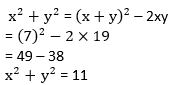
If x+y=7 and xy=19, then calculate the value of x²+y².
  • A.17
  • B.12
  • C.11
    ✓ Correct
  • D.19

Answer & Solution

Correct option is C

Given: ​
 x + y=7 
 xy=19 
Formula Used: ​
​(x+y)2=x2+y2+2xy(x+y)^2 = x^2+y^2 +2xy 
Solution: 
​
Q6.


  • A.9604
  • B.9602
    ✓ Correct
  • C.9600
  • D.

    9606

Answer & Solution

Correct option is B

Given:

x+1x=10x+\frac1x=10​

Concept Used:

If x + 1/x = a, then

x2 + 1/x2 = a2 - 2

Solution:

(x + 1/x) = 10
(x² + 1/x²) = 10² - 2
(x² + 1/x²) = 100 - 2 = 98
(x⁴ + 1/x⁴) = 98² - 2
(x⁴ + 1/x⁴) = 9604 - 2 = 9602

Q7.

Simplify x4−2x2+1x2−2x+1\frac{x^4 - 2x^2 + 1}{x^2 -2x +1}​​

  • A.

    ​x2−2x+1x^2 -2x + 1​​

  • B.

    ​x2+2x+2x^2 + 2x + 2​​

  • C.

    ​x2+2x+1x^2 + 2x + 1​​

    ✓ Correct
  • D.

    ​x2+x+1x^2 + x + 1​​

Answer & Solution

Correct option is C

Given:

x4−2x2+1x2−2x+1\frac{x^4 - 2x^2 + 1}{x^2 -2x +1} 

​Formula Used:  

(a−b)2=a2+b2−2ab(a-b)^2 = a^2 + b^2 - 2ab 

Solution: 

x4−2x2+1x2−2x+1\frac{x^4 - 2x^2 + 1}{x^2 -2x +1} 

= (x2−1)2(x−1)2\frac{(x^2 - 1)^2}{(x- 1)^2}

= [(x+1)(x−1)]2(x−1)2\frac{[(x + 1)(x-1)]^2}{(x- 1)^2} 

= (x+1)2(x−1)2(x−1)2\frac{(x+1)^2 (x-1)^2}{(x-1)^2} 

= (x+1)2(x+1)^2 

= x2+1+2xx^2 + 1 + 2x ​

Q8.
If 4(z + 7) (2z – 1) = Az² + Bz + C, then the value of A + B + C is:
  • A.28
  • B.32
    ✓ Correct
  • C.

    74

  • D.

    81

Answer & Solution

Correct option is B

Given:

We are given the equation 4(z + 7)(2z - 1) and need to find A + B + C after expanding and comparing it to Az² + Bz + C.

Formula Used:

We will expand the expression using the distributive property and collect the terms for z², z, and the constant.

Solution:

First, expand the expression 4(z + 7)(2z - 1):

4(z + 7)(2z - 1) = 4z(2z - 1) + 7(2z - 1)

= 4(2z² - z + 14z – 7)

= 4(2z² + 13z – 7)

= 8z² + 52z - 28

By comparing with the expression Az² + Bz + C, we have:

A = 8, B = 52, C = -28

Therefore, A + B + C:

A + B + C = 8 + 52 - 28

= 32

Therefore, the value of A + B + C is 32.

Q9.
If x² - 11x + 1 = 0, what is the value of x⁸ - 14159x⁴ + 11?
  • A.9
  • B.10
    ✓ Correct
  • C.12
  • D.11

Answer & Solution

Correct option is B

Given:

x^2 - 11x + 1 = 0 

Formula Used: 

x+1x=kx+\frac{1}{x} = k  

x2+1x2=k2−2x^2 + \frac{1}{x^2} = k^2 - 2 ​
Solution:

On dividing by  we get,

​=>x−11+1x=0 =>x+1x=11 =>x2+1x2=(11)2−2 x2+1x2=119\Rightarrow x - 11 + \frac{1}{x} = 0\\\ \\\Rightarrow x + \frac{1}{x} = 11\\\ \\\Rightarrow x^2 + \frac{1}{x^2} = (11)^2 - 2\\\ \\x^2 + \frac{1}{x^2} = 119​​

Squaring both sides

​​​x4+1x4=14161−2=14159 ​​x^4 + \frac{1}{x^4} = 14161 - 2 = 14159 \\\ \\ ​​

Then the value of  x⁸ - 14159x⁴ + 11​​


​x4(x4−14159)+11 x4(x4−x4−1x4)+11 x4(−1x4)+11 −1+11=10​x^4(x^4 - 14159) + 11\\\ \\x^4(x^4 -x^4- \frac{1}{x^4}) + 11\\\ \\x^4 \left( - \frac{1}{x^4} \right) + 11\\\ \\-1 + 11 = 10​​​
x⁸ - 14159x⁴ + 11

Q10.

The two roots of a quadratic equation are given as x=−14   and    x=23x = \frac{-1}{4} \ \ \ \text{and} \ \ \ \ x = \frac{2}{3}​​

The equation can be written as:

  • A.(3x-2)(4x-1) = 0
  • B.(2x+1)(3x-1) = 0
  • C.

    (4x+1)(3x-2) = 0

    ✓ Correct
  • D.

    (3x+1)(4x+1) = 0

Answer & Solution

Correct option is C

Given:
The two roots of the quadratic equation are:
x = −14-\frac{1}{4}​​
x = 23​\frac{2}{3}​​​
Formula Used:
The expanded form of the quadratic equation can be written as:
​y=x2+(α+β)x+(α×β)y = x^2 + (\alpha + \beta)x + (\alpha\times \beta)​​
where, α\alpha​ , and β\beta​ is roots of the equation.
Solution: 
​Sum of roots=−14+23=512 Product of roots=−212 Quadratic equation would be →x2−(512)x+(−212)=0 12x2−5x−2=0 12x2−8x+3x−2=0 (4x+1)(3x−2)=0\text{Sum of roots} = -\frac{1}{4} + \frac{2}{3} = \frac{5}{12} \\ \ \\\text{Product of roots} = -\frac{2}{12} \\ \ \\\text{Quadratic equation would be} \\ \ \\\rightarrow x^2 - \left(\frac{5}{12}\right)x + \left(-\frac{2}{12}\right) = 0 \\ \ \\12x^2 - 5x - 2 = 0 \\ \ \\12x^2 - 8x + 3x - 2 = 0 \\ \ \\(4x + 1)(3x - 2) = 0 ​​
Q11.

If a+ b + c= 11, ab + bc + ca= 16 then find the value of  (a3+b3+c3−3abc). (a^3 + b^3 + c^3 - 3abc).​

  • A.-803
  • B.803
    ✓ Correct
  • C.

    Both (a) and (b)

  • D.

    None

Answer & Solution

Correct option is B

Given:

The given conditions are:
a + b + c = 11
ab + bc + ca = 16
We need to find the value of (a3+b3+c3−3abc). (a^3 + b^3 + c^3 - 3abc).​​

Formula Used:

​(a3+b3+c3−3abc)=(a+b+c)((a+b+c)2−3(ab+bc+ca))(a^3 + b^3 + c^3 - 3abc) = (a + b + c)((a + b + c)^2 - 3(ab + bc + ca))​​

Solution:

​(a3+b3+c3−3abc)=(11)((11)2−3(16)) (a3+b3+c3−3abc)=11(121−48)=11(73)=803(a^3 + b^3 + c^3 - 3abc) = (11)((11)^2 - 3(16))\\\ \\(a^3 + b^3 + c^3 - 3abc) = 11(121 - 48) = 11(73) = 803​​

Thus, the value of (a3+b3+c3−3abc) (a^3 + b^3 + c^3 - 3abc)​ is 803.

Q12.

Find the value of K, if a+16a+k2a+\frac{1}{6}\sqrt{a} + k^2   is  a perfect square ?

  • A.

    16\frac{1}{6}​

  • B.

    112\frac{1}{12}​

    ✓ Correct
  • C.

    118\frac{1}{18}​

  • D.

    ​124\frac{1}{24}​​

Answer & Solution

Correct option is B

Given:  
a+16a+k2a+\frac{1}{6}\sqrt a+k^2​​
Concept Used: 
Algebraic Identity;
​(a+b)2=a2+b2+2ab(a + b)^2 = a^2 + b^2 + 2ab​​
Solution: 
Comparing the expression; 
For a perfect square = a+16a+k2a + \frac{1}{ 6} \sqrt a + k^2  
comparing the expression with ​(a+b)2=a2+b2+2ab(a + b)^2 = a^2 + b^2 + 2ab 
So,  expression can be written as 
(a)2+22×6a+k2  ⟹ (a)2+2×112×a+k2(\sqrt a)^2 + \frac{2}{2\times 6} \sqrt a + k^2 \\ \ \\ \implies (\sqrt a)^2 + 2 \times \frac{1}{12} \times\sqrt a + k^2 
Thus,  we can conclude from the above 
k = 112\bf \frac{1}{12}​​
​
Q13.

Regarding the roots of the quadratic equation ax2+bx+c=0ax^2 + bx + c = 0​, consider the following statements:
 I. If b = 0, the roots are equal in magnitude but opposite in sign.
II. If c = 0, one of the roots must strictly be zero.
Which of the statements is/are correct?

  • A.

    Only I

  • B.

    Only II

  • C.

    Both I and II

    ✓ Correct
  • D.

    Neither I nor II

Answer & Solution

Correct option is C

Given
Quadratic equation: ax2+bx+c=0ax^2 + bx + c = 0​​
Statement I: If b = 0, roots are equal in magnitude but opposite in sign.
Statement II: If c = 0, one of the roots must strictly be zero.
Formula Used
Sum of roots =−ba= \frac{-b}{a}​​
Product of roots =  ca\frac{c}{a}​​
Solution
Check Statement I:
If b = 0, the equation reduces to ax2+c=0.ax^2 + c = 0.​​
​ax2=−cx2=−ca x=±−caax^2 = -c\\x^2 = \frac{-c}{a}\\\ \\x = \pm \sqrt{\frac{-c}{a}}​​
The roots are indeed equal in numerical magnitude but have opposite signs. (Alternatively, sum of roots = 0 means roots are +k and -k). Statement I is fully correct.
Check Statement II:
If c = 0, the equation reduces to ax2+bx=0.ax^2 + bx = 0.​​
x(ax + b) = 0
The solutions are strictly x = 0 or x = −ba.\frac{-b}{a}.​​
Thus, one root is definitively zero (Since the product of roots = 0/a = 0, at least one root has to be 0). Statement II is fully correct.
Both statements are mathematically sound.
Final Answer
So the correct answer is (c)

Q14.

If x is a real number, which of the following represents the strictly minimum value of the quadratic expression ax2+bx+cax^2 + bx + c​ given that a > 0?

  • A.

    ​b2−4ac4a\frac{b^2 - 4ac}{4a}​​

  • B.

    ​4ac−b24a\frac{4ac - b^2}{4a}​​

    ✓ Correct
  • C.

    ​4ac−b22a\frac{4ac - b^2}{2a}​​

  • D.

    ​−b2a\frac{-b}{2a}​​

Answer & Solution

Correct option is B

Given
Quadratic expression = ax2+bx+cax^2 + bx + c​​
Condition = a > 0
Formula Used
Minimum value of a quadratic expression ax^2 + bx + c when a > 0 occurs at x = −b2a \frac{-b}{2a}​​
Minimum value = 4ac−b24a\frac{4ac - b^2}{4a}​​
Solution
A quadratic equation forms an upward-opening parabola when a > 0.
The vertex of this parabola gives the strictly minimum value.
The x-coordinate of the vertex is: x = −b2a \frac{-b}{2a}​​
Substitute x into the expression to find the minimum value:
​a(−b2a)2+b(−b2a)+c a(b24a2)−b22a+c b24a−2b24a+4ac4a −b2+4ac4a 4ac−b24aa(\frac{-b}{2a})^2 + b(\frac{-b}{2a}) + c \\\ \\a(\frac{b^2}{4a^2}) - \frac{b^2}{2a} + c\\\ \\\frac{b^2}{4a} - \frac{2b^2}{4a} + \frac{4ac}{4a}\\\ \\\frac{-b^2 + 4ac}{4a}\\\ \\\frac{4ac - b^2}{4a}\\​​
Final Answer
So the correct answer is (b)

Q15.

360 chocolates are to be distributed among ‘N’ number of students such that each student gets (N + 2) chocolates. Find the value of ‘N’ if all the chocolates are distributed.

  • A.

    16

  • B.

    18

    ✓ Correct
  • C.

    20

  • D.

    24

Answer & Solution

Correct option is B

​Given:Total chocolates =360Number of students =NChocolates per student =(N+2)Concept Used:Total quantity equals number of persons multiplied by quantity per person.Formula Used:Total chocolates=Number of students×Chocolates per studentSolution:N(N+2)=360N2+2N−360=0(N+20)(N−18)=0N=−20 or N=18Rejecting the negative value, N=18Final Answer:18\textbf{Given:} \\[4pt]\text{Total chocolates } = 360 \\\text{Number of students } = N \\\text{Chocolates per student } = (N+2)\\[6pt]\textbf{Concept Used:} \\[4pt]\text{Total quantity equals number of persons multiplied by quantity per person.}\\[6pt]\textbf{Formula Used:} \\[4pt]\text{Total chocolates} = \text{Number of students} \times \text{Chocolates per student}\\[6pt]\textbf{Solution:} \\[4pt]N(N+2) = 360 \\N^2 + 2N - 360 = 0 \\(N+20)(N-18) = 0 \\N = -20 \text{ or } N = 18 \\\text{Rejecting the negative value, } N = 18\\[6pt]\textbf{Final Answer:} \\[4pt]\boxed{18}​​