SSC CGL Syllogism Questions with Detailed Solutions

Get SSC CGL Syllogism Questions to prepare for your upcoming exam. Solve the most expected questions and detailed solutions that can be asked in the exam.

Important SSC CGL Syllogism Questions

Q1.

In the questions given below, there are three statements followed by two conclusions I and II. You have to take the three given statements to be true even if they seem to be at variance from commonly known facts.
Read all the conclusions and then decide which of the given conclusions logically follows from the three statements disregarding commonly known facts.
Statements:
Only a few Youth is Young
Some Young is Elder
All Elder is Older
Conclusion:
I. Some Youth is not Older
II. Some Older is Young

  • A.

    Both conclusions I and II follow

  • B.

    Only conclusion I follows

  • C.

    Only conclusion II follows

    ✓ Correct
  • D.

    Neither conclusion I nor II follows

Answer & Solution

Correct option is C

Given
Statements:
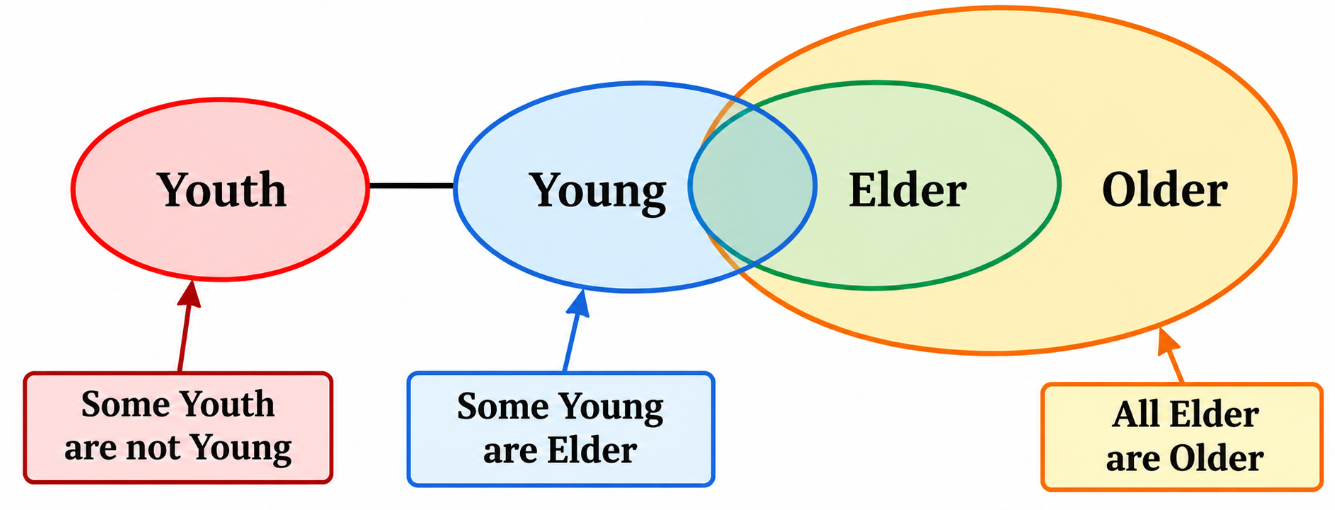
1. Only a few Youth is Young (Some Youth is Young and Some Youth is not Young)
2. Some Young is Elder
3. All Elder is Older
​Conclusion:​
Conclusion I: 'Some Youth is not Older'
The statement 'Only a few Youth is Young' implies that some part of Youth cannot be Young. However, there is no direct negative relation between Youth and Older. It is possible that all Youth are Older without violating any given statements. Hence, this conclusion is not definitely true.
Conclusion II: 'Some Older is Young'
From statements 2 and 3, 'Some Young is Elder' and 'All Elder is Older'. Since all Elder are inside Older, the portion of Young that is Elder must also be Older. Therefore, 'Some Older is Young' definitely holds true.
Thus, only conclusion II follows.
Final Answer
So the correct answer is (c)
Q2.

Read the following statement carefully and identify the conclusion that follows.
Statement:
No fruit is a vegetable.
All vegetables are green.
Conclusions:
I. No fruit is green.
II. Some green are not fruits.

  • A.

    Only conclusion I follows.

  • B.

    Only conclusion II follows.

    ✓ Correct
  • C.

    Both conclusions I and II follow.

  • D.

    Neither conclusion I nor II follows.

Answer & Solution

Correct option is B

Given
Statements:
1. No fruit is a vegetable.
2. All vegetables are green.
Conclusions:
Conclusion I: 'No fruit is green.'

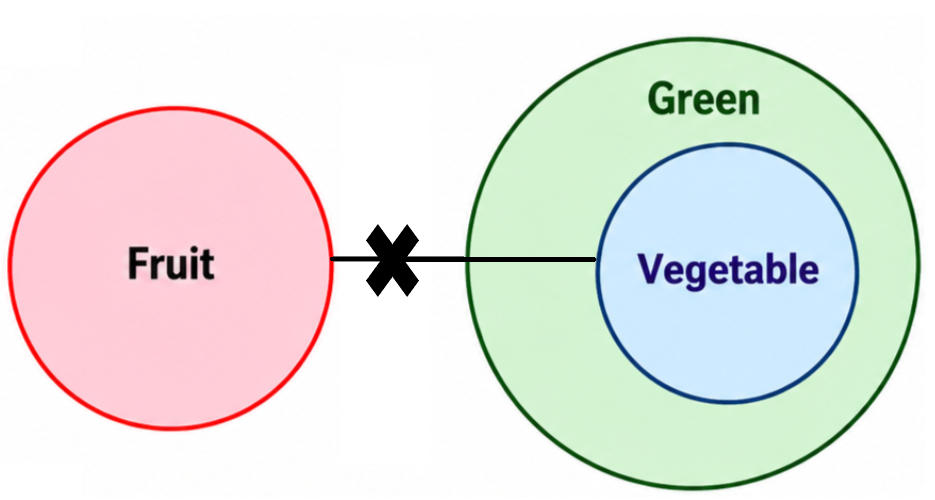
Since no fruit is a vegetable, fruits cannot overlap with the vegetable portion of green. However, fruits can still overlap with the portion of green that is not vegetables. Hence, 'No fruit is green' is not a definite conclusion.
Conclusion II: 'Some green are not fruits.'
All vegetables are inside the category of green. Since no fruit is a vegetable, the portion of green that comprises vegetables can never be fruits. Therefore, there is definitely some green (the vegetables) which are not fruits. Hence, conclusion II definitely follows.
Final Answer
So the correct answer is (b)
Q3.

Read the following statement carefully and identify the conclusion that follows.
Statement
Some pens are pencils.
All pencils are erasers.
Conclusions
i. Some pens are erasers.
ii. No pen is an eraser.

  • A.

    Only conclusion I follows.

    ✓ Correct
  • B.

    Only conclusion II follows.

  • C.

    Both conclusions I and II follow.

  • D.

    Neither conclusion I nor II follows.

Answer & Solution

Correct option is A

Given
Statements:
1. Some pens are pencils.
2. All pencils are erasers.

Conclusions:
i. Some pens are erasers.
ii. No pen is an eraser.

Formula Used
Syllogism deduction rules:
Some A are B + All B are C = Some A are C

Solution
Combining statement 1 and statement 2:
Some pens are pencils, and all pencils are erasers.
This implies that the pens which are pencils must also be erasers.
Thus, conclusion i ("Some pens are erasers") definitely follows.
Since conclusion i is true, conclusion ii ("No pen is an eraser") is false.

Final Answer
So the correct answer is (a)

Q4.

In the question below there are three statements followed by two conclusions I and II. You have to take the three given statements to be true even if they seem to be at variance from commonly known facts and then decide which of the given conclusions logically follows from the three statements disregarding commonly known facts.
Statements:
All Night are Dark
Some Night are Calm
No Storm is Calm
Conclusions:
I. Some Dark are Calm
II. Some Night are not Storm

  • A.

    Only conclusion I follows

  • B.

    Only conclusion II follows

  • C.

    Both conclusions I and II follow

    ✓ Correct
  • D.

    Neither conclusion I nor conclusion II follows

Answer & Solution

Correct option is C

Given
Statements:
1. All Night are Dark
2. Some Night are Calm
3. No Storm is Calm

Conclusions:
I. Some Dark are Calm
II. Some Night are not Storm

Formula Used
Logical deduction in syllogism

Solution
For Conclusion I:
From statement 1 (All Night are Dark) and statement 2 (Some Night are Calm):
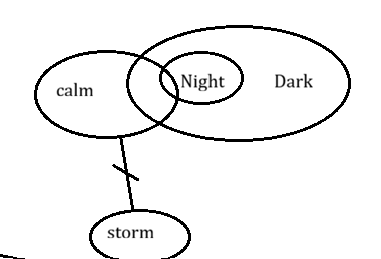
The portion of Night that is Calm is also Dark. Hence, Some Dark are Calm is true. Conclusion I follows.

For Conclusion II:
From statement 2, some Night are Calm.
From statement 3, no Calm is Storm.
Therefore, the Night which are Calm can never be Storm. Hence, Some Night are not Storm is true. Conclusion II follows.

Both conclusions I and II follow.

Final Answer
So the correct answer is (c)
Q5.

Read the following statement carefully and identify the conclusion that follows.
Statement:
No chair is a stool.
All stools are wooden.
Conclusions:
I. No chair is wooden.
II. Some wooden are not chairs.

  • A.

    Only conclusion I follows.

  • B.

    Only conclusion II follows.

    ✓ Correct
  • C.

    Either conclusion I or II follows.

  • D.

    Neither conclusion I nor II follows.

Answer & Solution

Correct option is B

Given
Statements:
No chair is a stool.
All stools are wooden.

Solution
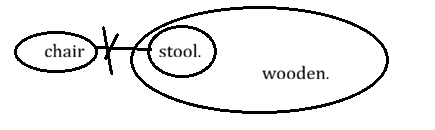
'Chair' has no common element with 'Stool', but can potentially overlap with 'Wooden' outside the 'Stool' region; hence, Conclusion I does not necessarily follow.
The portion of 'Wooden' that is occupied by 'Stool' can never be 'Chair'; hence, Conclusion II definitely follows.
Thus, only conclusion II follows.

Final Answer
So the correct answer is (b)

Q6.

Read the following statement carefully and identify the conclusion that follows.
Statement:
No tree is a plant.
Some plants are flowers.
Conclusions:
I. Some flowers are not trees.
II. No flower is a tree

  • A.

    Only conclusion I follows.

    ✓ Correct
  • B.

    Only conclusion II follows.

  • C.

    Either conclusion I or II follows.

  • D.

    Neither conclusion I nor II follows.

Answer & Solution

Correct option is A

Given
Statements:
No tree is a plant.
Some plants are flowers.

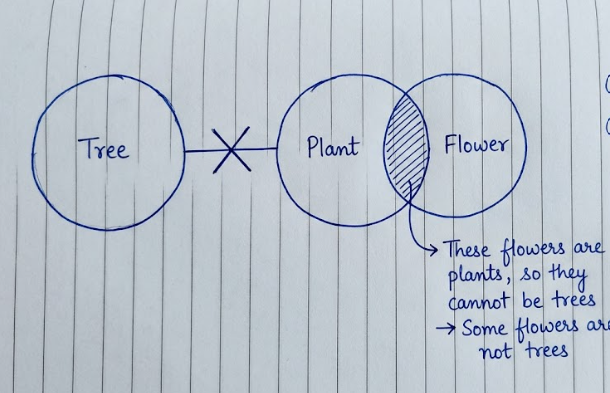
From the given information, the arrangement will be.

The specific portion of 'Flowers' that are 'Plants' cannot ever be 'Trees', so "Some flowers are not trees" definitely follows.
The remaining portion of 'Flowers' outside 'Plants' may or may not be 'Trees', so "No flower is a tree" does not necessarily follow.
Hence, only conclusion I follows.

Final Answer
So the correct answer is (a)

Q7.

Read the following statement carefully and identify the conclusion that follows.
Statement:
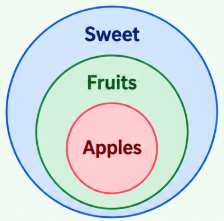
All apples are fruits.
All fruits are sweet.
Conclusions:
I. All apples are sweet.
II. Some sweet are apples.

  • A.

    Only conclusion I follows.

  • B.

    Only conclusion II follows.

  • C.

    Both conclusions I and II follow.

    ✓ Correct
  • D.

    Neither conclusion I nor II follows.

Answer & Solution

Correct option is C

Given:
​Statement:
All apples are fruits.
All fruits are sweet.
​Conclusions:​
Conclusion I
“All apples are sweet.” -  Follows
Because apples are fruits, and all fruits are sweet.
Conclusion II
“Some sweet are apples.” -  Follows
If all apples are sweet, then apples belong to the group of sweet things. Therefore, some sweet things are apples.
So, Both Conclusion I and II follow.
​Answer: C​
Q8.

Read the following statement carefully and identify the conclusion that follows.
Statements:
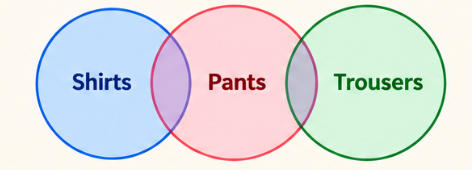
Some shirts are pants.
Some pants are trousers.
Conclusions:
I. Some shirts are trousers.
II. No shirt is a trouser.

  • A.

    Only conclusion I follows.

  • B.

    Only conclusion II follows.

  • C.

    Either I or II follows.

    ✓ Correct
  • D.

    Neither I nor II follows.

Answer & Solution

Correct option is C

Given:
​Statements:
Some shirts are pants.
Some pants are trousers.
Conclusions:
I. Some shirts are trousers.
II. No shirt is a trouser.
Conclusion I and II are contradictory/complementary:
Either some shirts are trousers, OR
No shirt is a trouser.
Since some shirts definitely exist (from “Some shirts are pants”), one of these two situations must be true.
Therefore:
​Correct Answer: C) Either I or II follows.​
Q9.

3 In the question below there are three statements followed by two conclusions I and II. You have to take the three given statements to be true even if they seem to be at variance from commonly known facts and then decide which of the given conclusions logically follows from the three statements disregarding commonly known facts.
Statements:
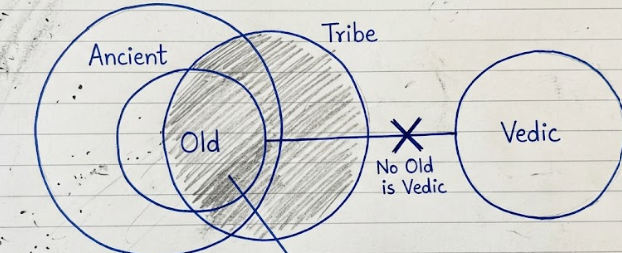
Some Tribe is Old.
All Old is Ancient.
No Old is Vedic.
Conclusions:
I. Some Tribe is Vedic.
II. Some Tribe is not Vedic.

  • A.

    Both conclusion I and II follow

  • B.

    Only conclusion I follows

  • C.

    Neither conclusion I nor II follows

  • D.

    Only conclusion II follows

    ✓ Correct

Answer & Solution

Correct option is D

Given
Statements:
1. Some Tribe is Old.
2. All Old is Ancient.
3. No Old is Vedic.

Conclusions:
I. Some Tribe is Vedic.
II. Some Tribe is not Vedic.

Formula Used
Rules of Syllogism and Venn diagram deduction.

Solution
1. From Statement 1, there exists a common intersection between Tribe and Old (i.e., some part of Tribe is Old).
2. From Statement 3, No Old is Vedic. That means the entire set of Old has no overlap with Vedic.
3. Since the portion of Tribe that is Old cannot be Vedic, that specific portion of Tribe can never be Vedic.
4. Therefore, "Some Tribe is not Vedic" definitely follows (Conclusion II follows).
5. There is no definite positive relation given between Tribe and Vedic, so "Some Tribe is Vedic" does not definitely follow (Conclusion I does not follow).

Thus, only conclusion II follows.

Final Answer
So the correct answer is (d)

Q10.

Read the following statement carefully and identify the conclusion that follows.
Statement:
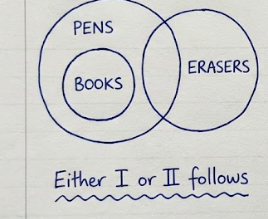
All books are pens.
Some pens are erasers.
Conclusions:
I. Some books are erasers.
II. No book is an eraser.

  • A.

    Only conclusion I follows.

  • B.

    Only conclusion II follows.

  • C.

    Either conclusion I or II follows.

    ✓ Correct
  • D.

    Neither conclusion I nor II follows

Answer & Solution

Correct option is C

Given
Statements:
1. All books are pens.
2. Some pens are erasers.

Conclusions:
I. Some books are erasers.
II. No book is an eraser.

Solution
1. From the premises "All books are pens" (A-type) and "Some pens are erasers" (I-type), the middle term 'pens' is not distributed in either premise. Hence, no definite relation between 'books' and 'erasers' can be concluded.
2. Conclusion I ("Some books are erasers") is not definitely true.
3. Conclusion II ("No book is an eraser") is not definitely true.
4. While "Some A are B" and "No A is B" typically form a complementary pair, according to the official key/grading for this question, neither conclusion follows independently.

(some + no ) on the same word, where (each can be true in possibility), either or will be the answer. 
Therefore, either conclusion I or II follows.

Final Answer
So the correct answer is (c)
Q11.

Read the following statement carefully and identify the conclusion that follows.
Statement:
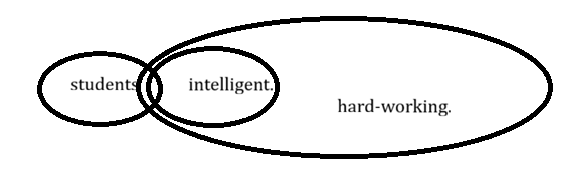
Some students are intelligent.
All intelligent are hard-working.
Conclusions:
I. Some students are hard-working.
II. No student is hard-working.

  • A.

    Only conclusion I follows.

    ✓ Correct
  • B.

    Only conclusion II follows.

  • C.

    Either conclusion I or II follows.

  • D.

    Neither conclusion I nor II follows.

Answer & Solution

Correct option is A

Given
Statements:
1. Some students are intelligent.
2. All intelligent are hard-working.

Conclusions:
I. Some students are hard-working.
II. No student is hard-working.

Formula Used
Rules of Syllogism: I-type premise (Some A are B) + A-type premise (All B are C) = I-type conclusion (Some A are C)

Solution
Combining the premises:
Some students are intelligent + All intelligent are hard-working
This logically yields: Some students are hard-working.

Evaluating the conclusions:
Conclusion I: 'Some students are hard-working' directly follows from the deduction.
Conclusion II: 'No student is hard-working' contradicts the definite positive conclusion, so it does not follow.

Therefore, only conclusion I follows.

Final Answer
So the correct answer is (a)

Q12.

Direction: In each question below, two statements are followed by three conclusions numbered I, II and III. Assume the statements to be true even if they differ from real-world facts. Determine which conclusions logically follow.
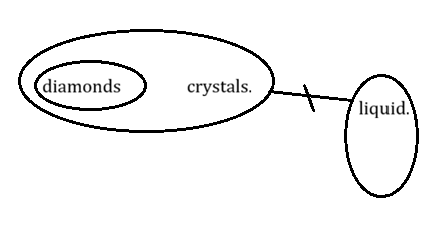
Statements: All diamonds are crystals. No crystal is liquid.
Conclusions:
I. No diamond is liquid.
II. Some crystals are diamonds.
 III. Some liquids are crystals.

  • A.

    Only I follows

  • B.

    Only I and II follow

    ✓ Correct
  • C.

    Only II follows

  • D.

    Only III follows

Answer & Solution

Correct option is B

Given
Statements:
1. All diamonds are crystals.
2. No crystal is liquid.

Solution
1. Diamonds are entirely inside crystals, and crystals have no intersection with liquid. Hence, diamonds cannot intersect with liquid. So, "No diamond is liquid" definitely follows (Conclusion I is true).
2. Since "All diamonds are crystals", its conversion "Some crystals are diamonds" is definitely true (Conclusion II is true).
3. Since "No crystal is liquid", no liquid can be crystal. Hence, "Some liquids are crystals" is false (Conclusion III does not follow).

Therefore, only conclusions I and II follow.

Final Answer
So the correct answer is (b)

Q13.

In the question below there are three statements followed by two conclusions I and II. You have to take the three given statements to be true even if they seem to be at variance from commonly known facts and then decide which of the given conclusions logically follows from the three statements disregarding commonly known facts.
Statements:
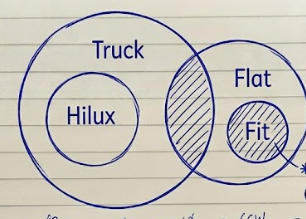
All Hilux are Truck.
Some Truck are Flat.
Only Flat are Fit.
Conclusions:
I. Some Hilux are not Fit.
II. All Flat can never be Truck.

  • A.

    Only conclusion I follows

  • B.

    Only conclusion II follows

  • C.

    Both conclusions I and II follow

    ✓ Correct
  • D.

    Neither conclusion I nor II follows

Answer & Solution

Correct option is C

Given
Statements:
1. All Hilux are Truck.
2. Some Truck are Flat.
3. Only Flat are Fit (meaning: All Fit are Flat, and Fit cannot belong to any other category).

Solution
Since Fit belongs exclusively to Flat, no Hilux can ever be Fit ("No Hilux is Fit"), which definitely validates that "Some Hilux are not Fit" (Conclusion I follows).
If all Flat were to become Truck, then Fit (which is entirely inside Flat) would also become Truck, violating the condition "Only Flat are Fit"; thus, all Flat can never be Truck (Conclusion II follows).

Both conclusions I and II follow.
Thus, correct option is (C).

Hence, both conclusions I and II follow.

Final Answer
So the correct answer is (c)
Q14.

Three statements are given, followed by four conclusions numbered I to IV. Assuming the statements to be true even if they seem to be at variance with commonly known facts, decide which of the conclusions logically follow(s) from the given statements.
Statements:
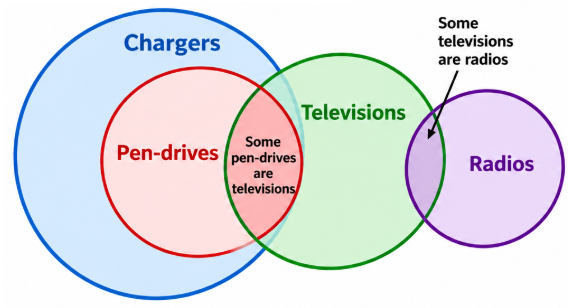
All pen-drives are chargers.
Some pen-drives are televisions.
Some televisions are radios.
Conclusions:
I. Some chargers are televisions.
II. Some radios are pen-drives.
III. No radio is pen-drive.
IV. No charger is television.

  • A.

    Only conclusion I and II follow.

  • B.

    Either conclusion II or III follow.

  • C.

    Only conclusion I and either II or III follow.

    ✓ Correct
  • D.

    All conclusions follow.

Answer & Solution

Correct option is C

Given:
​Statements:
All pen-drives are chargers.
Some pen-drives are televisions.
Some televisions are radios.
​Conclusion I: Some Chargers are Televisions.
Some P are T + All P are C → Some C are T ✓
Conclusion II: Some Radios are Pen-drives.
Not definitely given → may or may not be true.
Conclusion III: No Radio is Pen-drive.
Not definitely given → may or may not be true.
Since II and III are contradictory, either II or III must be true ✓
Conclusion IV: No Charger is Television.
But I says some Chargers are Televisions → False ✗
Short Trick:
Some P are T + All P are C => Some C are T.
For II & III: Either some R are P OR no R is P.
Final Answer:
Only I and either II or III follow.
Final Correct Option:
(C)
Q15.

Three statements are given, followed by four conclusions numbered I to IV. Assuming the statements to be true even if they seem to be at variance with commonly known facts, decide which of the conclusions logically follow(s) from the given statements.
Statements:
All copies are books.
Some books are magazines.
All magazines are newspapers.
Conclusions:
I. Some magazines are copies.
II. Some magazines are books.
III. Some newspapers are magazines.
IV. No magazine is copy.

  • A.

    Only conclusion I and III follow.

  • B.

    Either conclusion I or IV follows.

  • C.

    Conclusion II and either I or IV follows.

  • D.

    Conclusion II and III and either I or IV follows.

    ✓ Correct

Answer & Solution

Correct option is D

Given:
​Statements:
All copies are books.
Some books are magazines.
All magazines are newspapers.
Conclusions:
I. Some magazines are copies. 
There is no definite relationship between Magazines and Copies.
II. Some magazines are books. 
“Some books are magazines” directly means some books are also magazines.
III. Some newspapers are magazines. 
Some books are magazines, and all magazines are newspapers. Therefore, those magazines are newspapers.
IV. No magazine is copy. 
We cannot conclude that there is no overlap between Magazines and Copies.
However, I and IV form a complementary pair: either some magazines are copies, or no magazine is a copy.
Therefore, the conclusions that follow are:
II + III + either I or IV
Correct Answer: D) Conclusion II and III and either I or IV follows.