SSC CGL Statistics Questions with Detailed Solutions

Get SSC CGL Statistics Questions to prepare for your upcoming exam. Solve the most expected questions and detailed solutions that can be asked in the exam.

Important SSC CGL Statistics Questions

Q1.

The mean of five observations m, m + 5, m + 10, m + 15, and m + 20 is 20. The mean of the first four observations is:

  • A.

    15.5

  • B.

    16.5

  • C.

    16

  • D.

    17.5

    ✓ Correct

Answer & Solution

Correct option is D

Given:
Five observations: m, m + 5, m + 10, m + 15, m + 20
Mean of all five observations = 20
Formula Used:
Mean = Sum of observationsNumber of observations \frac{Sum\ of\ observations}{Number\ of \ observations}​​
Solution:
Sum of the five observations = m + (m + 5) + (m + 10) + (m + 15) + (m + 20) =
5m + 50
Mean = 5m+505 \frac{5m + 50}{5}​ = m + 10
We are given that the mean is 20:
m + 10 = 20
m = 10
The first four observations are m, m + 5, m + 10, and m + 15.
Substitute m = 10:
The observations are 10, 15, 20, 25.
Sum of first four = 10 + 15 + 20 + 25 = 70
Mean of first four = 704\frac{70}{4}​ = 17.5
Final Answer
So the correct answer is (d)
Q2.

A scholar was asked to find the arithmetic mean of the numbers 4,11,7,9,16,13,8,19,18,21,12 and x. He found the mean to be 12. What should be the number in place of x ?

  • A.

    8

  • B.

    5

  • C.

    6

    ✓ Correct
  • D.

    7

Answer & Solution

Correct option is C

Given:
The numbers are 4, 11, 7, 9, 16, 13, 8, 19, 18, 21, 12, and x.
The arithmetic mean of these 12 numbers is 12.
Formula Used:
Mean = Sum of all observationsTotal number of observations\frac{Sum\ of\ all\ observations}{Total\ number\ of\ observations}​​
Solution:
First, calculate the sum of the known 11 numbers:
4 + 11 + 7 + 9 + 16 + 13 + 8 + 19 + 18 + 21 + 12 = 138
The total sum including x is:
138 + x
Since the mean of the 12 numbers is 12, their total sum is:
12 × 12 = 144
Equating both sums:
138 + x = 144
x = 144 - 138 = 6
Final Answer
So the correct answer is (c)

Q3.

The standard deviation of a dataset is 6 . If each observation is multiplied by 2 and then increased by 5 , what will be the new standard deviation?

  • A.

    6

  • B.

    12

    ✓ Correct
  • C.

    17

  • D.

    18

Answer & Solution

Correct option is B

Given
Original Standard Deviation = 6
Operation on each observation: Multiply by 2, then add 5.

Formula Used
If each observation is multiplied by a constant 'k', the new standard deviation becomes |k| × original standard deviation.
Addition or subtraction of a constant does not change the standard deviation.

Solution
Multiplying each observation by 2 changes the standard deviation to 2 × 6 = 12.
Adding 5 to each observation shifts the mean but does not affect the spread or standard deviation.
Therefore, the new standard deviation remains 12.

Final Answer
So the correct answer is (b)

Q4.

A futuristic satellite network has two clusters. Cluster A has 20 satellites with average signal strength 80 units. Cluster B has 30 satellites with average signal strength 100 units. Due to calibration, signals of cluster A increase by 10% and cluster B decrease by 5%. Find the new combined mean signal strength.

  • A.

    90.8 units

  • B.

    98 units

  • C.

    92.2 units

    ✓ Correct
  • D.

    94.5 units

Answer & Solution

Correct option is C

Given
Cluster A: 20 satellites, Initial Average = 80
Cluster B: 30 satellites, Initial Average = 100
Cluster A signals increase by 10%
Cluster B signals decrease by 5%
Solution
New average of Cluster A = 80+(80×10100)=80+8=880 + (80 × \frac{10}{100}) = 80 + 8 = 88​​

New average of Cluster B = 100−(100×5100)=100−5=95100 - (100 × \frac{5}{100}) = 100 - 5 = 95​​
Total signal strength of Cluster A = 20 × 88 = 1760
Total signal strength of Cluster B = 30 × 95 = 2850
Total combined signal strength = 1760 + 2850 = 4610
Total number of satellites = 20 + 30 = 50
New combined mean = 461050=92.2 \frac{4610}{50} = 92.2​ units

Final Answer
So the correct answer is (c)

Q5.

The daily sales (in units) of two items, Aand B, over a9-day period are recorded as follows:
Item A: 25, 28, 30, 25, 32, 25, 35, 28, 25
Item B: 28, 30, 28, 33, 28, 35, 28, 25, 28
Consider the following statements:
I. The mode of Item A’s sales is equal to the mode of Item B’s sales minus 3.
II. The sum of their modal values is 53.
Which of the above statements is/are correct?

  • A.

    Only I

  • B.

    Only II

  • C.

    Both I and II

    ✓ Correct
  • D.

    Neither I nor II

Answer & Solution

Correct option is C

Given
Sales of Item A: 25, 28, 30, 25, 32, 25, 35, 28, 25
Sales of Item B: 28, 30, 28, 33, 28, 35, 28, 25, 28
Formula Used
Mode = The value that appears most frequently in a data set.
Solution
For Item A:
The frequency of 25 is 4, 28 is 2, 30 is 1, 32 is 1, and 35 is 1.
Since 25 has the highest frequency, Mode of Item A = 25.
For Item B:
The frequency of 28 is 5, 30 is 1, 33 is 1, 35 is 1, and 25 is 1.
Since 28 has the highest frequency, Mode of Item B = 28.
Checking the given statements:
Statement I: Mode of Item A = Mode of Item B - 3
25 = 28 - 3
25 = 25 (This statement is mathematically correct)
Statement II: Sum of their modal values = 53
25 + 28 = 53 (This statement is also mathematically correct)
Final Answer
So the correct answer is (a)

Q6.

A student is calculating the variance and standard deviation for various datasets. Which of the following calculated pairs of (Variance, Standard Deviation) is INCORRECT?

  • A.

    2.25, 1.5

  • B.

    0.09, 0.03

    ✓ Correct
  • C.

    324, 18

  • D.

    6.25, 2.5

Answer & Solution

Correct option is B

Given
Pairs of (Variance, Standard Deviation):
A: 2.25, 1.5
B: 0.09, 0.03
C: 324, 18
D: 6.25, 2.5
Formula Used
Variance = (Standard Deviation)2
Solution
Let us verify each given pair by squaring the standard deviation:
For Option A:
(1.5)2=2.25(1.5)^2 = 2.25​ (Correct calculation)
For Option B:
​(0.03)2=0.0009≠0.09(0.03)^2 = 0.0009 \neq 0.09​​
The correct standard deviation for a variance of 0.09 should be 0.3. Thus, this pair is incorrectly calculated.
For Option C:
(18)2=324(18)^2 = 324​ (Correct calculation)
For Option D:
(2.5)2=6.25(2.5)^2 = 6.25​ (Correct calculation)

Q7.

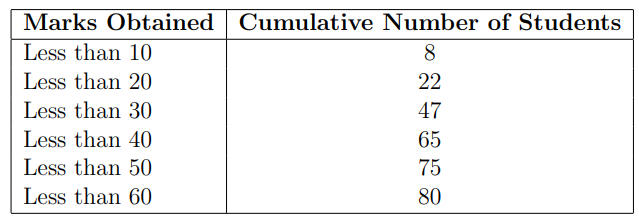
The following table illustrates the marks obtained by 80 students in a Quantitative Aptitude mock test. Find the mode of the marks obtained.

  • A.

    24.25

  • B.

    26.11

    ✓ Correct
  • C.

    25.50

  • D.

    28.33

Answer & Solution

Correct option is B

Given:
The cumulative frequency distribution is:

Marks

Cumulative Frequency

Less than 10

8

Less than 20

22

Less than 30

47

Less than 40

65

Less than 50

75

Less than 60

80

Total number of students, N = 80.

Converting cumulative frequencies into frequencies:

Marks

Frequency

0–10

8

10–20

22 − 8 = 14

20–30

47 − 22 = 25

30–40

65 − 47 = 18

40–50

75 − 65 = 10

50–60

80 − 75 = 5

The modal class is 20–30, as it has the highest frequency 25.

Formula Used:

Mode = l + [(f₁ − f₀) / (2f₁ − f₀ − f₂)] × h

Solution:

Here, l = 20, f₁ = 25, f₀ = 14, f₂ = 18, h = 10

Mode = 20 + [(25 − 14) / {2(25) − 14 − 18}] × 10

Mode = 20 + (11 / 18) × 10

Mode = 20 + 110/18

Mode ≈ 26.11

Therefore, the mode of the marks obtained is 26.11.

Q8.

Find the weighted mean for the following data:

Value :
10
12
15
18
20
Weight :
2
5
12
4
7
  • A.

    15.2

  • B.

    15.6

  • C.

    15.7

    ✓ Correct
  • D.

    14.3

Answer & Solution

Correct option is C

Given
Values (x): 10, 12, 15, 18, 20
Weights (w): 2, 5, 12, 4, 7
Formula Used
Weighted Mean = ∑(x×w)∑w\frac{\sum (x × w)}{\sum w}​​
Solution
Calculate sum of weights (∑w):(\sum w):​​
2 + 5 + 12 + 4 + 7 = 30
Calculate sum of products (∑x×w):(\sum x × w):​​
(10 × 2) + (12 × 5) + (15 × 12) + (18 × 4) + (20 × 7)
= 20 + 60 + 180 + 72 + 140
= 472
Weighted mean = 47230=15.733...\frac{472}{30} = 15.733...​​
Rounding to one decimal place gives 15.7.

Q9.

A school teacher recorded the number of days each of 9 students was absent during a semester: 12, 15, 12, 18, 12, 20, 15, 12, 22. The teacher needs to report the mode of this data set to the school's attendance committee, as it represents the most common absence pattern. What is the mode?

  • A.

    20

  • B.

    18

  • C.

    15

  • D.

    12

    ✓ Correct

Answer & Solution

Correct option is D

Given:
Data set: 12, 15, 12, 18, 12, 20, 15, 12, 22
Formula Used:
Mode = The value that appears most frequently in a data set.
Solution:
Count the frequency of each value in the data set:
12 appears 4 times.
15 appears 2 times.
18 appears 1 time.
20 appears 1 time.
22 appears 1 time.
Since 12 occurs most frequently, the mode is 12.
Final Answer
So the correct answer is (d)

Q10.

To analyze the performance of students following an educational channel's daily mock tests, a team lead compiles the scores of 40 students from a recent 50-mark quantitative aptitude exam. The scores are grouped as follows:
Marks: 0–10, 10–20, 20–30, 30–40, 40–50
Frequency: 6, 9, 10, 8, 7
Based on this frequency distribution, what is the exact median score of the test takers?

  • A.

    25

    ✓ Correct
  • B.

    24

  • C.

    26

  • D.

    23

Answer & Solution

Correct option is A

Given:
Total frequency, N = 40
Cumulative frequencies = 6, 15, 25, 33, 40.
Formula Used:
Median = l+[N2−cff]×hl + \left[\frac{\frac{N}{2} - cf}{f}\right]\times h​​
Solution:
N/2 = 40/2 = 20
The 20th observation lies in the 20–30 class.
Therefore,
l = 20, cf = 15, f = 10, h = 10
Median = 20 + [(20 − 15)/10] × 10
= 20 + 5
= 25
Hence, the median score is 25.

Q11.

A food vlogger recently shared a quick, healthy air-fried snack recipe and asked followers to rate it on a scale of 1 to 10. The first nine ratings received were: 4, 7, 6, 9, 5, 7, 8, 7, and 10. Determine the statistical mode of these ratings and the exact number of followers who gave a rating strictly higher than the average score.

  • A.

    Mode = 7, Number of followers scoring above average = 3

    ✓ Correct
  • B.

    Mode = 7, Number of followers scoring above average = 4

  • C.

    Mode = 8, Number of followers scoring above average = 4

  • D.

    Mode = 8, Number of followers scoring above average = 3

Answer & Solution

Correct option is A

Given:
Ratings = 4, 7, 6, 9, 5, 7, 8, 7, 10
Formula Used:
Mean = Sum of observations / Number of observations
Solution:
Sum of ratings = 4 + 7 + 6 + 9 + 5 + 7 + 8 + 7 + 10
= 63
Mean = 63/9 = 7
Ratings strictly greater than 7 are 8, 9 and 10.
Therefore, 3 followers gave a rating above the average.
The rating 7 occurs three times, which is the highest frequency.
Mode = 7
Hence, the correct answer is Mode = 7 and 3 followers above average.

Q12.

A public health department collected age data from 40 residents across six age-group intervals. The frequencies recorded for the class intervals 0-10, 10-20, 20-30, 30-40, 40-50, and 50-60 were 4, 6, 15, 8, 5, and 2 respectively. The department's statistician must report the median age of this group, rounded to two decimal places, for the quarterly health bulletin. What is the median?

  • A.

    28.33

  • B.

    30.50

  • C.

    26.67

    ✓ Correct
  • D.

    24.00

Answer & Solution

Correct option is C

Given:
Frequencies: 4, 6, 15, 8, 5, 2 for class intervals 0-10, 10-20, 20-30, 30-40, 40-50, 50-60.
Total N = 40.
Formula Used:
Median = L+N2−CFf×h,L + \frac{\frac{N}{2} - CF}{f} × h,​ where L is the lower limit of the median class, CF is the cumulative frequency before the median class, f is the frequency of the median class, and h is the class width.
Solution:
​N2=402=20.\frac{N}{2} = \frac{40}{2} = 20.​​
Cumulative frequencies: 4, 10, 25, 33, 38, 40.
The median class is 20-30 (first cumulative frequency ≥ 20).
Here L = 20, CF = 10, f = 15, h = 10.
Median = 20+20−1015×10=20+1015×10=20+1001520 + \frac{20 - 10}{15} × 10 = 20 + \frac{10}{15} × 10 = 20 + \frac{100}{15}​ = 20 + 6.67 = 26.67
Final Answer
So the correct answer is (c)

Q13.

Match the statistical metrics in List I with their corresponding calculated values in List II based on the following grouped data representing the weekly hours spent studying by a group of competitive exam aspirants:

Hours
10–20
20–30
30–40
40–50
50–60
No. of Aspirants
5
7
13
9
6

List I (Metric)
A. Total number of Aspirants surveyed (Σf)
B. Cumulative Frequency just preceding the median class
C. Estimated Mean hours studied by an aspirant
List II (Value)
1. 36
2. 40
3. 12
4. 24
Choose the correct matching code:

  • A.

    A-3, B-2, C-4

  • B.

    A-2, B-4, C-1

  • C.

    A-1, B-3, C-2

  • D.

    A-2, B-3, C-1

    ✓ Correct

Answer & Solution

Correct option is D

Given
Frequency distribution of studying hours of aspirants.
Formula Used
Mean = ΣfxΣf\frac{\Sigma fx}{\Sigma f}​​
Median class is the class where cumulative frequency is just greater than or equal to N2\frac{N}{2}​​
Solution
Total frequency (Σf)=5+7+13+9+6=40(\Sigma f) = 5 + 7 + 13 + 9 + 6 = 40​​
So, metric A matches 2.
Calculating Cumulative Frequencies (CF): 5, 12, 25, 34, 40.
​N2=402=20\frac{N}{2} = \frac{40}{2} = 20​​
The median class is 30-40 (since its CF of 25 is the first to exceed 20).
The cumulative frequency just preceding the median class is 12.
So, metric B matches 3.
Calculating Midpoints (x): 15, 25, 35, 45, 55.
​Σfx=(5×15)+(7×25)+(13×35)+(9×45)+(6×55)Σfx=75+175+455+405+330=1440\Sigma fx = (5 \times 15) + (7 \times 25) + (13 \times 35) + (9 \times 45) + (6 \times 55) \\\Sigma fx = 75 + 175 + 455 + 405 + 330 = 1440​​
Estimated Mean = \frac{1440}{40} = 36
So, metric C matches 1.
The correct match is A-2, B-3, C-1.
Final Answer
So the correct answer is (d)

Q14.

The annual performance scores of a large team of employees in a multinational corporation were analyzed, yielding a calculated variance of 49. To account for a newly introduced base-level metric across the board, the HR manager decides to deduct a flat 15 points from every single employee's performance score. After this universal adjustment is made, what will be the new standard deviation of the department's performance scores?

  • A.

    15

  • B.

    7

    ✓ Correct
  • C.

    49

  • D.

    -7

Answer & Solution

Correct option is B

Given
Initial variance = 49
Adjustment = Subtraction of 15 points from each score
Formula Used
Standard Deviation = Variance\sqrt{Variance}​​
Effect of shift of origin on Standard Deviation.
Solution
First, determine the original standard deviation of the dataset:
Standard Deviation = 49=7 \sqrt{49} = 7​​
A fundamental property of measures of dispersion (such as variance and standard deviation) is that they are entirely independent of the change of origin. This means that adding or subtracting a constant value to every observation in a dataset does not change the spread of the data.
Therefore, after deducting 15 points universally, the standard deviation remains unchanged at 7.
Final Answer
So the correct answer is (b)

Q15.

If the marks scored by the students in a class test out of 50 then, Find the Median of the following data:

Marks
Frequency
0-10
5
10-20
8
20-30
6
30-40
6
40-50
5
  • A.

    38.9

  • B.

    18.8

  • C.

    14.1

  • D.

    23.3

    ✓ Correct

Answer & Solution

Correct option is D

Given
Class Intervals: 0-10, 10-20, 20-30, 30-40, 40-50
Frequencies (f): 5, 8, 6, 6, 5
Formula Used
Median = L+N2−CFf×h L + \frac{\frac{N}{2} - CF}{f} × h​​
Where L is the lower limit of median class, CF is cumulative frequency of the preceding class, f is frequency of median class, h is class size, and N is total frequency.
Solution
Total frequency N = 5 + 8 + 6 + 6 + 5 = 30
​N2=302=15\frac{N}{2} = \frac{30}{2} = 15​​
Cumulative frequencies (CF) are: 5, 13, 19, 25, 30.
The median class is the class where CF is just greater than or equal to 15, which is 20-30.
For median class 20-30:
L = 20
CF = 13 (cumulative frequency of class 10-20)
f = 6
h = 10
Median =  20+15−136×1020 + \frac{15 - 13}{6} × 10​

Median =  20+26×1020 + \frac{2}{6} × 10​​

Median =  20+103=20+3.33=23.3320 + \frac{10}{3} = 20 + 3.33 = 23.33​​
Final Answer
So the correct answer is (d)