SSC CGL HCF AND LCM Questions with Detailed Solutions

Get SSC CGL HCF AND LCM Questions to prepare for your upcoming exam. Solve the most expected questions and detailed solutions that can be asked in the exam.

Important SSC CGL HCF AND LCM Questions

Q1.

198 chips and 330 toffees are to be distributed among maximum number of boys. Each boy gets the same number of chips. Each boy get the same number of toffees. How many chips does each boy get?

  • A.

    2

  • B.

    5

  • C.

    3

    ✓ Correct
  • D.

    4

Answer & Solution

Correct option is C

Given
Number of chips = 198
Number of toffees = 330
Formula Used
Maximum number of boys = HCF(198, 330)
Chips per boy =Total chipsNumber of boys \frac{\text{Total chips}}{\text{Number of boys}}​​
Solution
Calculate the Highest Common Factor (HCF) of 198 and 330 to find the maximum possible number of boys.
​198=2×32×11330=2×3×5×11198 = 2 \times 3^2 \times 11 \\330 = 2 \times 3 \times 5 \times 11​​
HCF = 2×3×11=66 2 \times 3 \times 11 = 66​​
So, maximum number of boys = 66.
Number of chips each boy gets =  19866=3\frac{198}{66} = 3​​
Final Answer
So the correct answer is (c)
Q2.

The LCM and HCF of three numbers are 420 and 4 respectively. If one number is 12, then the other two numbers are

  • A.

    28, 60

    ✓ Correct
  • B.

    4, 420

  • C.

    30, 28

  • D.

    28, 84

Answer & Solution

Correct option is A

Given:
LCM of three numbers = 420.
HCF of three numbers = 4.
One number = 12.
Formula Used:
HCF is the common factor of all numbers. LCM is found using prime factorisation.
HCF(a,b,c) = common prime factors with least powers
LCM(a,b,c) = all prime factors with highest powers
Solution:
Since HCF = 4, all three numbers are multiples of 4. One number is 12 = 4×3.
Check option A: numbers are 12, 28, 60.
​12=22×3,28=22×7,60=22×3×512=2^2×3, 28=2^2×7, 60=2^2×3×5​​
HCF = 222^2 =4
LCM = 22×3×5×72^2×3×5×7 =420 
Both conditions are satisfied by 28 and 60.
Final Answer
So the correct answer is (a)

Q3.

The greatest number that will divide 187, 233 and 279 leaving the same remainder in each case is

  • A.

    30

  • B.

    36

  • C.

    46

    ✓ Correct
  • D.

    56

Answer & Solution

Correct option is C

Given:
Numbers: 187, 233, 279.
Find the greatest number that divides all three leaving the same remainder.
Solution:

Differences: 233-187 = 46 and 279 - 233 = 46.
The required divisor = HCF(46, 46) = 46.
Final Answer
So the correct answer is (c)

Q4.

If A, B and C are three numbers, such that the L.C.M. of A and B is B and the L.C.M. of B and C is C, then the L.C.M. of A, B and C is:

  • A.

    A

  • B.

    B

  • C.

    C

    ✓ Correct
  • D.

    A×B×C

Answer & Solution

Correct option is C

Given
LCM(A, B) = B
LCM(B, C) = C
Formula Used
If LCM(x, y) = y, then x is a factor of y.
Solution
From LCM(A, B) = B, we deduce that A divides perfectly into B (A is a factor of B).
From LCM(B, C) = C, we deduce that B divides perfectly into C (B is a factor of C).
Since A divides B, and B divides C, it follows that A also divides C.
Thus, among A, B, and C, the largest multiple containing all factors is C.
Therefore, the LCM(A, B, C) = C.
Final Answer
So the correct answer is (c)

Q5.

Two numbers are such that their HCF is 18 and their LCM is 540. If the sum of the two numbers is 198, find the numbers.

  • A.

    84 and 114

  • B.

    72 and 126

  • C.

    96 and 102

  • D.

    90 and 108

    ✓ Correct

Answer & Solution

Correct option is D

Given:
HCF of two numbers = 18
LCM of two numbers = 540
Sum of the numbers = 198
Formula Used:
Product of two numbers = HCF × LCM
Solution:
Let the two numbers be 18a and 18b, where a and b are co-prime.
Sum of the numbers:
18a + 18b = 198
a + b = 11
Product of the numbers:
18a × 18b = 18 × 540
ab = 30
We need two numbers a and b such that their sum is 11 and their product is 30.
The values satisfying these conditions are 5 and 6.
Therefore, a = 5 and b = 6.
The required numbers are:
18 × 5 = 90
18 × 6 = 108
Final Answer
So the correct answer is (d)

Q6.

Highest Common Factor of A and B is 36 and C = 18. What is the Highest Common Factor of A, B and C?

  • A.

    6

  • B.

    12

  • C.

    18

    ✓ Correct
  • D.

    36

Answer & Solution

Correct option is C

Given
HCF of A and B = 36
Value of C = 18
Formula Used
HCF(A, B, C) = HCF(HCF(A, B), C)
Solution
The HCF of A and B is already known to be 36.
To find the overall HCF of all three numbers, we find the HCF of 36 and C.
HCF of A, B, and C = HCF(36, 18)
Since 36 is perfectly divisible by 18, the highest common factor for both numbers is 18.
Final Answer
So the correct answer is (c)

Q7.

The LCM of two numbers is 168, and their HCF is 14. If one of the numbers is 42, find the other number.

  • A.

    48

  • B.

    56

    ✓ Correct
  • C.

    60

  • D.

    64

Answer & Solution

Correct option is B

Given:
LCM = 168
HCF = 14
First number = 42
Formula Used:
LCM × HCF = First number × Second number
Solution:
Let the second number be x.
168 × 14 = 42 × x
x = 168×1442\frac{168 × 14}{42}​​
x = 4 × 14
x = 56
Final Answer
So the correct answer is (b)

Q8.

There is a rectangular floor of size 525 cm × 700 cm. The floor is to tiled with largest square tiles. How many such tiles will be required?

  • A.

    10

  • B.

    12

    ✓ Correct
  • C.

    14

  • D.

    16

Answer & Solution

Correct option is B

Given:
Length of floor = 525 cm
Breadth of floor = 700 cm
Formula Used:
Side of largest square tile = HCF(Length, Breadth)
Number of tiles = Area of floorArea of one tile\frac{Area\ of\ floor}{Area\ of\ one\ tile}​​
Solution:
Find the Highest Common Factor (HCF) of 525 and 700.
525 = 25 × 21 = 5 × 5 × 3 × 7
700 = 100 × 7 = 2 × 2 × 5 × 5 × 7
HCF = 5 × 5 × 7 = 175
So, the side of the largest square tile is 175 cm.
Number of tiles = 525×700175×175\frac{525 × 700}{175 × 175}​​

= 525175×700175 \frac{525}{175} × \frac{700}{175}​​

= 3 × 4 = 12
Final Answer
So the correct answer is (b)

Q9.

Find the smallest number which is a perfect square and is divisible by 6, 10, 15, and 30.

  • A.

    400

  • B.

    900

    ✓ Correct
  • C.

    2500

  • D.

    1600

Answer & Solution

Correct option is B

Given:
Numbers: 6, 10, 15, 30
Formula Used:
Smallest divisible perfect square = LCM of numbers multiplied by missing prime factors to form pairs.
Solution:
First, find the LCM of the given numbers.
6 = 2 × 3
10 = 2 × 5
15 = 3 × 5
30 = 2 × 3 × 5
LCM = 2 × 3 × 5 = 30
To make 30 a perfect square, every prime factor must be in a pair. Currently, 2, 3, and 5 appear only once.
We must multiply by 2 × 3 × 5 to pair them up.
Perfect square = 30 × 30 = 900
Final Answer
So the correct answer is (b)

Q10.

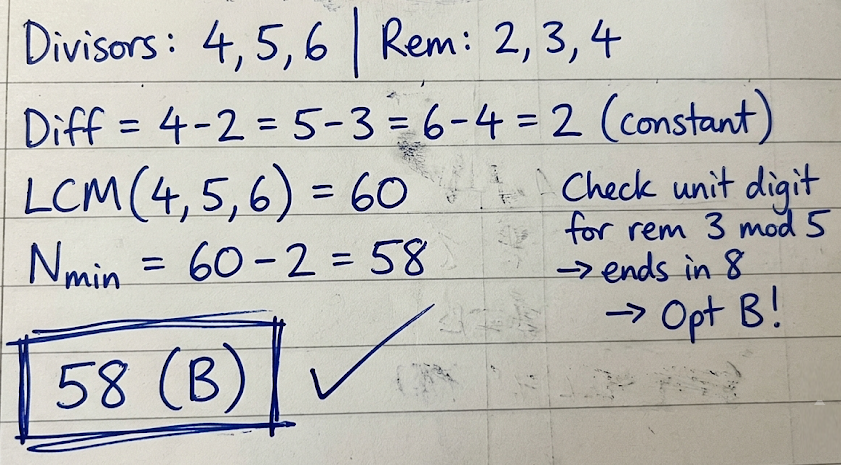
An arithmetic student encounters an unknown positive integer 'N'. The mathematical parameters state that when this specific integer 'N' is successively divided by the numbers 4, 5, and 6, the respective remainders generated are consistently observed to be 2, 3, and 4. What is the absolute least possible numerical value that such an integer 'N' can hold?

  • A.

    56

  • B.

    58

    ✓ Correct
  • C.

    62

  • D.

    64

Answer & Solution

Correct option is B

Given:
Divisors = 4, 5, and 6
Respective remainders observed = 2, 3, and 4
Formula Used:
If an integer N leaves respective remainders r1,r2,r3 r_1, r_2, r_3​ when divided independently by divisors d1,d2,d3d_1, d_2, d_3​ and the numerical difference (di−ri) (d_i - r_i) ​is a uniform constant, then N = LCM(d1,d2,d3)(d_1, d_2, d_3)​ - constant.
Solution:
Verify the difference between each specific divisor and its corresponding observed remainder.
4 - 2 = 2
5 - 3 = 2
6 - 4 = 2
Because the difference forms a constant value of 2 across all given parameters, the absolute least possible numerical value for N equals the LCM of all divisors minus this constant.
LCM(4, 5, 6) = 60
N = 60 - 2
N = 58
Final Answer
So the correct answer is (b) 

Exam Hall Method: 

Q11.

An examination invigilator finds two answer sheet bundles, one containing 43 sheets and the other containing 91 sheets. She wants to distribute all the sheets from both bundles equally into the largest possible groups, with each group receiving the same number of sheets from each bundle and some sheets remaining in both cases. Find the greatest number of sheets in each group.

  • A.

    24

  • B.

    36

  • C.

    43

  • D.

    48

    ✓ Correct

Answer & Solution

Correct option is D

Given:
Number of sheets in the first bundle: 43
Number of sheets in the second bundle: 91
They are divided into groups of equal sizes, leaving the same remainder.
Formula Used:
The greatest number dividing given quantities leaving the same remainder is the Highest Common Factor (HCF) of their absolute differences.
Solution:
Find the absolute difference between the two numbers of sheets.
91 - 43 = 48
The greatest number of sheets in each group must divide this difference exactly.
Since there are only two bundles, the highest possible group size is the difference itself.
Group size = 48
Final Answer
So the correct answer is (d)

Q12.

Inside a highly secure server mainframe room, a network administrator monitors three distinct diagnostic warning lights mounted on a primary router. Due to their independent scanning cycles, the red light blinks exactly every 12 seconds, the blue light every 15 seconds, and the yellow light every 20 seconds. If a massive data surge causes all three lights to blink simultaneously at precisely 12:00:00 PM, at what exact timestamp will the three lights next blink together in perfect unison?

  • A.

    12:02:00 PM

  • B.

    12:01:00 PM

    ✓ Correct
  • C.

    12:01:30 PM

  • D.

    12:03:00 PM

Answer & Solution

Correct option is B

Given:
Red light blinking interval = 12 seconds
Blue light blinking interval = 15 seconds
Yellow light blinking interval = 20 seconds
Simultaneous blink timestamp = 12:00:00 PM
Formula Used:
Next simultaneous event occurs at the Least Common Multiple (LCM) of the intervals.
Solution:
Find the LCM of 12, 15, and 20.
Prime factorization:
12 = 222^2​ × 3
15 = 3 × 5
20 = 222^2​ × 5
LCM = 222^2​ × 3 × 5 = 60 seconds
60 seconds is exactly equal to 1 minute.
Next simultaneous blink timestamp = 12:00:00 PM + 1 minute = 12:01:00 PM
Final Answer
So the correct answer is (b)

Q13.

What is the HCF of  (429−16)(4^{29}-16)​ and (438−16)(4^{38}-16)​ ?

  • A.

    8

  • B.

    ​(49−1)(4^9-1)​​

  • C.

    ​(48−1)(4^8-1)​​

  • D.

    None of the above

    ✓ Correct

Answer & Solution

Correct option is D

Given
Expressions: (429−16)and(438−16)(4^{29} - 16) and (4^{38} - 16)​​

Formula Used
Factor out the common term.
HCF of  (am−1)(a^m - 1)  and (an−1) (a^n - 1) is aHCF(m,n)−1a^{HCF(m, n)} - 1​​
Solution
First expression: 429−16=16(427−1) 4^{29} - 16 = 16(4^{27} - 1)​​
Second expression: 438−16=16(436−1) 4^{38} - 16 = 16(4^{36} - 1)​​
Now we need HCF of 16(427−1)16(4^{27} - 1)​ and 16(436−1)16(4^{36} - 1)​​
HCF = 16×HCF(427−1,436−1)16 × HCF(4^{27} - 1, 4^{36} - 1)​​
Using the standard property, the HCF is 4HCF(27,36)−1. 4^{HCF(27, 36)} - 1.​​
HCF(27, 36) = 9.
HCF = 16(49−1)16(4^9 - 1)​​
Since 16(49−1)16(4^9 - 1)​ is not explicitly listed in options A, B, or C, the correct choice is None of the above.

Q14.

A farmer wants to plant 121 apple trees, 154 banana trees and 198 mango trees in equal rows. Also he wants to make distinct rows of trees (i.e. only one type of trees in one row). The minimum number of rows required are

  • A.

    41

  • B.

    42

  • C.

    43

    ✓ Correct
  • D.

    11

Answer & Solution

Correct option is C

Given
Apple trees = 121
Banana trees = 154
Mango trees = 198
Formula Used
For minimum rows, trees per row must be maximum, which is the HCF of the number of trees.
Total Rows = Sum of rows for each tree type.
Solution
Find HCF of 121, 154, and 198.
121 = 11 × 11
154 = 11 × 14
198 = 11 × 18
HCF = 11 (This is the number of trees in each row)
Number of rows for apple =  12111=11\frac{121}{11} = 11​

Number of rows for banana =  15411=14\frac{154}{11} = 14​

Number of rows for mango = 19811=18 \frac{198}{11} = 18​​
Total rows = 11 + 14 + 18 = 43

Q15.

The LCM and HCF of two positive numbers is 1000 and 50 respectively. Which of the following could be the pair of such numbers?

  • A.

    200 and 500

  • B.

    150 and 250

  • C.

    50 and 100

  • D.

    200 and 250

    ✓ Correct

Answer & Solution

Correct option is D

Given
LCM of two positive numbers = 1000
HCF of two positive numbers = 50
Formula Used
LCM(a, b) and HCF(a, b) properties.
The numbers must be multiples of their HCF.
Solution
Let's check the given options to see which pair yields an LCM of 1000 and HCF of 50.
Option A (200, 500): HCF = 100 (Incorrect)
Option B (150, 250): HCF = 50, LCM = 750 (Incorrect)
Option C (50, 100): HCF = 50, LCM = 100 (Incorrect)
Option D (200, 250): HCF = 50. Let's check LCM.
200 = 50 × 4
250 = 50 × 5
LCM = 50 × 4 × 5 = 1000 (Correct)