SSC CGL Time AND Work Questions with Detailed Solutions

Get SSC CGL Time AND Work Questions to prepare for your upcoming exam. Solve the most expected questions and detailed solutions that can be asked in the exam.

Important SSC CGL Time AND Work Questions

Q1.

P and Q together can complete a job in 16 days. Q and R together can complete it in 24 days, and R and P together can do it in 32 days. In how many days can P alone complete the job?

  • A.

    3012\frac12​ days

  • B.

    32 days

  • C.

    3825\frac{2}{5}​ days

    ✓ Correct
  • D.

    48 days

Answer & Solution

Correct option is C

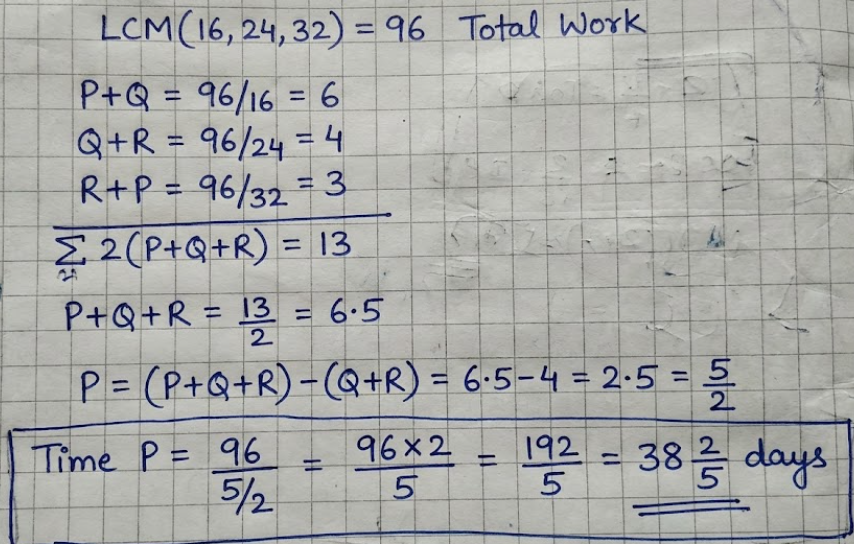
​Given:  P+Q=116  Q+R=124  R+P=132  Formula Used:  Work rate=1Time  Solution:  (p+q)+(q+r)+(r+p)=116+124+132  2(p+q+r)=6+4+396=1396  p+q+r=13192  p=13192−124  p=13−8192=5192  Time taken by P=1p=1925=3825days  Final Answer:  3825days\textbf{Given:}\\\ \, \\P+Q=\frac{1}{16}\\\ \, \\Q+R=\frac{1}{24}\\\ \, \\R+P=\frac{1}{32}\\\ \, \\\textbf{Formula Used:}\\\ \, \\\text{Work rate}=\frac{1}{\text{Time}}\\\ \, \\\textbf{Solution:}\\\ \, \\(p+q)+(q+r)+(r+p)=\frac{1}{16}+\frac{1}{24}+\frac{1}{32}\\\ \, \\2(p+q+r)=\frac{6+4+3}{96}=\frac{13}{96}\\\ \, \\p+q+r=\frac{13}{192}\\\ \, \\p=\frac{13}{192}-\frac{1}{24}\\\ \, \\p=\frac{13-8}{192}=\frac{5}{192}\\\ \, \\\text{Time taken by P}=\frac{1}{p}=\frac{192}{5}=38\frac{2}{5} \text{days}\\\ \, \\\textbf{Final Answer:}\\\ \, \\38\frac{2}{5} \text{days}

Exam - Hall Method: 

Q2.

X, Y, and Z can complete a project in 20, 40, and 60 days respectively. X works every day, while Y and Z join X every third day. How long will it take to finish the project?

  • A.

    1272\frac{7}2​ days

  • B.

    155615\frac56​ days

    ✓ Correct
  • C.

    1656\frac{5}6​ days

  • D.

    18 days

Answer & Solution

Correct option is B

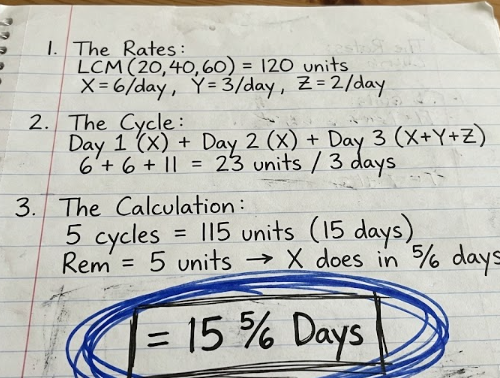
​Given:  X can do work in 20 days  Y can do work in 40 days  Z can do work in 60 days  X works every day  Y and Z work every third day  Formula Used:  Work per day=LCMDays  Solution:  LCM of 20,40,60=120  X=12020=6  Y=12040=3  Z=12060=2  Work in 3 days:  Day 1=6  Day 2=6  Day 3=6+3+2=11  Total in 3 days=23  Work in 15 days=5×23=115  Remaining work=120−115=5  Time for remaining work=56 day  Total time=15+56  =1556 days  Final Answer  1556 days\textbf{Given:} \\\ \, \\X \text{ can do work in } 20 \text{ days} \\\ \, \\Y \text{ can do work in } 40 \text{ days} \\\ \, \\Z \text{ can do work in } 60 \text{ days} \\\ \, \\X \text{ works every day} \\\ \, \\Y \text{ and } Z \text{ work every third day} \\\ \, \\\textbf{Formula Used:} \\\ \, \\\text{Work per day} = \frac{\text{LCM}}{\text{Days}} \\\ \, \\\textbf{Solution:} \\\ \, \\\text{LCM of } 20,40,60 = 120 \\\ \, \\X = \frac{120}{20} = 6 \\\ \, \\Y = \frac{120}{40} = 3 \\\ \, \\Z = \frac{120}{60} = 2 \\\ \, \\\text{Work in 3 days:} \\\ \, \\\text{Day 1} = 6 \\\ \, \\\text{Day 2} = 6 \\\ \, \\\text{Day 3} = 6 + 3 + 2 = 11 \\\ \, \\\text{Total in 3 days} = 23 \\\ \, \\\text{Work in 15 days} = 5 \times 23 = 115 \\\ \, \\\text{Remaining work} = 120 - 115 = 5 \\\ \, \\\text{Time for remaining work} = \frac{5}{6} \text{ day} \\\ \, \\\text{Total time} = 15 + \frac{5}{6} \\\ \, \\= 15\tfrac{5}{6} \text{ days} \\\ \, \\\textbf{Final Answer} \\\ \, \\15\tfrac{5}{6}\ \text{days} 
Exam Hall Method:

Q3.

X is able to complete a task in 12 days, while Y takes 18 days to finish the same task. If they collaborate and work together for 3 days, what fraction of the work will still remain?

  • A.

    1/3

  • B.

    5/12

  • C.

    7/12

    ✓ Correct
  • D.

    9/12

Answer & Solution

Correct option is C

​Given:X completes work in 12 daysY completes work in 18 daysThey work together for 3 daysConcept Used:Work and timeFormula Used:Work per day=1Number of daysTotal work=Daily work×TimeSolution:Work by X in one day=112Work by Y in one day=118Combined work in one day=112+118=3+236=536Work done in 3 days=3×536=1536=512Remaining work=1−512=712Final Answer:712\textbf{Given:}\\\text{X completes work in } 12 \text{ days}\\\\\text{Y completes work in } 18 \text{ days}\\\\\text{They work together for } 3 \text{ days}\\\\\textbf{Concept Used:}\\\text{Work and time}\\\\\textbf{Formula Used:}\\\text{Work per day} = \frac{1}{\text{Number of days}}\\\\\text{Total work} = \text{Daily work} \times \text{Time}\\\\\textbf{Solution:}\\\text{Work by X in one day} = \frac{1}{12}\\\\\text{Work by Y in one day} = \frac{1}{18}\\\\\text{Combined work in one day} = \frac{1}{12} + \frac{1}{18}\\\\= \frac{3 + 2}{36} = \frac{5}{36}\\\\\text{Work done in 3 days} = 3 \times \frac{5}{36} = \frac{15}{36} = \frac{5}{12}\\\\\text{Remaining work} = 1 - \frac{5}{12} = \frac{7}{12}\\\\\textbf{Final Answer:}\\\frac{7}{12}​​

Q4.

Three pumps, A, B, and C are capable of filling a reservoir. A fills in 5 hours, B in 7 hours, and C in 10 hours. When all three pumps are opened together, they operate for 1.5 hours before pump C is closed. How much additional time will it take to completely fill the reservoir after that?

  • A.

    1/2 hours

  • B.

    43/25 hours

  • C.

    47/48 hours

    ✓ Correct
  • D.

    45/41 hours

Answer & Solution

Correct option is C

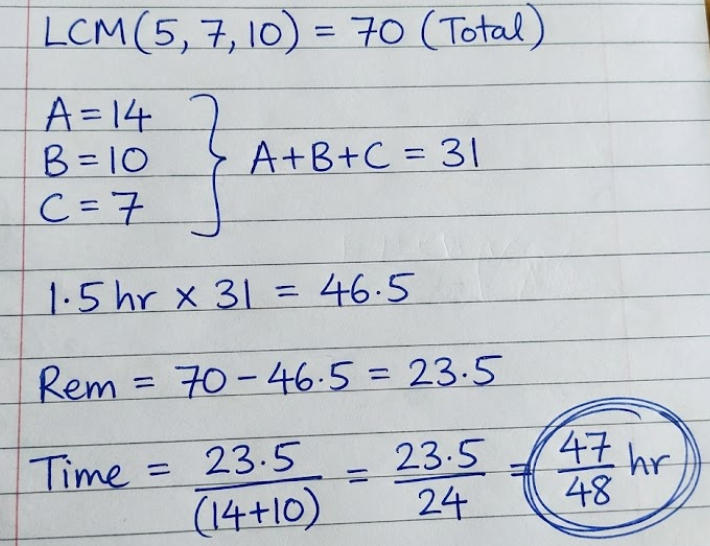
​Given:A fills in 5 hoursB fills in 7 hoursC fills in 10 hoursAll work for 1.5 hoursConcept Used:Work and timeFormula Used:Work per hour=1Time requiredWork done=Rate×TimeSolution:Rate of A=15 Rate of B=17 Rate of C=110 Combined rate=15+17+110=3170 Work done in 32 hours=3170×32=93140 Remaining work=1−93140=47140 Rate of A and B=15+17=1235 Time required=471401235=4748 Final Answer:4748 hours\textbf{Given:}\\A \text{ fills in } 5 \text{ hours}\\\\B \text{ fills in } 7 \text{ hours}\\\\C \text{ fills in } 10 \text{ hours}\\\\\text{All work for } 1.5 \text{ hours}\\\\\textbf{Concept Used:}\\\text{Work and time}\\\\\textbf{Formula Used:}\\\text{Work per hour} = \frac{1}{\text{Time required}}\\\\\text{Work done} = \text{Rate} \times \text{Time}\\\\\textbf{Solution:}\\\text{Rate of A} = \frac{1}{5}\\\\ \ \\\text{Rate of B} = \frac{1}{7}\\\\ \ \\\text{Rate of C} = \frac{1}{10}\\\\ \ \\\text{Combined rate} = \frac{1}{5} + \frac{1}{7} + \frac{1}{10} = \frac{31}{70}\\\\ \ \\\text{Work done in } \frac{3}{2} \text{ hours} = \frac{31}{70} \times \frac{3}{2} = \frac{93}{140}\\\\ \ \\\text{Remaining work} = 1 - \frac{93}{140} = \frac{47}{140}\\\\ \ \\ \text{Rate of A and B} = \frac{1}{5} + \frac{1}{7} = \frac{12}{35}\\\\ \ \\\text{Time required} = \frac{\frac{47}{140}}{\frac{12}{35}} = \frac{47}{48}\\\\ \ \\\textbf{Final Answer:}\\\frac{47}{48} \text{ hours}

Exam Hall Method: 

Q5.

The ratio of the time taken by A and B to complete a task is 3 : 2. If B can complete the task alone in 18 hours, how many hours will they take to complete the task if they work together?

  • A.

    12 hours

  • B.

    10.8 hours

    ✓ Correct
  • C.

    9.8 hours

  • D.

    10 hours

Answer & Solution

Correct option is B

Given:

Time ratio A : B = 3 : 2.
B alone takes 18 hours.

​Solution:​

Find A’s time using ratio
​TATB=32\frac{T_A}{T_B} = \frac{3}{2}​​

​TB=18T_B = 18 (given)

​TA=32×18=27 hoursT_A = \frac{3}{2} \times 18 = 27 \text{ hours}​​

Combined rate:
​127+118=254+354=554\frac{1}{27} + \frac{1}{18} = \frac{2}{54} + \frac{3}{54} = \frac{5}{54}​​

Time together:
​T=545=10.8 hoursT = \frac{54}{5} = 10.8 \text{ hours}​​

They take 10.8 hours together.

Q6.

A alone can complete a job in 12 days and B alone in 18 days. A and B agree to do the work for ₹ 7,200. With C’s help they finish it in 5 days. How much should C be paid?

  • A.

    ₹2,200

    ✓ Correct
  • B.

    ₹2,400

  • C.

    ₹2,600

  • D.

    ₹2,800

Answer & Solution

Correct option is A

Given:

A alone completes the job in 12 days.
B alone completes the job in 18 days.
A, B and C together finish the job in 5 days.
Total payment = ₹7,200.
Find C’s share.

Solution:
​RateA=112,RateB=118\text{Rate}_A=\frac{1}{12},\quad \text{Rate}B=\frac{1}{18}​​

​RateA+B=112+118=536\text{Rate}{A+B}=\frac{1}{12}+\frac{1}{18}=\frac{5}{36}​

​RateC=15−536\text{Rate}_C=\frac{1}{5}-\frac{5}{36}​​=36−25180=11180=\frac{36-25}{180}=\frac{11}{180}​​

Work done in 5 days:

​WorkA=112×5=512=1536\text{Work}_A=\frac{1}{12}\times5=\frac{5}{12}=\frac{15}{36}​​

​WorkB=118×5=518=1036\text{Work}_B=\frac{1}{18}\times5=\frac{5}{18}=\frac{10}{36}​

​WorkC=11180×5=55180=1136\text{Work}_C=\frac{11}{180}\times5=\frac{55}{180}=\frac{11}{36}​​

C’s share of the payment:
​C’s share=11361×7200=11×720036\text{C's share}=\frac{\frac{11}{36}}{1}\times 7200=\frac{11\times7200}{36}​​
= 2200

C should be paid ₹2,200.

Q7.

Rani and Adya, working separately, can finish a task in 12 days and 16 days ,respectively. They work in stretches of one day alternately. If Rani starts working first,then the task will be completed in

  • A.

    ​1213 days12\frac{1}{3}\space\text{days}​​

  • B.

    ​1323 days13\frac{2}{3}\space\text{days}​​

    ✓ Correct
  • C.

    ​1313 days13\frac{1}{3}\space\text{days}​​

  • D.

    ​1223 days12\frac{2}{3}\space\text{days}​​

Answer & Solution

Correct option is B

Given:

Rani alone can complete the task in 12 days.

Adya alone can complete the task in 16 days.

Solution:

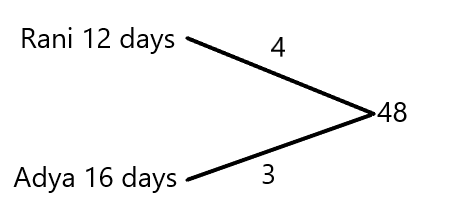
Work done by Rani in one day = 4 units

Work done by Adya in one day = 3 units

Total Work done by Rani and Adya alternately in 2 days = 4 + 3 = 7 units

In 2 days, 7 unit of work is completed

So, in 12 days, 42 unit of work is completed.

Remaining Work = 48 - 42 = 6 unit

Now, 6 unit of work done have to be completed by Rani and Adya

First 4 unit of work done by Rani.

So, in 13 days, 46 unit of work is completed.

So, Time taken by Adya to complete the remaining work = 23\frac23​​

Total time = 13+23=132313 + \frac23 = 13\frac23days ​

Q8.

Pipe Q can fill the tank in 60 hours while pipe R may fill in 45 hours. Q and R pipes are opened together for 6 hours after which pipe W is also opened to empty the tank. All three pipes are opened simultaneously for 24 hours to reach the half level mark. How much time (in hours) will pipe W alone take to empty the entire tank.

  • A.

    48

  • B.

    42

  • C.

    36

    ✓ Correct
  • D.

    30

Answer & Solution

Correct option is C

Given Data:

Pipe Q fills the tank in 60 hours.

Pipe R fills the tank in 45 hours.

Pipes Q and R are opened together for 6 hours.

Pipe W is then opened, and all three pipes work for 24 hours to fill half of the tank.

Solution:

We need to determine the time taken by pipe W alone to empty the entire tank.

LCM(60,45)=180 units (Let total tank capacity be 180 units)

Work Done by Each Pipe per Hour

Pipe Q's filling rate: = 18060 \frac{180}{60}​ = 3  units/hour

Pipe R's filling rate: 18045\frac{180}{45}​ = 4 units/hour

Let Pipe W's emptying rate be x units/hour.

Work Done by Pipes Q and R in 6 Hours

For the first 6 hours, only pipes Q and R are open.

(3+4)×6=7×6=42 units

After 6 hours, 42 units of water are filled.

Work Done by All Three Pipes in 24 Hours

After 6 hours, pipe W is also opened, and all three pipes operate for 24 hours to reach half of the tank.

Half of the tank = 1802\frac{180}{2}​ = 90 units

Total work already done = 42 units
Additional work required = 90−42=48 units

Since pipes Q, R, and W are all open during these 24 hours, their combined rate must fill 48 units in 24 hours.

Thus, the effective rate of all three pipes together:

(3+4−x)×24=48= 48

(7−x)×24=48

​7−x=4824=27−x= \frac{48}{24} = 2​​

x=7−2=5 units\hour

So, pipe W empties 5 units per hour.

Time Taken by Pipe W Alone to Empty the Tank

Total capacity of the tank = 180 units
Pipe W’s rate = 5 units/hour

Time = 1805\frac{180}{5} ​= 36 hours

Pipe W alone will take 36 hours to empty the entire tank.

Q9.

One pipe can fill a tank four times as fast as another pipe. If together the two pipes can fill the tank in 48 minutes, the slower pipe alone will be able to fill the tank in:

  • A.

    192 minutes

  • B.

    288 minutes

  • C.

    240 minutes

    ✓ Correct
  • D.

    144 minutes

Answer & Solution

Correct option is C

Given:

One pipe fills four times faster than the other.

Together, both pipes fill the tank in 48 minutes.

Concept Used:

The work done per minute by a pipe filling a tank in t minutes is 1t\frac{1}{t} ​(since it completes the tank in t minutes).

Solution:

Let the slower pipe take x minutes to fill the tank.

The faster pipe, being 4 times faster, will take x4\frac{x}{4}​ minutes.

Their combined work per minute is:1x+4x=5x \frac{1}{x} + \frac{4}{x} = \frac{5}{x}​

Given that together they fill the tank in 48 minutes: 5x=148\frac{5}{x} = \frac{1}{48}​

x = 5×48 5 \times 48​​

x = 240 minutes

Alternate Method: 

Suppose A is faster pipe , B is slower pipe.

A  = 4B

Efficiency ratio

​AB=41\frac{A}{B}=\frac{4}{1}

Total work = Efficiency ×\times Time

= 48 ×\times 5 = 240 unit 

Slower pipe(B) alone will be able to fill the tank in =  2401\frac{240}{1}  ​

= 240 minutes

​  


​​

Q10.

Pipe A can fill a cistern in 4 hours and Pipe B can fill the same cistern in 5 hours. Pipe C can empty a full cistern in 3 hours.If all three pipes are opened together, then the time (in minutes) taken to fill the tank is: (round to the nearest minute)

  • A.

    625

  • B.

    445

  • C.

    800

  • D.

    514

    ✓ Correct

Answer & Solution

Correct option is D

Given:

Pipe A fills the cistern in 4 hours.

Pipe B fills the cistern in 5 hours.

Pipe C empties the cistern in 3 hours.

Formula Used:

Work Rate = 1Time Taken\frac{1}{\text{Time Taken}}​​

Solution:

Work Rate of A = 14 \frac{1}{4}​ cistern per hour

Work Rate of B = 15 \frac{1}{5}​ cistern per hour

Work Rate of C = 13 \frac{1}{3}​ cistern per hour

Net Work Rate = 14+15−13\frac{1}{4} + \frac{1}{5} - \frac{1}{3}​​

= 15+12−2060 \frac{15 + 12 - 20}{60}​​

= 760\frac{7}{60}​​

Time Taken = 1760=607 hours=36007≈\frac{1}{\frac{7}{60}} = \frac{60}{7} \ hours = \frac{3600}{7} \approx ​514.29 minutes = 514 minutes

The time taken to fill the cistern is 514 minutes

Alternate Solution:

Total work = work rate × time

Total work = LCM of 4, 5 and 3 = 60

Work Rate of A = 604=15\frac{60}{4} = 15​​

Work Rate of B = 605=12\frac{60}{5} = 12​​

Work Rate of C(empty) = 603\frac{60}{3} ​= 20

Time taken to fill he cistern =6015+12–20=607 \frac{60}{15 + 12 – 20} = \frac{60}{7}​ = 514.29 minutes

Q11.

One pipe can fill a tank 6 times faster than another pipe. If both the pipes together can fill the tank in 40 minutes, then in howmany minutes will the slower pipe alone be able to fill the tank?

  • A.

    275

  • B.

    285

  • C.

    290

  • D.

    280

    ✓ Correct

Answer & Solution

Correct option is D

Given:

One pipe fills the tank 6 times faster than the other pipe.

Together, both pipes fill the tank in 40 minutes.

Formula Used:

Work Rate = 1Time Taken\frac{1}{\text{Time Taken}}​​

Solution:

Let the slower pipe fill the tank in x minutes.

The faster pipe fills the tank 6 times faster, so it fills the tank in x6\frac{x}{6}​ minutes.

Work rate of the slower pipe = 1x\frac{1}{x}​​

Work rate of the faster pipe = 6x \frac{6}{x}​​

Combined work rate:

​1x+6x=7x\frac{1}{x} + \frac{6}{x} = \frac{7}{x}​​

Together, they fill the tank in 40 minutes, so their combined work rate is:

​7x=140\frac{7}{x} = \frac{1}{40}​​

x = 7×407 \times 40​ = 280

The slower pipe alone will take 280 minutes to fill the tank.

Alternate Solution:

Total work = work rate × time

Work rate of first pipe = 6

Work rate of other pipe = 1

Combined work rate = 6 + 1 = 7

Total work = 7 × 40 = 280

So, the other pipe time to fill the tank;

= 2801=280 min \frac{280}{1} = 280 \ min​​

Q12.

Three pipes, P, Q and R, together take four hours to fill a tank. All the three pipes were opened at the same time. After three hours, P was closed, and Q and R filled the remaining tank in two hours. How many hours will P alone take to fill the tank?

  • A.

    8

    ✓ Correct
  • B.

    10

  • C.

    12

  • D.

    9

Answer & Solution

Correct option is A

Given:

Three pipes P, Q, R together fill the tank in 4 hours.

After 3 hours, pipe P is closed.

Pipes Q and R fill the remaining tank in 2 hours.

Concept Used:

Work and Time Relation: If a pipe fills the tank in x hours, its work rate is 1x\frac{1}{x}​ (i.e., it fills 1x\frac{1}{x}​ of the tank per hour).

Total work done = 1 (full tank).

Formula Used:

Work done per hour = 1Time taken to fill the tank\frac{1}{\text{Time taken to fill the tank}}​

Solution:

Work done by P, Q, R together in 1 hour:

​14\frac{1}{4}​

Work done by P, Q, R in 3 hours:

3×14=343 \times \frac{1}{4} = \frac{3}{4}​

(So, 3/4th of the tank is filled in 3 hours.)

Remaining work to be done:

1−34=14 - \frac{3}{4} = \frac{1}{4}​

Pipes Q and R together fill the remaining 14\frac{1}{4}​ of the tank in 2 hours, so their combined work rate is:

​14÷2=18\frac{1}{4} \div 2 = \frac{1}{8}​

Work rate of PP:

Rate of P, Q, R - Rate of Q, R = 14−18=28−18=18\frac{1}{4} - \frac{1}{8} = \frac{2}{8} - \frac{1}{8} = \frac{1}{8}​

Time taken by PP alone to fill the tank:

Time = 1Rate of P=118=8 hours\frac{1}{\text{Rate of } P} = \frac{1}{\frac{1}{8}} = 8 \text{ hours}  

Alternate Method: 

Total work = 4 unit

​P+ Q + R = 4 hours 

P+ Q + R,  Efficiency = 1 

After 3 hours = 3×\times1 = 3

Remaining tank Efficiency = 4 - 3 = 1

Q + R  Done Remaining Work in 2 hours 

So,

​​Q + R  Efficiency = 12\frac12 

P Efficiency = 1- (Q + R) Efficiency

P Efficiency = 1−12=2−12=121-\frac12= \frac{2-1}2= \frac12 

P Done Hole Work Alone = 412=4×2=8\frac4{\frac12}= 4\times2 = 8​ hours


Q13.

A tank can be filled by pipe A in 4 hours and pipe B in 6 hours. At 8:00 a.m., pipe A was opened. At what time will the tank be filled if pipe B is opened at 9:00 a.m.?

  • A.

    10:16 a.m.

  • B.

    10:22 a.m.

  • C.

    10:48 a.m.

    ✓ Correct
  • D.

    10:18 a.m.

Answer & Solution

Correct option is C

Given:

Pipe A can fill the tank in 4 hours.

Pipe B can fill the tank in 6 hours.

Pipe A is opened at 8:00 a.m.

Pipe B is opened at 9:00 a.m.

Formula Used:

Rate of pipe A = 14 \frac{1}{4}​ tank/hour

Rate of pipe B = 16\frac{1}{6} ​tank/hour

Combined rate of A and B = 14+16\frac{1}{4} + \frac{1}{6}​​

Solution:

Work done by pipe A in the first hour (8:00 a.m. to 9:00 a.m.):

Work done = Rate of A×Time=14×1=14 tank\text{Rate of A} \times \text{Time} = \frac{1}{4} \times 1 = \frac{1}{4} \text{ tank}​​

Remaining work to fill the tank:

Remaining work = 1−14=34 tank1 - \frac{1}{4} = \frac{3}{4} \text{ tank}​​

Combined rate of pipes A and B:

Combined rate = 14+16=312+212=512 tank/hour\frac{1}{4} + \frac{1}{6} = \frac{3}{12} + \frac{2}{12} = \frac{5}{12} \text{ tank/hour}​​

Time taken to fill the remaining 34\frac{3}{4}​ tank with both pipes open:

Time = =34512=34×125=3620=1.8 hours = \frac{\frac{3}{4}}{\frac{5}{12}} = \frac{3}{4} \times \frac{12}{5} = \frac{36}{20} = 1.8 \text{ hours}​​

So, the total time taken after 9:00 a.m. is 1 hour and 48 minutes.

Total time taken to fill the tank:

8:00 a.m. + 2 hours and 48 minutes = 10:48 a.m.

Alternate Solution:

Total work = rate × time

Let the total work be 12 units (LCM of 4 and 6).

Rate of pipe A = 124\frac{12}{4}​ = 3 units/hour

Rate of pipe B = 126 \frac{12}{6} ​= 2 units/hour

Work done by pipe A in the first hour = 3 units

Remaining work = 12 - 3 = 9 units

Combined rate of A and B = 3 + 2 = 5 units/hour

Time taken to fill the remaining work = 95\frac{9}{5}​ = 1.8 hours = 1 hour and 48 minutes

Total time = 1 hour + 1 hour and 48 minutes = 2 hours and 48 minutes

Tank will be filled at 10:48 a.m.

Q14.

Pipes A and B can fill a tank in 6 hours and 8 hours, respectively. Both pipes are opened together for 3 hours. After that pipe A is closed, and B continues to fill the tank. In how many hours will the tank be filled?

  • A.

    2

  • B.

    4

    ✓ Correct
  • C.

    3

  • D.

    6

Answer & Solution

Correct option is B

Given:

Pipe A can fill the tank in 6 hours.

Pipe B can fill the tank in 8 hours.

Both pipes are opened together for 3 hours.

After 3 hours, pipe A is closed, and pipe B continues to fill the tank.

Solution:

Rate of pipe A = 16\frac{1}{6}​ tank/hour

Rate of pipe B = 18\frac{1}{8} tank/hour

Combined rate of A and B:

Combined rate = 16+18=424+324=724 tank/hour \frac{1}{6} + \frac{1}{8} = \frac{4}{24} + \frac{3}{24} = \frac{7}{24} \text{ tank/hour}​​

Work done in 3 hours:

Work done = 724×3=2124=78 tank\frac{7}{24} \times 3 = \frac{21}{24} = \frac{7}{8} \text{ tank}​​

Remaining work = 1−78=18 tank1 - \frac{7}{8} = \frac{1}{8} \text{ tank}​​

Time taken by pipe B to fill the remaining work:

Time = 1818=1 hour\frac{\frac{1}{8}}{\frac{1}{8}} = 1 \text{ hour}​​

Total time to fill the tank:

Total time = 3 hours+1 hour=4 hours3 \text{ hours} + 1 \text{ hour} = 4 \text{ hours}​​

Thus, The tank will be filled in 4 hours

Alternate Solution:

Total work done = Time × rate

Let the total work be 24 units (LCM of 6 and 8).

Rate of pipe A = 246\frac{24}{6}​ = 4 units/hour

Rate of pipe B = 248\frac{24}{8}​ = 3 units/hour

Combined rate of A and B = 4 + 3 = 7 units/hour

Work done in 3 hours = 7×37 \times 3 = 21 units

Remaining work = 24 - 21 = 3 units

Time taken by pipe B to fill the remaining work = 33\frac{3}{3}​ = 1 hour

Total time = 3 + 1 = 4 hours

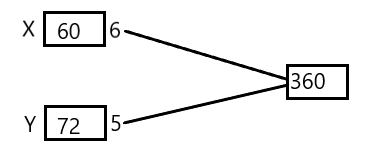
Q15.

Pipe X can fill a tank in 60 hours while pipe Y can fill the tank in 72 hours. Both pipes are opened together for 20 hours. How much of the tank is left empty?

  • A.

    ​18\frac{1}{8}​​

  • B.

    ​243360\frac{243}{360}​​

  • C.

    ​718\frac{7}{18}​​

    ✓ Correct
  • D.

    ​38\frac{3}{8}​​

Answer & Solution

Correct option is C

Given:

Pipe X can fill the tank in 60 hours.

Pipe Y can fill the tank in 72 hours.

Both pipes are opened together for 20 hours.

We need to determine how much of the tank is left empty after both pipes have been open for 20 hours.

Concept Used:

The rate of Pipe X is 160\frac{1}{60}​ of the tank per hour.

The rate of Pipe Y is 172\frac{1}{72}​ of the tank per hour.

Solution:

Combined Rate = 160+172\frac{1}{60} + \frac{1}{72}​

LCM of 60 and 72 = 360

​160=6360,172=5360\frac{1}{60} = \frac{6}{360}, \quad \frac{1}{72} = \frac{5}{360}​

​6360+5360=11360\frac{6}{360} + \frac{5}{360} = \frac{11}{360}​

Amount filled = 20 ×11360=220360=1118\times \frac{11}{360} = \frac{220}{360} = \frac{11}{18}​

Amount left empty = 1−1118=1818−1118=7181 - \frac{11}{18} = \frac{18}{18} - \frac{11}{18} = \frac{7}{18}  

Alternate Method: 

Efficiency Both = 6 + 5 = 11 

11×\times20 = 220

Remaining = 360 - 220 = 140 

Remaining Empty = 140360=1436=718\frac{140}{360}= \frac{14}{36} = \frac7{18}​​