Three solutions contain acid and water in the ratios 1:2, 2:3, and 3:2 respectively. Equal quantities of the first two solutions and twice the quantity of the third solution are mixed together. What is the ratio of acid to water in the final mixture?
Answer & Solution
Correct option is A
Given:
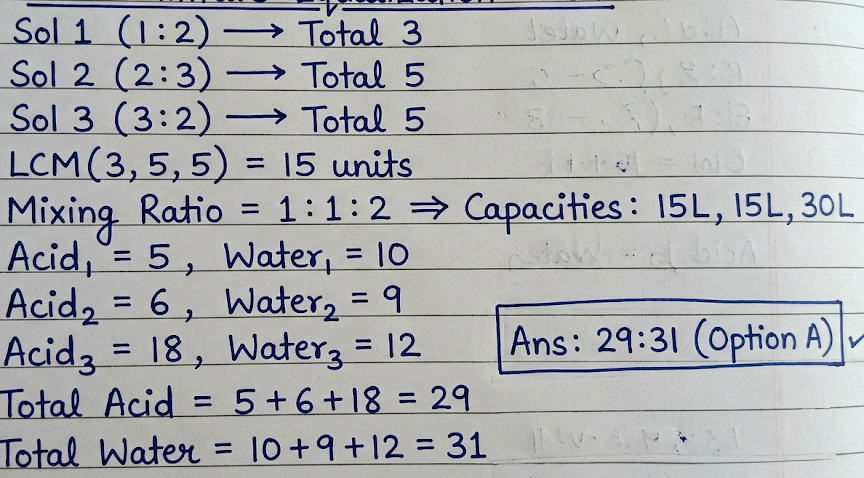
Ratio of acid to water in Solution 1 = 1:2 (Total 3 parts)
Ratio of acid to water in Solution 2 = 2:3 (Total 5 parts)
Ratio of acid to water in Solution 3 = 3:2 (Total 5 parts)
Mixing proportion: 1 part of Solution 1, 1 part of Solution 2, and 2 parts of Solution 3.
Formula Used:
Amount of component = × Volume
Solution:
To avoid fractions, assume the base volume for 1 unit is the Least Common Multiple of the sum of the ratio parts (3, 5, and 5).
LCM(3, 5) = 15 liters.
Quantity of Solution 1 taken = 15 liters.
Acid in Solution 1 = × 15 = 5 liters.
Water in Solution 1 = × 15 = 10 liters.
Quantity of Solution 2 taken = 15 liters.
Acid in Solution 2 = × 15 = 6 liters.
Water in Solution 2 = × 15 = 9 liters.
Quantity of Solution 3 taken = 2 × 15 = 30 liters.
Acid in Solution 3 = × 30 = 18 liters.
Water in Solution 3 = × 30 = 12 liters.
Calculate the total volumes of acid and water:
Total Acid = 5 + 6 + 18 = 29 liters.
Total Water = 10 + 9 + 12 = 31 liters.
The final ratio of acid to water is 29:31.
Final Answer
So the correct answer is (a)
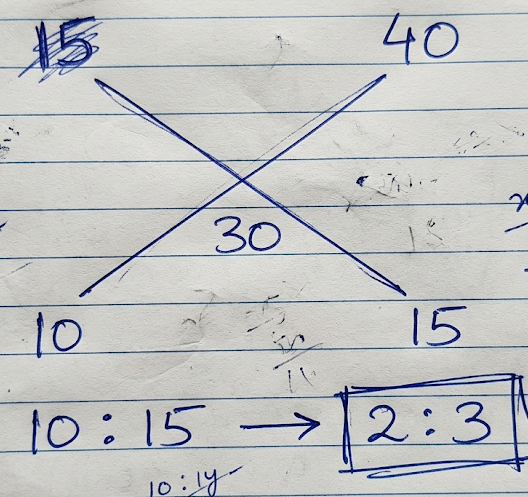
Exam Hall Method: