SSC CGL Height AND Distance Questions with Detailed Solutions

Get SSC CGL Height AND Distance Questions to prepare for your upcoming exam. Solve the most expected questions and detailed solutions that can be asked in the exam.

Important SSC CGL Height AND Distance Questions

Q1.

A man standing on the deck of a ship (25 m above water level) observes the angle of elevation of the top of a cliff as 60° and the angle of depression of the base as 30°. Find the height of the cliff.

  • A.

    90 m

  • B.

    100 m

    ✓ Correct
  • C.

    103.92 m

  • D.

    152 m

Answer & Solution

Correct option is B

Given
Height of the deck (h) = 25 m
Angle of elevation of cliff top = 60°
Angle of depression of cliff base = 30°
Formula Used
​tan⁡(θ)=PerpendicularBase\tan(θ) = \frac{\text{Perpendicular}}{\text{Base}}​​
Solution
Let the horizontal distance from the ship to the cliff be x meters.
From the angle of depression:
​tan⁡(30°)=25x 13=25x=>x=253m\tan(30°) = \frac{25}{x} \\\ \\\frac{1}{\sqrt{3}} = \frac{25}{x} => x = 25\sqrt{3} m​​

Let the height of the cliff above the deck level be H.
From the angle of elevation:
​tan⁡(60°)=Hx 3=H253\tan(60°) = \frac{H}{x} \\\ \\\sqrt{3} = \frac{H}{25\sqrt{3}}​​

H = 25 × 3 = 75 m
Total height of the cliff = H + h = 75 + 25 = 100 m
Final Answer
So the correct answer is (b)
Q2.

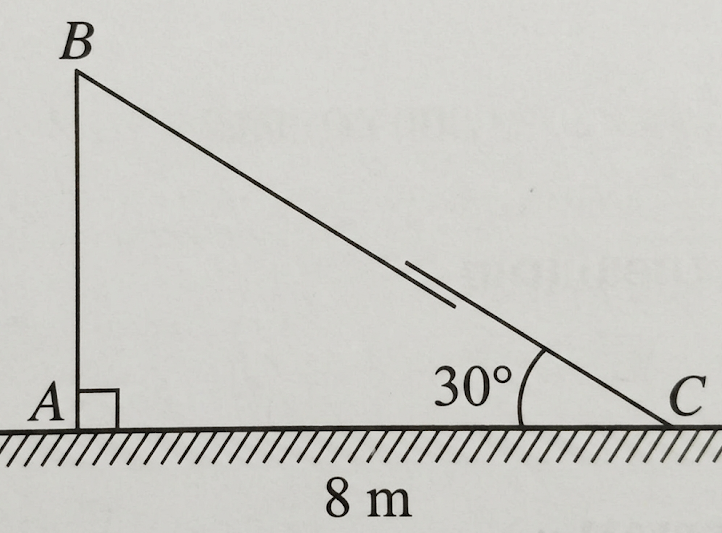
During a storm, a tree standing vertically on level ground got broken in such a manner that the upper broken part of the tree bent over and touched the ground at a point 8 metres away from the base of the tree, without getting detached from the stump. A gardener inspecting the damage notices that the broken upper part makes an angle of 30° with the level ground. The gardener needs to report the original height of the tree to the horticulture department so that a replacement of equal height can be arranged. What was the original height of the tree?

  • A.

    8√3 m

    ✓ Correct
  • B.

    6√3 m

  • C.

    12√3 m

  • D.

    10√3 m

Answer & Solution

Correct option is A

Given:
Distance from the base of the tree to the point where the top touches the ground = 8 m
Angle made by the broken part with the ground = 30°
Formula Used:
​tan⁡(30∘)=PerpendicularBase\tan(30^\circ) = \frac{Perpendicular}{Base}​​
​cos⁡(30∘)=BaseHypotenuse\cos(30^\circ) = \frac{Base}{Hypotenuse}​​
Solution: 

Let the height of the standing stump be h and the length of the broken bent part be x.
Total original height of the tree = h + x
Using the tangent ratio for the stump height:
​tan⁡(30∘)=h8\tan(30^\circ) = \frac{h}{8}​​
​13=h8\frac{1}{\sqrt{3}} = \frac{h}{8}​​
​h=83h = \frac{8}{\sqrt{3}}​​
Using the cosine ratio for the broken part:
​cos⁡(30∘)=8x\cos(30^\circ) = \frac{8}{x}​​
​32=8x\frac{\sqrt{3}}{2} = \frac{8}{x}​​
​x=163x = \frac{16}{\sqrt{3}}​​
Total height = h + x
Total height = 83+163=243 \frac{8}{\sqrt{3}} + \frac{16}{\sqrt{3}} = \frac{24}{\sqrt{3}}​ = 838\sqrt{3}​ m
Final Answer
So the correct answer is (a)

Q3.

A ladder 13 m long leans against a wall. The foot of the ladder is 5 m from the wall. What is sin⁡θ, where θ is the angle between the ladder and the ground?

  • A.

    5/13

  • B.

    12/13

    ✓ Correct
  • C.

    13/5

  • D.

    12/5

Answer & Solution

Correct option is B

Given
Length of ladder (Hypotenuse) = 13 m
Distance of foot from wall (Base) = 5 m
Angle between ladder and ground = θ

Formula Used
In a right-angled triangle, sin θ = PerpendicularHypotenuse\frac{Perpendicular}{Hypotenuse}​​
Perpendicular = Hypotenuse2−Base2\sqrt{Hypotenuse^2 - Base^2}​​

Solution
The ladder forms a right-angled triangle with the wall and the ground.
Perpendicular (height on the wall) =132−52=169−25=144=12 \sqrt{13^2 - 5^2} = \sqrt{169 - 25} = \sqrt{144} = 12​ m
We need to find sin θ, which is the ratio of Perpendicular to Hypotenuse.
sin θ =1213= \frac{12}{13}​​

Final Answer
So the correct answer is (b)
Q4.

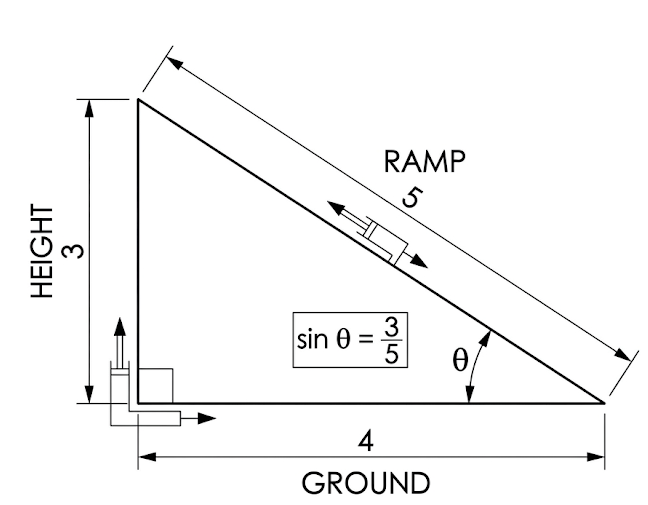
A structural engineering team is evaluating the optimal deployment angle for a heavy-duty hydraulic lifting ramp. The design specifications denote the ramp's inclination angle to the horizontal ground as θ\theta​. Telemetry sensors confirm that the sine of this crucial angle is exactly 3/5. To calibrate the hydraulic load sensors properly, the control software must process the sum of the secant and the tangent of this inclination angle. What is this computed value?

  • A.

    3

  • B.

    1.5

  • C.

    2.5

  • D.

    2

    ✓ Correct

Answer & Solution

Correct option is D

Given:
​sin⁡(θ)=35\sin(\theta) = \frac{3}{5}​​
Formula Used:
​sin⁡2(θ)+cos⁡2(θ)=1\sin^2(\theta) + \cos^2(\theta) = 1​​
​sec⁡(θ)=1cos⁡(θ)\sec(\theta) = \frac{1}{\cos(\theta)}​​
​tan⁡(θ)=sin⁡(θ)cos⁡(θ)\tan(\theta) = \frac{\sin(\theta)}{\cos(\theta)}​​
Solution:  

In a right-angled triangle, if perpendicular is 3 and hypotenuse is 5, the base is 52−32=4 \sqrt{5^2 - 3^2} = 4​​
​cos⁡(θ)=45\cos(\theta) = \frac{4}{5}​​

​sec⁡(θ)=54\sec(\theta) = \frac{5}{4}​

​tan⁡(θ)=34\tan(\theta) = \frac{3}{4}​​
Sum = sec⁡(θ)+tan⁡(θ) \sec(\theta) + \tan(\theta)​​
Sum = 54+34=84 \frac{5}{4} + \frac{3}{4} = \frac{8}{4}​ = 2
Final Answer
So the correct answer is (d)

Q5.

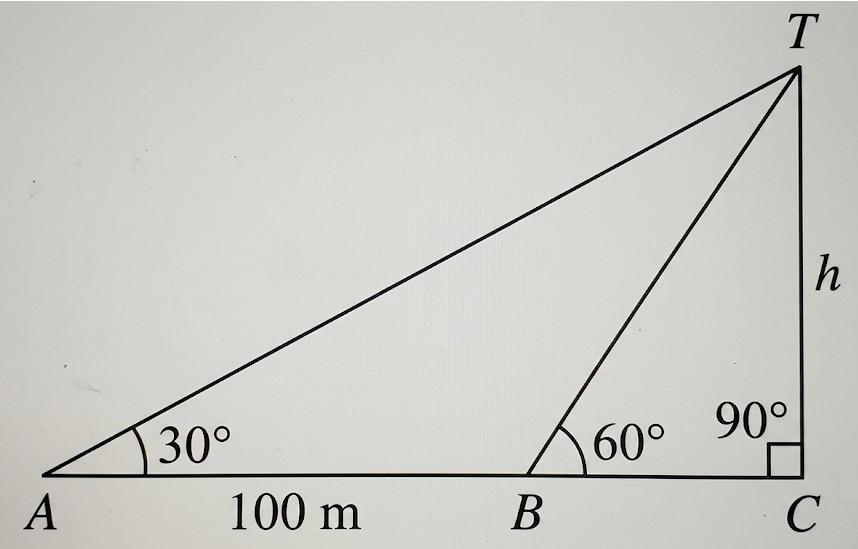
A civil engineering surveyor is utilizing a highly calibrated laser theodolite to ascertain the height of a newly erected cellular transmission mast. From his initial vantage point, the angle of elevation to the absolute top of the mast is 30 degrees. After marching exactly 100 meters forward in a straight line directly towards the base of the mast, the angle of elevation increases to 60 degrees. What is the true vertical height of the mast?

  • A.

    50350\sqrt 3​ meters

    ✓ Correct
  • B.

    1003100\sqrt 3​ meters

  • C.

    503\frac{50}{\sqrt 3}​ meters

  • D.

    75375\sqrt 3​ meters

Answer & Solution

Correct option is A

Given:
Initial angle of elevation θ1=30∘\theta_1 = 30^\circ​​
Final angle of elevation θ2=60∘\theta_2 = 60^\circ​​
Distance marched towards the mast d = 100 meters
Formula Used:
Height of the mast h = dcot⁡(θ1)−cot⁡(θ2)\frac{d}{\cot(\theta_1) - \cot(\theta_2)}​​
Solution: 

Let the height of the mast be h.
Substitute the values into the formula:
h = 100cot⁡(30∘)−cot⁡(60∘) \frac{100}{\cot(30^\circ) - \cot(60^\circ)}​​

h = 1003−13\frac{100}{\sqrt{3} - \frac{1}{\sqrt{3}}}​​

h = 1003−13 \frac{100}{\frac{3 - 1}{\sqrt{3}}}​​

h = 10023 \frac{100}{\frac{2}{\sqrt{3}}}​​
h = 50350 \sqrt{3}​ meters
Final Answer
So the correct answer is (a)

Q6.

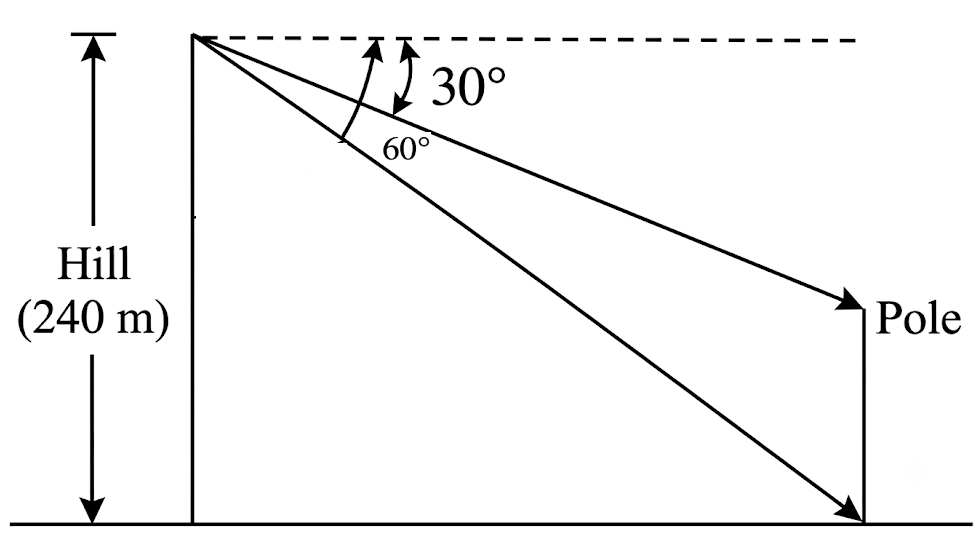
From the top of a hill 240 metres high, the angles of depression of the top and bottom of a pole are 30° and 60°, respectively. The difference (in metres) between the height of the pole and its distance from the hill is:

  • A.

    120(2 - √3)

  • B.

    120(√3 - 1)

  • C.

    80 (√3 - 1)

  • D.

    80(2 - √3)

    ✓ Correct

Answer & Solution

Correct option is D

Given:
Height of the hill = 240 m.
Angle of depression to the top of the pole = 30∘30^\circ​​
Angle of depression to the bottom of the pole = 60∘60^\circ​​
Formula Used:
​tan⁡θ=PerpendicularBase\tan \theta = \frac{\text{Perpendicular}}{\text{Base}}​​
Solution: 

Let the height of the pole be h and the horizontal distance between the hill and the pole be d.
From the right-angled triangle formed with the bottom of the pole:
​tan⁡60∘=240d\tan 60^\circ = \frac{240}{d}​​
​3=240d=>d=2403=803m\sqrt{3} = \frac{240}{d} \Rightarrow d = \frac{240}{\sqrt{3}} = 80\sqrt{3} m​​
From the right-angled triangle formed with the top of the pole:
​tan⁡30∘=240−hd\tan 30^\circ = \frac{240 - h}{d}​​

​13=240−h803\frac{1}{\sqrt{3}} = \frac{240 - h}{80\sqrt{3}}​​
​240−h=80=>h=160m240 - h = 80 \Rightarrow h = 160 m​​
The difference between the height of the pole and its distance from the hill is:
h−d=160−803=80(2−3)h - d = 160 - 80\sqrt{3} = 80(2 - \sqrt{3})​ m
Final Answer
So the correct answer is (d)

Q7.

A ladder is leaning against a wall makes an angle ‘x’ with the horizontal ground such that tan x = 192/80. If the length of the ladder is 52 metres, then what is the distance (in metres) of the foot of the ladder from the wall?

  • A.

    20 metres

    ✓ Correct
  • B.

    15 metres

  • C.

    30 metres

  • D.

    40 metres

Answer & Solution

Correct option is A

Given
Length of ladder (Hypotenuse) = 52 metres
tan x = 19280=125 \frac{192}{80} = \frac{12}{5}​​
Formula Used
​tan⁡x=PerpendicularBase Hypotenuse=Perpendicular2+Base2\tan x = \frac{\text{Perpendicular}}{\text{Base}} \\\ \\ \text{Hypotenuse} = \sqrt{\text{Perpendicular}^2 + \text{Base}^2}​​
Solution
Let the Perpendicular be 12k and the Base (distance from wall) be 5k.
Using Pythagoras theorem:
Hypotenuse = (12k)2+(5k)2 \sqrt{(12k)^2 + (5k)^2}​​
Hypotenuse = 144k2+25k2=169k2=13k \sqrt{144k^2 + 25k^2} = \sqrt{169k^2} = 13k​​
We are given that the length of the ladder is 52 metres.
13k = 52
k = 4
Distance of the foot of the ladder from the wall (Base) = 5k = 5 × 4 = 20 metres
Final Answer
So the correct answer is (a)

Q8.

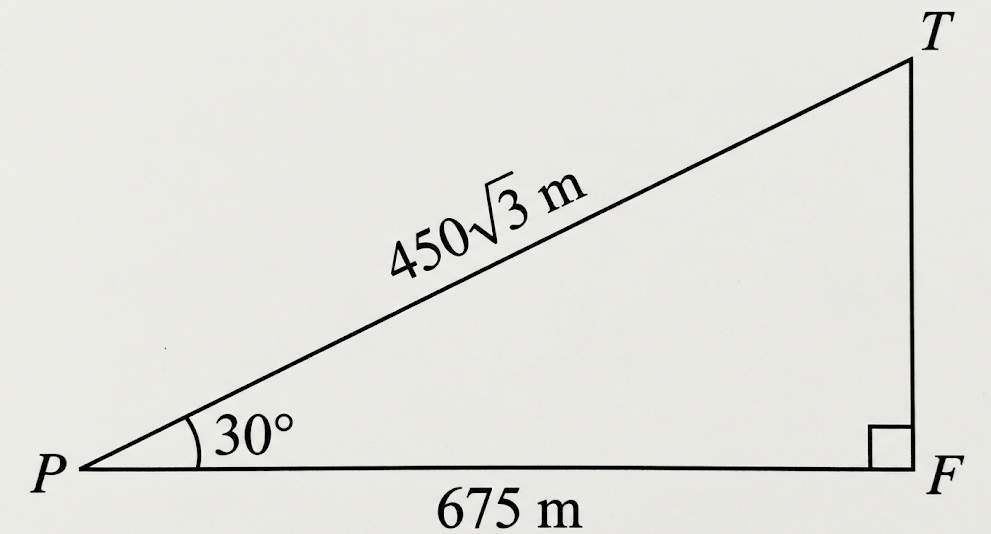
From point P on the ground, a long metallic cable is laid to the top of a cliff, making an angle of 30° with the ground such that the length of the cable laid is 450√3 metres. Find the distance between point P and the foot of the cliff.​

  • A.

    580 metres​

  • B.

    625 metres​

  • C.

    675 metres​

    ✓ Correct
  • D.

    560 metres​

Answer & Solution

Correct option is C

Given:
Angle of elevation = 30∘30^{\circ}​​
Length of the cable (Hypotenuse) = 4503450\sqrt{3}​ m
Formula Used:
​cos⁡θ=BaseHypotenuse\cos \theta = \frac{Base}{Hypotenuse}​​
Solution: 

Let the distance between point P and the foot of the cliff be the Base.
​cos⁡30∘=Base4503\cos 30^{\circ} = \frac{Base}{450\sqrt{3}}​​

Since  cos⁡30∘=32,\cos 30^{\circ} = \frac{\sqrt{3}}{2}, ​we have:
​32=Base4503\frac{\sqrt{3}}{2} = \frac{Base}{450\sqrt{3}}​​

Base = 4503×32 \frac{450\sqrt{3} × \sqrt{3}}{2}​

Base =450×32= \frac{450 × 3}{2}​ = 225 × 3 = 675 m
Final Answer
So the correct answer is (c)

Q9.

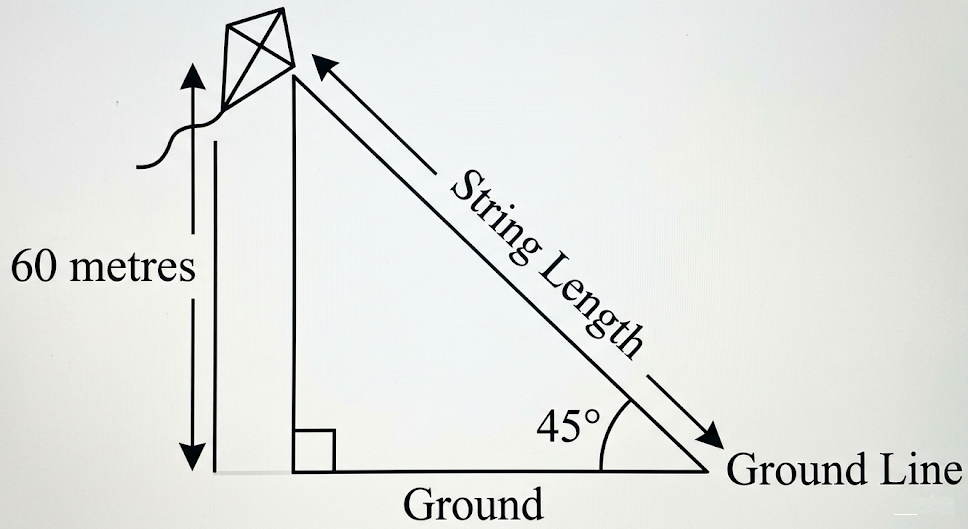
A kite flying at a height of 60 metres above the ground is attached to string that makes an angle of 45° with the ground. What is the length (in metres) of the string?

  • A.

    40√2 metres

  • B.

    60√2 metres

    ✓ Correct
  • C.

    70√2 metres

  • D.

    50√2 metres

Answer & Solution

Correct option is B

Given:
Height of kite = 60 metres
Angle of string with ground = 45°
Formula Used:
​sin⁡θ=HeightLength\sin \theta = \frac{Height}{Length}​​
Solution:  

​sin⁡45∘=60Length\sin 45^\circ = \frac{60}{Length}​​

​12=60Length\frac{1}{\sqrt{2}} = \frac{60}{Length}​​

Length = 602 60\sqrt{2}​ metres
Final Answer
So the correct answer is (b)
Q10.

The angle of elevation of a ladder leaning against a wall is 60∘ and the foot of the ladder is 4.6 m away from the wall. The length of the ladder is

  • A.

    2.3 m

  • B.

    4.6 m

  • C.

    7.8 m

  • D.

    9.2 m

    ✓ Correct

Answer & Solution

Correct option is D

Given:
Angle of elevation = 60∘ 60^{\circ}​​
Distance from foot of ladder to wall = 4.6 m
Formula Used:
​cos⁡(θ)=BaseHypotenuse\cos(\theta) = \frac{Base}{Hypotenuse}​​
Solution:
Let the length of the ladder be L (which acts as the hypotenuse of the right-angled triangle).
The distance from the wall is the base of the triangle.
​cos⁡(60∘)=4.6L\cos(60^{\circ}) = \frac{4.6}{L}​​
We know that cos⁡(60∘)\cos(60^{\circ})​ = 0.5
​0.5=4.6L0.5 = \frac{4.6}{L}​​
L = 4.60.5 \frac{4.6}{0.5}​​
L = 9.2 m
Final Answer
So the correct answer is (d)

Q11.

A man pulls a rope tied to a flagpole at ground level. The rope is 20 meters long and makes an angle of 60° with the ground. How high up the flagpole is the point where the rope is tied? Also, find the horizontal distance between the man and the base of the flagpole.

  • A.

    9.55 meters and 15 meters

  • B.

    11.45 meters and 16 meters

  • C.

    17.32 meters and 10 meters

    ✓ Correct
  • D.

    12.88 meters and 19 meters

Answer & Solution

Correct option is C

Given:
Length of the rope (Hypotenuse) = 20 meters
Angle with the ground = 60 degrees
Formula Used:
​sin⁡θ=PerpendicularHypotenuse\sin \theta = \frac{Perpendicular}{Hypotenuse}​​

​cos⁡θ=BaseHypotenuse\cos \theta = \frac{Base}{Hypotenuse}​​
Solution:
Let the height of the point on the flagpole be h and the horizontal distance be d.
Using trigonometry for height:
​h=20×sin⁡(60∘)h = 20 × \sin(60^\circ)​​
​h=20×32=103h = 20 × \frac{\sqrt{3}}{2} = 10\sqrt{3}​​
Since 3 \sqrt{3}​ is approximately 1.732:
h = 10 × 1.732 = 17.32
Now, find the horizontal distance:
d = 20×cos⁡(60∘)20 × \cos(60^\circ)​​
d = 20×12=1020 × \frac{1}{2} = 10​​
The height is 17.32 meters and the distance is 10 meters.
Final Answer
So the correct answer is (c)

Q12.

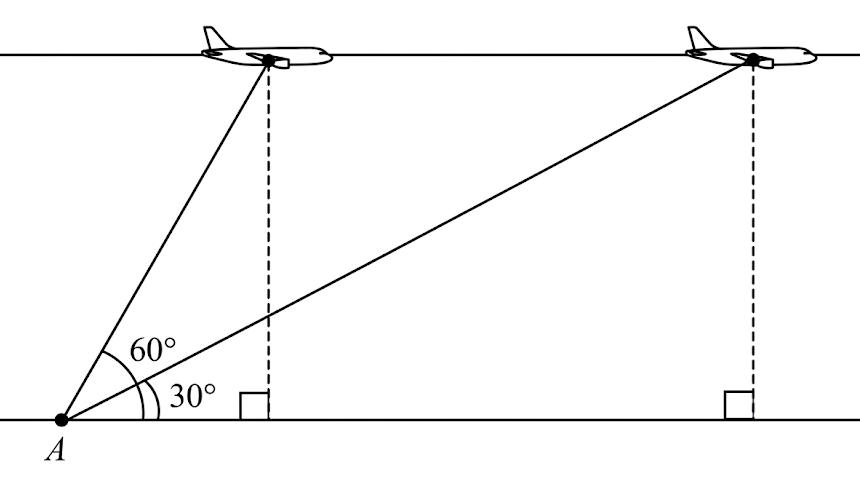
The angle of elevation of an aeroplane from point A on the ground is 60∘. After a flight of 15 seconds horizontally, the angle of elevation changes to 30∘. If the aeroplane is flying at a speed of 200 m/s, then the constant height at which the aeroplane is flying is:

  • A.

    1300√3 m

  • B.

    1500√3 m

    ✓ Correct
  • C.

    1500/√3 m

  • D.

    1300/√5 m

Answer & Solution

Correct option is B

Given:
Initial angle of elevation = 60∘60^{\circ}​​
Angle of elevation after 15 seconds = 30∘30^{\circ}​​
Speed of aeroplane = 200 m/s
Formula Used:
Distance = Speed × Time
tan⁡(θ)\tan(\theta)​ =  PerpendicularBase\frac{Perpendicular}{Base}​​
Solution: 

Distance travelled horizontally in 15 seconds = 200 × 15 = 3000 m.
Let the constant height be h and the initial horizontal distance be x.
​tan⁡(60∘)=hx ⟹ 3=hx ⟹ x=h3\tan(60^{\circ}) = \frac{h}{x} \implies \sqrt{3} = \frac{h}{x} \implies x = \frac{h}{\sqrt{3}}​​
​tan⁡(30∘)=hx+3000 ⟹ 13=hx+3000\tan(30^{\circ}) = \frac{h}{x + 3000} \implies \frac{1}{\sqrt{3}} = \frac{h}{x + 3000}​​
Substitute x into the second equation:
​x+3000=h3x + 3000 = h\sqrt{3}​​
​h3+3000=h3\frac{h}{\sqrt{3}} + 3000 = h\sqrt{3}​​
​3000=h3−h3=2h33000 = h\sqrt{3} - \frac{h}{\sqrt{3}} = \frac{2h}{\sqrt{3}}​​
h=15003h = 1500\sqrt{3}​ m
Final Answer
So the correct answer is (b)
Q13.

The angle of elevation of a tower from a point 120 m away is 45045^0​. Find the height of the tower.

  • A.

    100 m

  • B.

    150 m

  • C.

    120 m

    ✓ Correct
  • D.

    10

Answer & Solution

Correct option is C

Given
Distance from the tower = 120 m
Angle of elevation =45∘ 45^\circ​​

Formula Used
​tan⁡θ=PerpendicularBase\tan \theta = \frac{\text{Perpendicular}}{\text{Base}}​​

Solution
Let the height of the tower be h.
In the right-angled triangle formed:
​tan⁡(45∘)=h120 1=h120 h=120m \tan(45^\circ) = \frac{h}{120} \\\ \\1 = \frac{h}{120}\\\ \\h = 120 m\\\ \\
Final Answer
So the correct answer is (c)

Q14.

From a point 20 m above ground level on a vertical tower, the angle of depression of a point on the ground is 30. Find the distance from the base of the tower to that point.

  • A.

    10 m

  • B.

    34.64m

    ✓ Correct
  • C.

    110 m

  • D.

    90 m

Answer & Solution

Correct option is B

Given
Height of the observation point = 20 m
Angle of depression = 30∘30^\circ​​
Formula Used
​tan⁡θ=PerpendicularBase\tan \theta = \frac{\text{Perpendicular}}{\text{Base}}​​
Solution
The angle of elevation from the point on the ground to the observation point is equal to the angle of depression, which is 30^\circ.
Let the distance from the base be d.

tan⁡(30∘)=20d 13=20d d=203 \tan(30^\circ) = \frac{20}{d} \\\ \\\frac{1}{\sqrt{3}} = \frac{20}{d}\\\ \\d = 20\sqrt{3}\\\ \\​​
Using 3≈1.732:\sqrt{3} \approx 1.732:​​
​d=20×1.732=34.64md = 20 \times 1.732 = 34.64 m​​
Final Answer
So the correct answer is (b)
Q15.

A tower and a pole stand vertically. From a point between them on the ground, the angles of elevation of their tops are 45° and 30° respectively. If the pole is 20 m high, and the point is equidistant from both, find the height of the tower.

  • A.

    20 m

  • B.

    40 m

  • C.

    34.64 m

    ✓ Correct
  • D.

    90 m

Answer & Solution

Correct option is C

Given
Height of pole = 20 m
Angle of elevation of tower = 45°
Angle of elevation of pole = 30°
Point is equidistant from both
Formula Used
tan θ = PerpendicularBase\frac{Perpendicular}{Base}​​
Solution
Let the equidistant base from the point be x
For the pole:
​tan30°=20x 13=20xtan 30° = \frac{20}{x} \\\ \\\frac{1}{\sqrt{3}} = \frac{20}{x}​​
x = 203 20\sqrt{3}​ m
For the tower:
Let height of tower be h
tan45°=hx 1=h203 h=203m h=20×1.732=34.64m tan 45° = \frac{h}{x} \\\ \\1 = \frac{h}{20\sqrt{3}} \\\ \\h = 20\sqrt{3} m \\\ \\h = 20 × 1.732 = 34.64 m \\\ \\​
Final Answer
So the correct answer is (c)