SSC CGL Circle Questions with Detailed Solutions

Get SSC CGL Circle Questions to prepare for your upcoming exam. Solve the most expected questions and detailed solutions that can be asked in the exam.

Important SSC CGL Circle Questions

Q1.

Two circles of radii 6 cm and 4 cm touch externally. How many common tangents can be drawn?

  • A.

    1

  • B.

    2

  • C.

    3

    ✓ Correct
  • D.

    4

Answer & Solution

Correct option is C

Given
Radius 1 = 6 cm
Radius 2 = 4 cm
Circles touch externally.
Formula Used
When two circles touch each other externally, they have 3 common tangents (2 direct common tangents and 1 transverse common tangent).
Solution
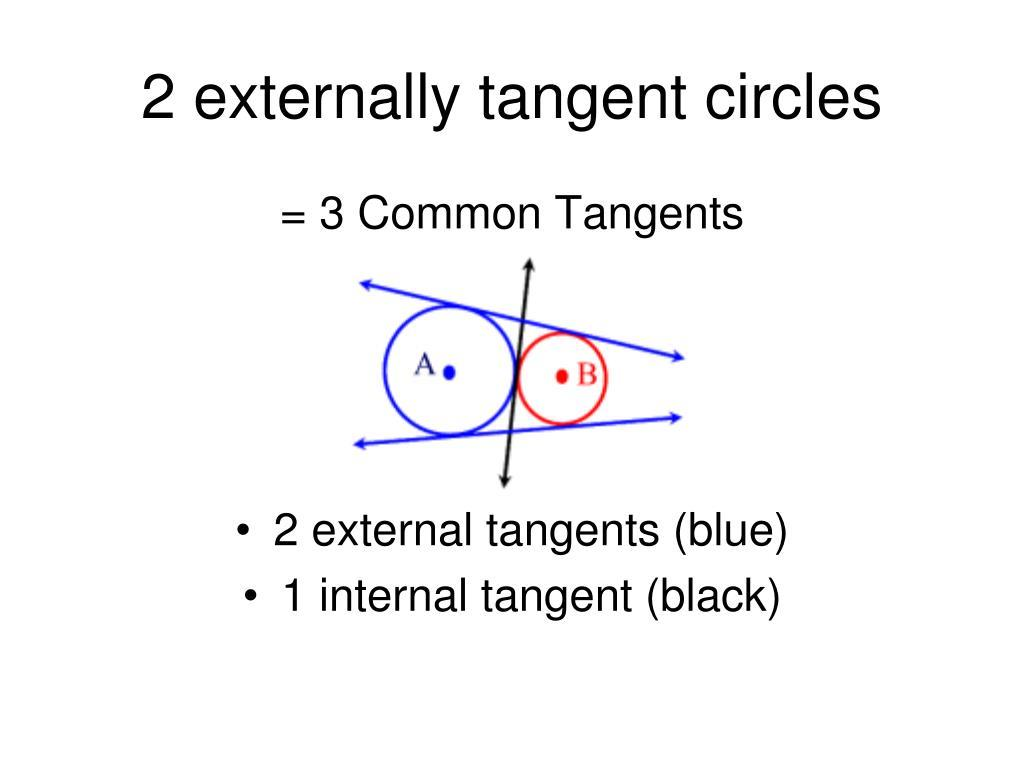
Since the circles touch externally at a single point, we can draw:
1. One transverse common tangent passing through the point of contact.
2. Two direct common tangents touching both circles on the outside.
Total number of tangents = 3.
​Final Answer
So the correct answer is (c)​

Q2.

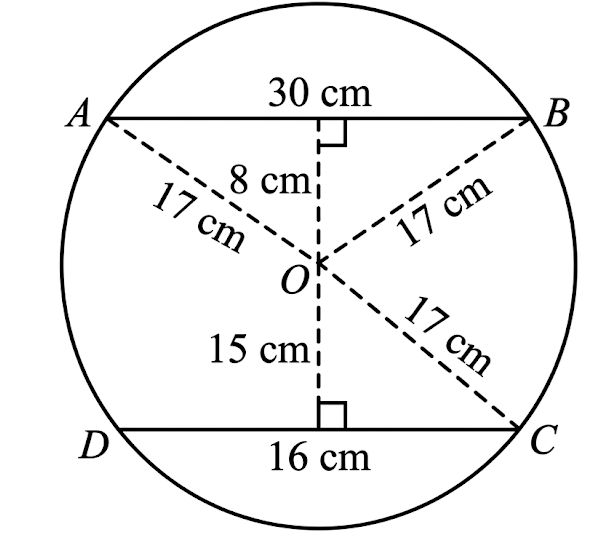
In a circle of radius 17 cm, two parallel chords are drawn on opposite sides of the centre. One chord is 16 cm long and the distance between them is 23 cm. Find the difference between the lengths of the two chords (in cm).

  • A.

    10 cm

  • B.

    14 cm

    ✓ Correct
  • C.

    18 cm

  • D.

    22 cm

Answer & Solution

Correct option is B

Given
Radius (r) = 17 cm
Length of first chord = 16 cm
Total distance between chords = 23 cm
Formula Used
Distance from centre to chord = r2−(half of chord)2\sqrt{r^2 - (\text{half of chord})^2}​​
Solution
Half of the first chord =162=8 = \frac{16}{2} = 8​ cm.
Distance of the first chord from the centre (d_1):
d1=172−82=289−64=225=15d_1 = \sqrt{17^2 - 8^2} = \sqrt{289 - 64} = \sqrt{225} = 15​ cm.
Since the chords are on opposite sides, the total distance is d1+d2=23. d_1 + d_2 = 23.​​
d2=23−15=8d_2 = 23 - 15 = 8​ cm.
Let the length of the second chord be 2x. Then half of the second chord is x.
x=r2−d22=172−82=289−64=225=15x = \sqrt{r^2 - d_2^2} = \sqrt{17^2 - 8^2} = \sqrt{289 - 64} = \sqrt{225} = 15​ cm.
Length of the second chord = 2 × 15 = 30 cm.
Difference in lengths = 30 - 16 = 14 cm.
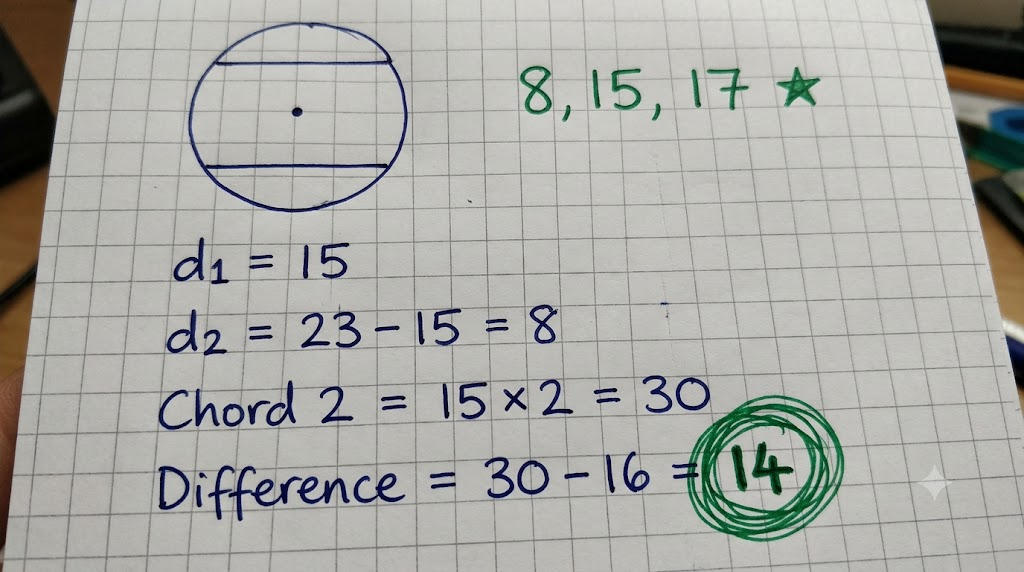
Exam Hall Approach: 
Spot the hidden Pythagorean Triplet! The radius is 17 and half of the first chord is 8 (16/2).
The standard triplet (8, 15, 17) means the first chord's distance from the center is 15.
The total distance between chords is 23, so the second chord must be 23 - 15 = 8 cm away from the center.
This simply flips the triplet! Half of the second chord is now 15, making its full length 15 \times 2 = 30
The difference between the two chords is 30 - 16 = 14 cm.

Q3.

Two circles have a common external tangent of length 9 and a common internal tangent of length 5. Find the product of the radii of the circles.

  • A.

    14

    ✓ Correct
  • B.

    15

  • C.

    17

  • D.

    18

Answer & Solution

Correct option is A

Given
Length of common external tangent = 9
Length of common internal tangent = 5
Formula Used
​Lext=d2−(R−r)2 Lint=d2−(R+r)2L_{ext} = \sqrt{d^2 - (R - r)^2} \\\ \\L_{int} = \sqrt{d^2 - (R + r)^2}​​
Solution
Square both formulas:
​Lext2=d2−(R−r)2 Lint2=d2−(R+r)2L_{ext}^2 = d^2 - (R - r)^2 \\\ \\L_{int}^2 = d^2 - (R + r)^2​​
Subtract the second equation from the first:
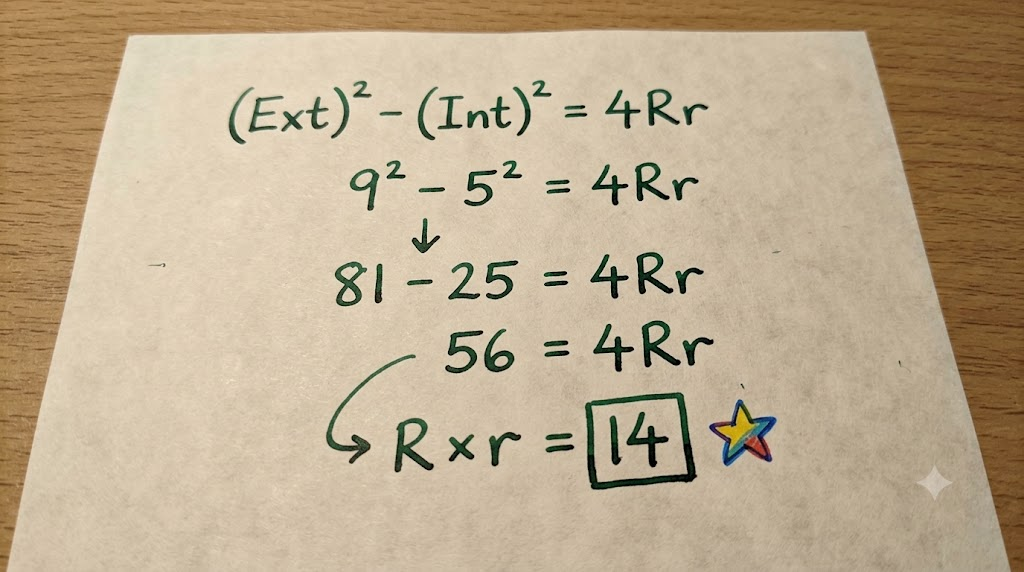
​Lext2−Lint2=(R+r)2−(R−r)2 Lext2−Lint2=4RrL_{ext}^2 - L_{int}^2 = (R + r)^2 - (R - r)^2 \\\ \\L_{ext}^2 - L_{int}^2 = 4Rr​​
Substitute the given values:
​92−52=4Rr81−25=4Rr56=4RrRr=564 Rr=149^2 - 5^2 = 4Rr \\81 - 25 = 4Rr\\56 = 4Rr\\ Rr = \frac{56}{4} \\\ \\Rr = 14​​
Final Answer
So the correct answer is (a)
Exam Hall Approach:

Q4.

A chord passes through the center of the circle. What is it called?

  • A.

    Radius

  • B.

    Diameter

    ✓ Correct
  • C.

    Tangent

  • D.

    Secant

Answer & Solution

Correct option is B

Given:
A chord passes through the center of the circle.
Solution:
A chord is a line segment whose endpoints lie on the circle. When a chord passes through the center, it becomes the longest possible chord in the circle, which is strictly defined as the diameter.
Final Answer
So the correct answer is (b)

Q5.

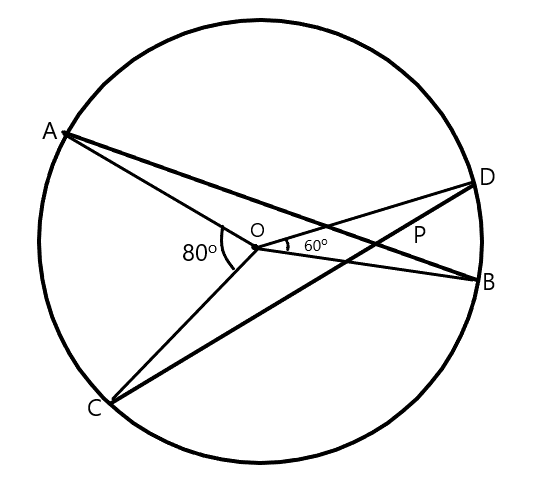
In a circle with center O, chords AB and CD intersect at point P. If ∠AOC = 80° and ∠BOD = 60°, what is the measure of ∠APC?

  • A.

    60°

  • B.

    70°

    ✓ Correct
  • C.

    80°

  • D.

    90°

Answer & Solution

Correct option is B

Given:
Chords AB and CD intersect at point P.
∠AOC = 80°
∠BOD = 60°
Formula Used:
Angle of intersection of two chords inside a circle: ∠APC = 12(∠AOC+∠BOD)\frac{1}{2}(∠AOC + ∠BOD)​​
Solution: 

The angle between two intersecting chords is half the sum of the intercepted arcs.
∠APC = 12(80°+60°)\frac{1}{2}(80° + 60°)​​

∠APC = 12(140°)\frac{1}{2}(140°)​​

∠APC = 70°
Final Answer
So the correct answer is (b)

Q6.

The distance between two parallel chords of lengths 16 cm and 12 cm in a circle of radius 10 cm is:

  • A.

    2 cm or 14 cm

    ✓ Correct
  • B.

    4 cm or 16 cm

  • C.

    6 cm or 18 cm

  • D.

    8 cm or 20 cm

Answer & Solution

Correct option is A

Given:
Radius (r) = 10 cm
Chord 1 (AB) = 16 cm
Chord 2 (CD) = 12 cm
Formula Used:
Perpendicular from the center bisects the chord.
d = r2−(Chord2)2\sqrt{r^2 - (\frac{Chord}{2})^2}​​
Solution:
Distance of AB from center (d1d_1​):
d1=102−82=100−64d_1 = \sqrt{10^2 - 8^2} = \sqrt{100 - 64}​ = 6 cm
Distance of CD from center (d2d_2​):
d2=102−62=100−36d_2 = \sqrt{10^2 - 6^2} = \sqrt{100 - 36}​ = 8 cm
Case 1: If chords are on the same side of the center, distance = d2−d1d_2 - d_1​ = 8 - 6 = 2 cm
Case 2: If chords are on opposite sides of the center, distance = d2+d1d_2 + d_1​ = 8 + 6 = 14 cm
Therefore, the distance is 2 cm or 14 cm.
Final Answer
So the correct answer is (a)

Q7.

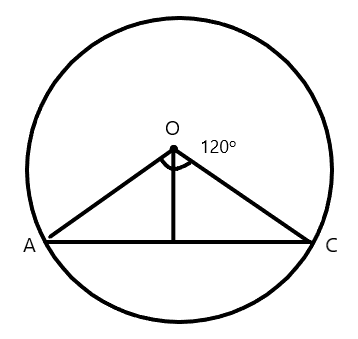
If the angle subtended by a chord AC at the center O is 120° and the length of the chord AC is 10√3 cm, what is the radius of the circle?

  • A.

    20 cm

  • B.

    5 cm

  • C.

    10 cm

    ✓ Correct
  • D.

    5√3 cm

Answer & Solution

Correct option is C

Given:
Angle subtended by chord AC at center = 120°
Length of chord AC = 10310\sqrt{3}​ cm
Formula Used:
Length of chord = 2rsin⁡(θ2)2r \sin(\frac{\theta}{2})​​
Solution: 

Draw a perpendicular from O to AC, bisecting it and the angle at the center.
The triangle is divided into two right-angled triangles with angle 60° at the center.
Half length of chord = 535\sqrt{3}​ cm
Using trigonometry: sin⁡(60°)=PerpendicularHypotenuse\sin(60°) = \frac{Perpendicular}{Hypotenuse}​ = 53r\frac{5\sqrt{3}}{r}​​
​32=53r\frac{\sqrt{3}}{2} = \frac{5\sqrt{3}}{r}​​
r = 5 × 2 = 10 cm
Final Answer
So the correct answer is (c)
Q8.

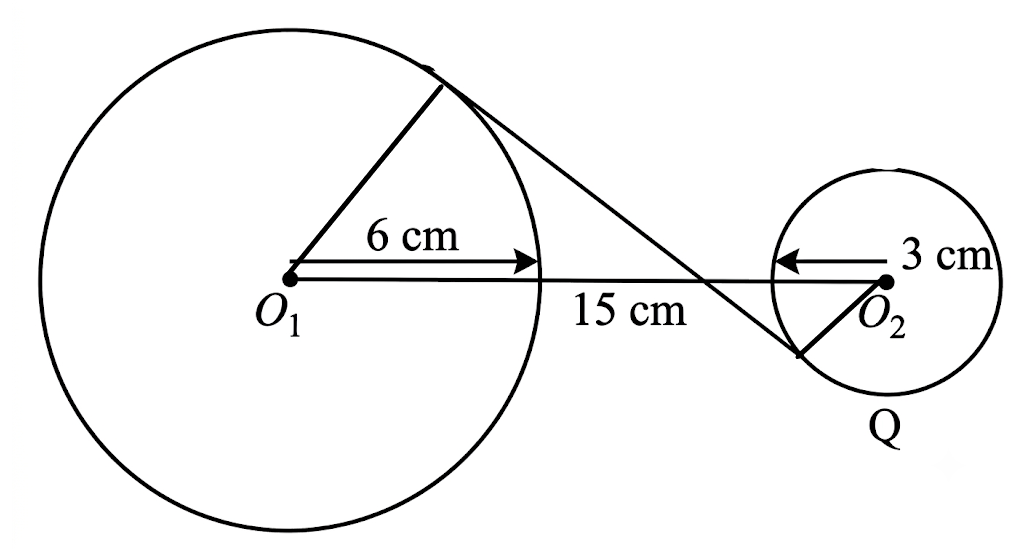
In a geometry assignment, a student is given two non-intersecting circles having radii of 6 cm and 3 cm respectively. The straight-line distance spanning between the absolute centers of these two circles is precisely measured as 15 cm. The student must draw a transverse common tangent that crosses between the two circles, touching both. What is the exact length of this transverse common tangent?

  • A.

    12 cm

    ✓ Correct
  • B.

    8 cm

  • C.

    14 cm

  • D.

    10 cm

Answer & Solution

Correct option is A

Given:
Radius of the first circle r1 r_1​ = 6 cm
Radius of the second circle  r2r_2​ = 3 cm
Distance spanning between the centers d = 15 cm
Formula Used:
Length of Transverse Common Tangent = d2−(r1+r2)2\sqrt{d^2 - (r_1 + r_2)^2}​​
Solution: 

Substitute the precise values into the Transverse Common Tangent formula.
Length = 152−(6+3)2\sqrt{15^2 - (6 + 3)^2}​​
Length = 152−92\sqrt{15^2 - 9^2}​​
Length = 225−81 \sqrt{225 - 81}​​
Length = 144 \sqrt{144}​​
Length = 12
Final Answer
So the correct answer is (a)

Q9.

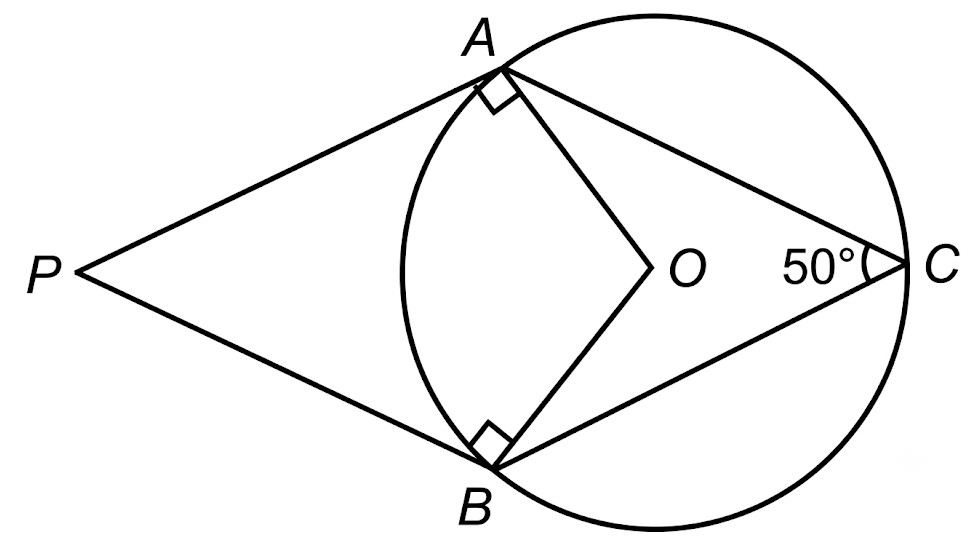
In a circle with centre O, PA and PB are tangents touching the circle at A and B respectively. Point C lies on the major arc AB. If ∠ACB = 50°, find ∠APB.

  • A.

    80°

    ✓ Correct
  • B.

    100°

  • C.

    120°

  • D.

    160°

Answer & Solution

Correct option is A

Given:
∠ACB = 50°
PA and PB are tangents.
Formula Used:
Angle at center is twice the angle at circumference: ∠AOB = 2 × ∠ACB
Sum of angles in a quadrilateral is 360°.
Radius is perpendicular to tangent at point of contact: ∠OAP = ∠OBP = 90°.
Solution: 

∠AOB = 2 × 50° = 100°.
In quadrilateral OAPB:
∠OAP + ∠APB + ∠OBP + ∠AOB = 360°
90° + ∠APB + 90° + 100° = 360°
280° + ∠APB = 360°
∠APB = 360° - 280° = 80°
Final Answer
So the correct answer is (a)

Q10.

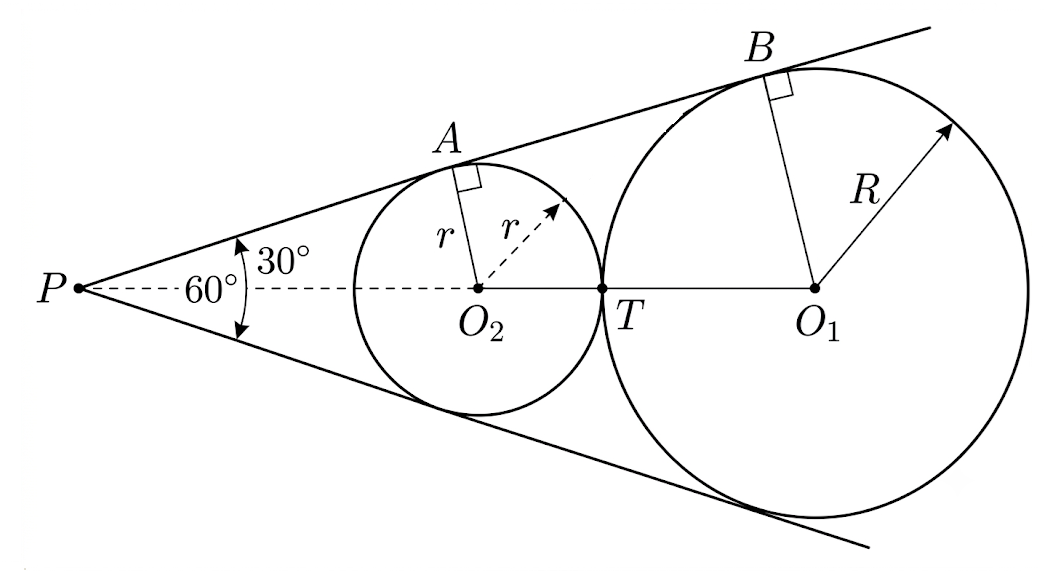
Two circles with radii R and r (R > r) touch each other externally. If the angle between their two direct common tangents is 60°, find the ratio of their radii, R : r.

  • A.

    5:1

  • B.

    3:1

    ✓ Correct
  • C.

    2:7

  • D.

    3:7

Answer & Solution

Correct option is B

Given:
Radii = R, r
Angle between direct common tangents = 60°
Formula Used:
Properties of similar triangles and trigonometry.
Solution: 

Let the tangents intersect at point P.
The line joining the centers bisects the angle between the tangents, so the half-angle is 30°.
Let the distance from P to the center of the smaller circle be d.
In the smaller right triangle: sin⁡(30∘)=rd⟹12=rd⟹d=2r\sin(30^\circ) = \frac{r}{d} ⟹ \frac{1}{2} = \frac{r}{d} ⟹ d = 2r​​
In the larger right triangle: sin⁡(30∘)=Rd+r+R\sin(30^\circ) = \frac{R}{d + r + R}​​
​12=R2r+r+R\frac{1}{2} = \frac{R}{2r + r + R}​​

​12=R3r+R\frac{1}{2} = \frac{R}{3r + R}​​

3r + R = 2R
R = 3r
​Rr=31\frac{R}{r} = \frac{3}{1}​​
Final Answer
So the correct answer is (b)

Q11.

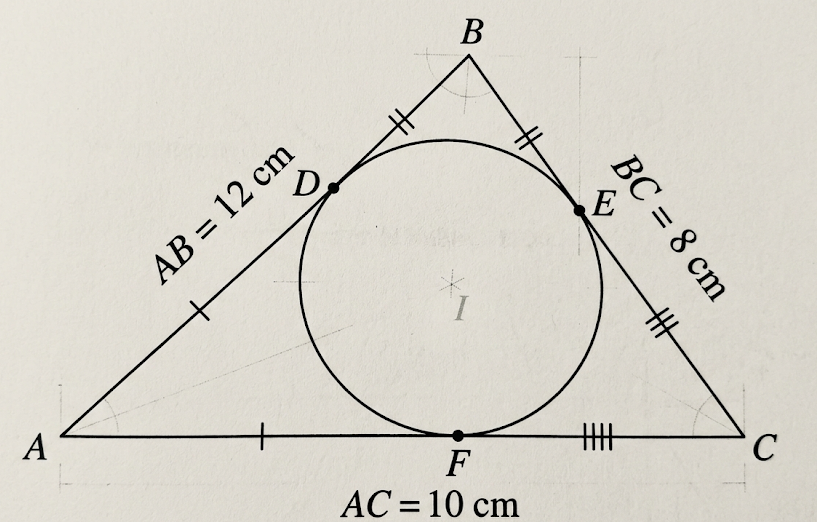
Consider a circle inscribed in ∆ABC touches its sides AB, BC and AC at points D, E and F respectively. If AB = 12 cm, BC = 8 cm and AC = 10 cm, then find the lengths of AD, BE and CF.

  • A.

    7 cm, 5 cm, 3 cm

    ✓ Correct
  • B.

    8 cm, 5 cm, 2 cm

  • C.

    9 cm, 7 cm, 2 cm

  • D.

    10 cm, 8cm, 2 cm

Answer & Solution

Correct option is A

Given:
AB = c = 12 cm
BC = a = 8 cm
AC = b = 10 cm
Solution:

Lengths of tangents from an external point to a circle are equal.
Let AD = AF = x
Let BD = BE = y
Let CE = CF = z
We know that:
x + y = AB = 12
y + z = BC = 8
x + z = AC = 10
Adding all three equations:
2(x + y + z) = 12 + 8 + 10 = 30
x + y + z = 15
Now, find individual lengths:
x = (x + y + z) - (y + z) = 15 - 8 = 7 cm (AD)
y = (x + y + z) - (x + z) = 15 - 10 = 5 cm (BE)
z = (x + y + z) - (x + y) = 15 - 12 = 3 cm (CF)
Final Answer
So the correct answer is (a)

Q12.

The common direct tangent of two circles is 26 cm long, while their common transverse tangent is 10 cm long. Find the product of the radii of the circles.

  • A.

    72

  • B.

    86

  • C.

    100

  • D.

    144

    ✓ Correct

Answer & Solution

Correct option is D

Given:
Length of direct common tangent (LdL_d​) = 26 cm
Length of transverse common tangent (LtL_t​) = 10 cm
Formula Used:
​Ld2=d2−(R−r)2L_d^2 = d^2 - (R - r)^2​​
​Lt2=d2−(R+r)2L_t^2 = d^2 - (R + r)^2​​
Solution:
Let the distance between centers be d, and the radii be R and r.
​Ld2=262=676L_d^2 = 26^2 = 676​​
​Lt2=102=100L_t^2 = 10^2 = 100​​
Subtract the second equation from the first:
​Ld2−Lt2=(d2−(R−r)2)−(d2−(R+r)2)L_d^2 - L_t^2 = (d^2 - (R - r)^2) - (d^2 - (R + r)^2)​​
​676−100=(R+r)2−(R−r)2676 - 100 = (R + r)^2 - (R - r)^2​​
We know that (a+b)2−(a−b)2=4ab(a + b)^2 - (a - b)^2 = 4ab​:
576 = 4Rr
Rr =  5764\frac{576}{4}​ = 144
The product of the radii is 144.
Final Answer
So the correct answer is (d)

Q13.

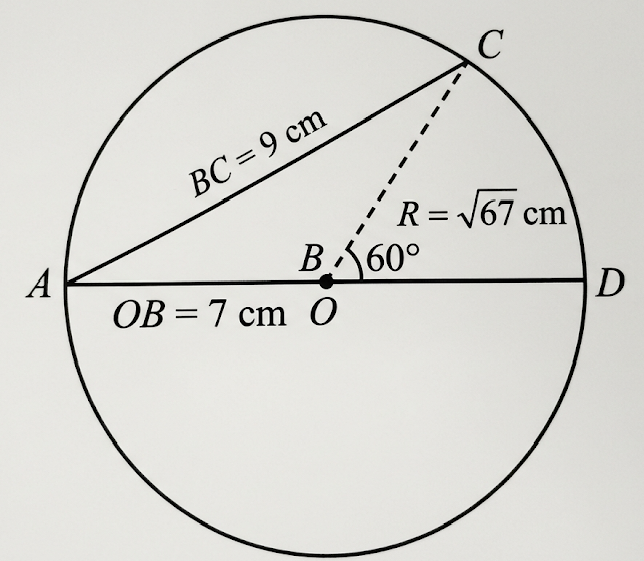
In a circle with center O, AD is a diameter and AC is a chord. Point B is on AD such that OB = 7cm and BC = 9cm If ∠OBC = 60° find the radius of the circle.

  • A.

    16 cm

  • B.

    √90 cm

  • C.

    25 cm

  • D.

    √67 cm

    ✓ Correct

Answer & Solution

Correct option is D

Given:
OB = 7 cm
BC = 9 cm
∠OBC = 60°
Formula Used:
Cosine Rule: c2=a2+b2−2abcos⁡(θ)c^2 = a^2 + b^2 - 2ab \cos(\theta)​​
Solution: 

Since AD is the diameter and O is the center, C is a point on the circle, meaning OC is the radius of the circle (let it be r).
In triangle OBC, we apply the cosine rule to find OC:
​OC2=OB2+BC2−2(OB)(BC)cos⁡(∠OBC)OC^2 = OB^2 + BC^2 - 2(OB)(BC)\cos(\angle OBC)​​
​r2=72+92−2(7)(9)cos⁡(60∘)r^2 = 7^2 + 9^2 - 2(7)(9)\cos(60^\circ)​​
​r2=49+81−2(63)(12)r^2 = 49 + 81 - 2(63)(\frac{1}{2})​​
​r2=130−63r^2 = 130 - 63​​
​r2=67r^2 = 67​​
r=67r = \sqrt{67}​ cm
Final Answer
So the correct answer is (d)

Q14.

In a circle with a diameter of 34 cm, two parallel chords are drawn on opposite sides of the center. The length of one chord is 30 cm, and the perpendicular distance between the two chords is 23 cm. Calculate the length of the other chord.

  • A.

    14 cm

  • B.

    16 cm

    ✓ Correct
  • C.

    20 cm

  • D.

    24 cm

Answer & Solution

Correct option is B

Given:
Diameter = 34 cm, so Radius (r) = 17 cm
Length of first chord = 30 cm
Distance between the two chords = 23 cm
Formula Used:
The perpendicular from the center to a chord bisects the chord.
Pythagorean theorem: d = r2−(L2)2 \sqrt{r^2 - (\frac{L}{2})^2}​​
Solution: 

Half-length of the first chord = 302 \frac{30}{2}​ = 15 cm.
Distance of the first chord from the center (d1d_1​):
d1=172−152=289−225=64d_1 = \sqrt{17^2 - 15^2} = \sqrt{289 - 225} = \sqrt{64}​ = 8 cm.
The chords are on opposite sides of the center, so the total distance is d1+d2d_1 + d_2​ = 23 cm.
Distance of the second chord from the center (d_2):
d2d_2​ = 23 - 8 = 15 cm.
Let the half-length of the second chord be x.
x = 172−152=289−225=64 \sqrt{17^2 - 15^2} = \sqrt{289 - 225} = \sqrt{64}​ = 8 cm.
Total length of the second chord = 2 × 8 = 16 cm.
Final Answer
So the correct answer is (b)

Q15.

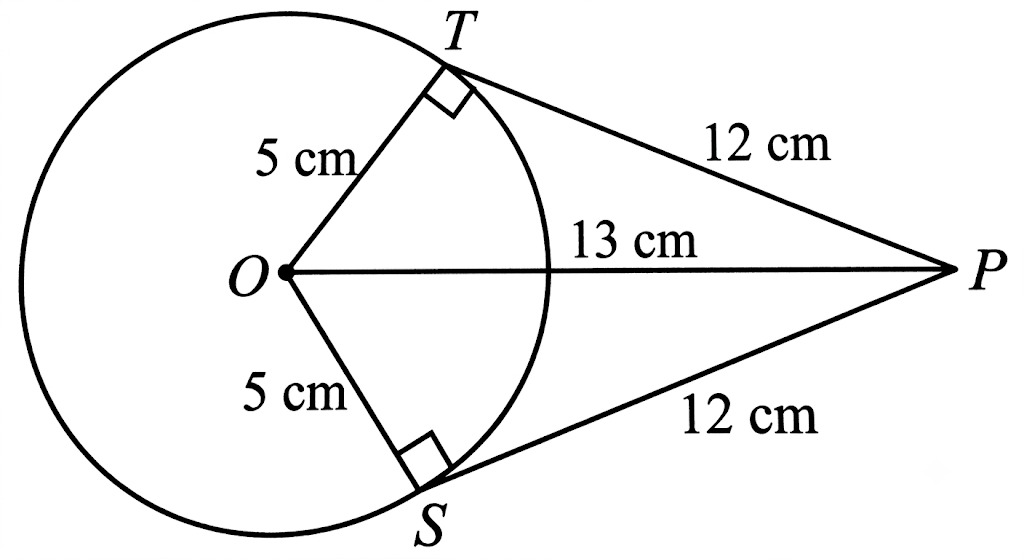
Tangents PT and PS are drawn from an external point P to a circle of radius 5 cm. If the distance from P to the center O is 13 cm, find the area of quadrilateral PTOS.

  • A.

    30 cm²

  • B.

    45 cm²

  • C.

    60 cm²

    ✓ Correct
  • D.

    65 cm²

Answer & Solution

Correct option is C

Given:
Radius (OT = OS) = 5 cm
Distance (OP) = 13 cm
Formula Used:
Pythagorean theorem in a right-angled triangle.
Area of a triangle = 12 \frac{1}{2}​ × base × height
Solution: 

The radius is perpendicular to the tangent at the point of contact. Thus, triangle OTP is a right-angled triangle at T.
Using the Pythagorean theorem in triangle OTP:
PT = OP2−OT2 \sqrt{OP^2 - OT^2}​​
PT = 132−52=169−25=144 \sqrt{13^2 - 5^2} = \sqrt{169 - 25} = \sqrt{144}​ = 12 cm.
The area of triangle OTP = 12\frac{1}{2}​ × OT × PT
Area of triangle OTP =12 \frac{1}{2}​ × 5 × 12 = 30 cm².
The quadrilateral PTOS is formed by two congruent right-angled triangles, OTP and OSP.
Total Area of PTOS = 2 × Area of triangle OTP
Total Area = 2 × 30 = 60 cm².
Final Answer
So the correct answer is (c)