Correct option is B
The correct answer is: (2) Tight junction, desmosome, and gap junction together form the junctional complex.
Explanation:
The statement that tight junction, desmosome, and gap junction together form the junctional complex is incorrect. The junctional complex refers specifically to the tight junctions, adherens junctions, and desmosomes, but gap junctions do not form part of this complex. The junctional complex typically involves tight junctions, which seal cells together, adherens junctions that connect actin filaments, and desmosomes that link intermediate filaments between adjacent cells. Gap junctions, on the other hand, form channels between cells for communication and do not participate in the structural cohesion provided by the junctional complex.
Information Booster:
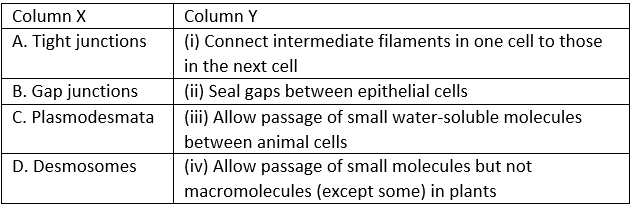
Gap junctions are specialized for intercellular communication and form channels that allow ions and small molecules to pass directly between the cytoplasm of adjacent cells.
Tight junctions create a seal between adjacent cells, preventing the leakage of molecules between cells, especially in epithelial layers.
Desmosomes provide mechanical strength by linking intermediate filaments, providing adhesion between cells.
Junctional complexes are formed by tight junctions, adherens junctions, and desmosomes, which together play a role in maintaining tissue integrity and function.
Additional Knowledge:
Hemidesmosomes (option 3) are anchoring junctions that connect intermediate filaments in the cytoskeleton to the extracellular matrix, providing structural support and stability.
Adherens junctions (option 4) help in connecting actin filaments of adjacent cells, playing a role in cell-cell adhesion and maintaining tissue integrity, especially in epithelial tissues.