Correct option is B
Explanation-
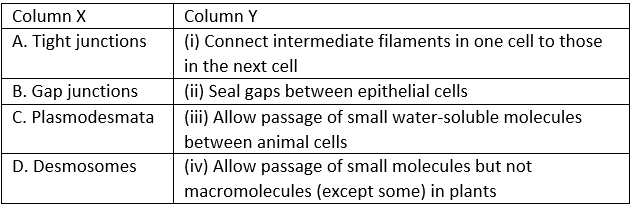
A. Tight junctions → (ii) seal gaps between epithelial cells
Tight junctions are specialized connections between adjacent epithelial cells. They prevent the passage of molecules and ions through the space between cells. This ensures that substances must pass through the cells, thus tightly regulating what gets absorbed.
B. Gap junctions → (iii) allow passage of small water-soluble molecules from cell to cell in animal tissues
Gap junctions are found in animal cells and are made up of connexins. These channels allow the movement of ions and small molecules like nutrients, signaling molecules, and ions between adjacent cells, facilitating communication.
C. Plasmodesmata → (iv) allows passage of small molecules but not macromolecules (with exceptions) in plants
Plasmodesmata are channels that pass through plant cell walls and connect the cytoplasm of adjacent cells. While they mainly allow the movement of small molecules and ions, in some cases, larger molecules like RNA and proteins may also move, but not all macromolecules.
D. Desmosomes → (i) connect intermediate filaments in one cell to those in the next cell
Desmosomes provide mechanical strength to tissues by anchoring intermediate filaments of the cytoskeleton (like keratin) in adjacent cells. They are crucial in tissues under mechanical stress, like skin and heart muscle.
Final Answer- A-ii; B-iii; C-iv; D-i
Correct Option- b