Correct option is A
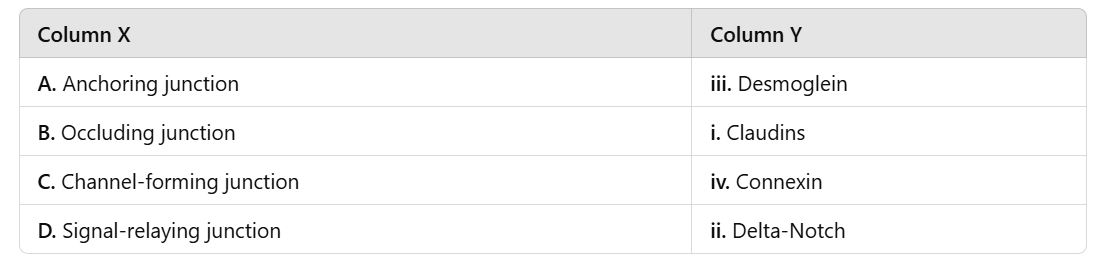
The correct associations are:
- Anchoring junction (A) → Desmoglein (iii): Anchoring junctions include desmosomes and adherens junctions, which use proteins like desmoglein (a cadherin protein) for cell-cell adhesion.
- Occluding junction (B) → Claudins (i): Tight junctions, which occlude passage between cells, rely on claudins and occludins for their function.
- Channel-forming junction (C) → Connexin (iv): Gap junctions are formed by connexin proteins, enabling intercellular communication via channels.
- Signal-relaying junction (D) → Delta-Notch (ii): Signal-relaying junctions involve signaling proteins like Delta and Notch in intercellular communication.
Information Booster:
- Anchoring junctions provide mechanical stability and include desmosomes and adherens junctions.
- Occluding junctions form barriers between cells, regulating paracellular transport.
- Channel-forming junctions allow direct communication between cells via gap junctions.
- Signal-relaying junctions are critical in developmental and intercellular signaling, including Delta-Notch signaling.
- Junction-specific proteins include desmoglein (anchoring), claudins (tight junctions), connexins (gap junctions), and Delta-Notch (signal-relaying).
Additional Knowledge:
- Anchoring Junctions (A-iii):
Desmoglein is a cadherin family protein found in desmosomes, anchoring adjacent cells together. These junctions are important in tissues subjected to mechanical stress, such as skin and heart. - Occluding Junctions (B-i):
Tight junctions are formed by claudins and occludins, creating a barrier to prevent the passage of molecules between cells. They are critical in epithelial and endothelial cells. - Channel-forming Junctions (C-iv):
Connexins assemble to form gap junctions, which create intercellular channels for the exchange of ions, nutrients, and signaling molecules. - Signal-relaying Junctions (D-ii):
Delta-Notch signaling is crucial in developmental pathways and cell differentiation. These junctions transmit signals between adjacent cells.