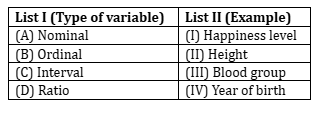
Correct option is B
The correct answer is
(b) Pearson’s r.
Pearson’s r (also known as Pearson’s correlation coefficient) is the most suitable measure for determining the strength and direction of the association between two continuous variables measured on an interval or ratio scale. Pearson’s r ranges from -1 to +1, where values close to +1 indicate a strong positive correlation, values close to -1 indicate a strong negative correlation, and values near 0 suggest no correlation.
Information Booster: 1.
Pearson’s r: Best used when both variables are continuous and meet the assumptions of normality.
2.
Strength of Correlation: Values closer to +1 or -1 indicate a stronger association, while values near 0 indicate a weaker or no association.
3.
Positive and Negative Correlation: A positive value of r indicates a direct relationship, while a negative value indicates an inverse relationship.
4.
Interval and Ratio Data: Pearson’s r is specifically suited for interval or ratio data types.
5.
Assumptions: Pearson’s r requires linearity and homoscedasticity between the variables for accurate measurement.
6.
Squared Correlation (r²): Provides the proportion of variance in one variable that is predictable from the other.
 English
 10 Questions
 20 Marks
 12 Mins