Correct option is B
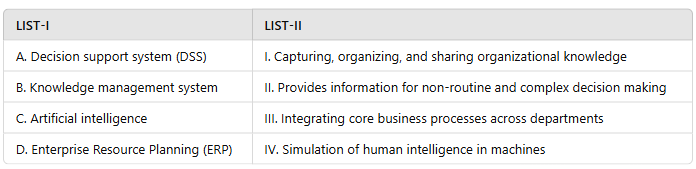
A Decision Support System (DSS) is an interactive system designed to assist managers and decision-makers in making informed choices in ill-structured or semi-structured decision-making scenarios. It uses data, models, and analytical tools to process and analyze complex data, often presenting it in the form of “what if” models.
For example:
- Managers can use a DSS to simulate different scenarios by changing variables in a complex spreadsheet, such as profit margins, cost fluctuations, or sales projections.
- DSS tools include forecasting models, sensitivity analysis, and decision trees.
Information Booster:
A Decision Support System (DSS) is a computer-based tool that helps people make better decisions, especially in complicated or unclear situations. It combines data, models, and user-friendly tools to analyze problems and predict outcomes.
Key Features of DSS:
1. Problem Solving: Helps with semi-structured or unstructured decisions.
2. "What-If" Analysis: Tests different scenarios to predict results.
3. Data Integration: Uses data from various sources.
4. User-Friendly: Easy for managers to use without technical skills.
Additional Knowledge:
- Management Information System (MIS) (Incorrect): Provides routine data and reports for structured decision-making. It focuses on operational and transaction-level data but lacks the flexibility needed for "what if" analysis.
- Knowledge Work System (KWS) (Incorrect): Supports specialized knowledge workers in tasks like design and document creation, but it is not designed for decision-making support.
- Executive Support System (ESS) (Incorrect): Used by top executives for strategic decision-making. While it aggregates data and trends, it is less interactive and lacks the modeling capability of a DSS.
Thus, a DSS stands out for its capability to aid in analyzing ill-structured problems by integrating data, models, and user-friendly interfaces.
 English
 10 Questions
 20 Marks
 12 Mins