Correct option is A
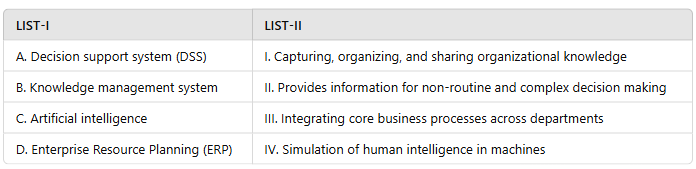
A Management Information System (MIS) is a structured system that helps organizations collect, process, store, and disseminate information to support management decision-making. It integrates various systems to ensure smooth business operations and data-driven decision-making.
Transaction Processing System (TPS): Included in MIS
TPS handles routine, structured transactions like payroll processing, order processing, and billing.
It collects and stores data, which is later used for generating reports in an MIS.
Enterprise Resource Planning (ERP): Included in MIS
ERP integrates different business functions such as finance, human resources, and supply chain into a centralized system.
It supports MIS by ensuring data consistency and process automation.
Operating System Kernel (OSK): Not Included in MIS
OSK is a core component of an operating system that manages hardware resources.
It does not perform managerial decision-making or business intelligence functions.
Decision Support System (DSS): Included in MIS
DSS provides analytical tools and models to assist in decision-making.
It complements MIS by offering insights and simulations for better planning.
Information Booster:
Role of TPS in MIS:
Acts as the foundation for data collection and storage in MIS.
Automates repetitive tasks, ensuring efficiency in transaction management.
Examples: POS systems, banking systems, and airline reservation systems.
How ERP Supports MIS:
Centralizes data from multiple departments, preventing duplication and errors.
Helps businesses streamline operations through automated workflows.
Common ERP software: SAP, Oracle ERP, Microsoft Dynamics.
DSS and Its Relationship with MIS:
Provides tools like forecasting, simulation, and trend analysis for managerial decisions.
Enhances MIS with advanced analytics, improving data-driven decisions.
Example: A DSS can help a retail company analyze sales trends and optimize inventory.
Additional Knowledge:
Operating System Kernel (OSK) [Incorrect]:
The kernel is the core part of an operating system (like Windows, Linux, macOS).
It manages CPU, memory, and input/output operations but does not process business information.
Unlike MIS, OSK does not support business decision-making or reporting.
 English
 10 Questions
 20 Marks
 12 Mins