Correct option is A
Management Information Systems (MIS) play a critical role in decision-making across different levels of an organization. The decision-making process in MIS is classified into three major levels:
Operational Level:
Focuses on day-to-day activities and routine decisions.
Examples: Order processing, scheduling, inventory control.
Decisions are structured and follow predefined procedures.
Tactical (Managerial) Level:
Deals with medium-term planning and control.
Examples: Budgeting, resource allocation, performance evaluation.
Decisions are semi-structured, requiring some human judgment.
Strategic Level:
Involves long-term planning and high-level decision-making.
Examples: Business expansion, mergers, product development strategies.
Decisions are unstructured and require significant analysis and forecasting.
MIS provides data-driven insights at each level to support informed decision-making.
Information Booster:
MIS helps in decision-making by providing real-time, accurate data for operational, tactical, and strategic levels.
Operational-level decisions rely heavily on Transaction Processing Systems (TPS), ensuring smooth daily operations.
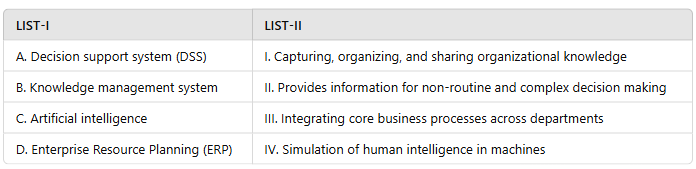
Tactical decisions require Management Information Systems (MIS) and Decision Support Systems (DSS) to analyze trends and reports.
Strategic decisions are supported by Executive Information Systems (EIS), offering top-level executives insights into market trends and future planning.
Proper classification of decisions in MIS enhances efficiency and organizational performance.
Different decision levels require different information processing capabilities, from detailed reports at the operational level to high-level summaries at the strategic level.
Additional Knowledge:
Option 2 (Local, National, Global) - Incorrect
These are geographical classifications and do not relate to decision-making levels in MIS.
MIS decisions are based on organizational hierarchy, not location.
Option 3 (Financial, Managerial, Operational) - Incorrect
While finance and management are important, decision levels in MIS are categorized based on complexity and hierarchy, not functions like finance or management.
Option 4 (Direct, Indirect, Strategic) - Incorrect
Direct and indirect do not represent structured decision levels in MIS.
Decision-making in MIS is based on operational, tactical, and strategic needs, not direct or indirect classification.
 English
 10 Questions
 20 Marks
 12 Mins