Correct option is B
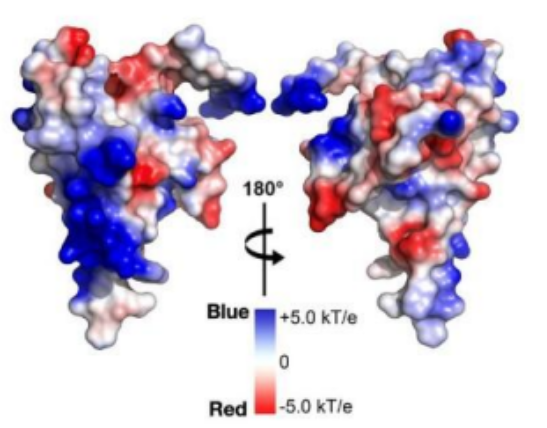
The map indicates the distribution of positive (blue) and negative (red) charges on the surface of the protein.
- Blue regions (positively charged) could interact with negatively charged molecules, such as DNA and RNA (which have negative charges on their phosphate backbone).
- Red regions (negatively charged) could interact with positively charged molecules such as proteins or certain lipids.
Explanation of Each Statement:
Fatty acids and cellulose:
- Fatty acids, which are typically hydrophobic and have non-polar characteristics, would unlikely interact strongly with charged regions of the protein, unless there is some other specific hydrophobic pocket on the protein's surface.
- Cellulose, being a polysaccharide, is also typically neutral but could interact with the protein if there is a complementary charge or structural affinity.
DNA and RNA:
- DNA and RNA both have negatively charged phosphate groups along their backbone. The positively charged regions of the protein (blue areas) would interact with the negatively charged backbone of these nucleic acids.
- This makes DNA and RNA a very likely substrate for the protein due to the electrostatic attraction between the positive regions on the protein and the negative charges on the nucleic acids.
DNA and cellulose:
- DNA (as discussed above) would interact with the positively charged regions of the protein.
- Cellulose, being neutral, is less likely to interact with the protein through electrostatic interactions, so this combination is less likely than DNA alone.
Only cellulose:
- Cellulose, being neutral, would interact weakly with the protein through non-electrostatic interactions such as hydrophobic interactions or hydrogen bonding, but this would be a less favorable substrate compared to DNA.
Most Likely Substrate:
The most likely natural substrate for the protein, based on the electrostatic potential map, is DNA and RNA due to the interaction between the positive charge on the protein's surface and the negative charge on the nucleic acids.