Correct option is B
Explanation:
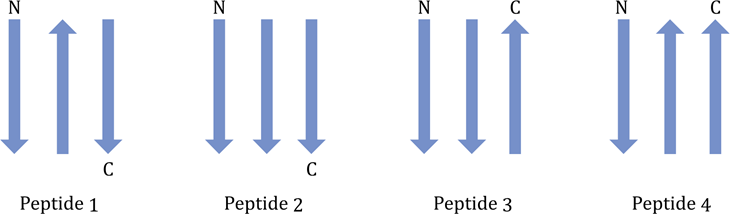
Peptide 1 and Peptide 2 are oriented parallel to each other, while Peptide 3 and Peptide 4 are antiparallel.
Parallel Beta-sheet (Peptides 1 and 2):
The hydrogen bonds are less favorable because the N-terminus of one strand is aligned with the N-terminus of the adjacent strand. This arrangement is typically less stable and leads to shorter peptide chains.
Antiparallel Beta-sheet (Peptides 3 and 4):
The hydrogen bonds are more stable because the N-terminus of one strand aligns with the C-terminus of the adjacent strand, making the interactions stronger. This typically leads to longer peptides.
Peptide 1 is the shortestbecause it is involved in a less stable, parallel arrangement.
Peptide 2 is the longestbecause it is more stabilized by the parallel arrangement but has a larger sequence involved in hydrogen bonding.
Peptide 3 and Peptide 4 are similar in lengthbecause they are antiparallel, and the peptide chains are longer than those in the parallel arrangement.
Conclusion:
Peptide 1 < (Peptide 3 = Peptide 4) < Peptide 2.
Correct Answer: Option 2.