arrow
arrow
arrow
​The Ramachandran plot graphically shows which combination of torsional angles phi (φ) and psi (ψ) of amino acid residues contained in a peptide are p
Question

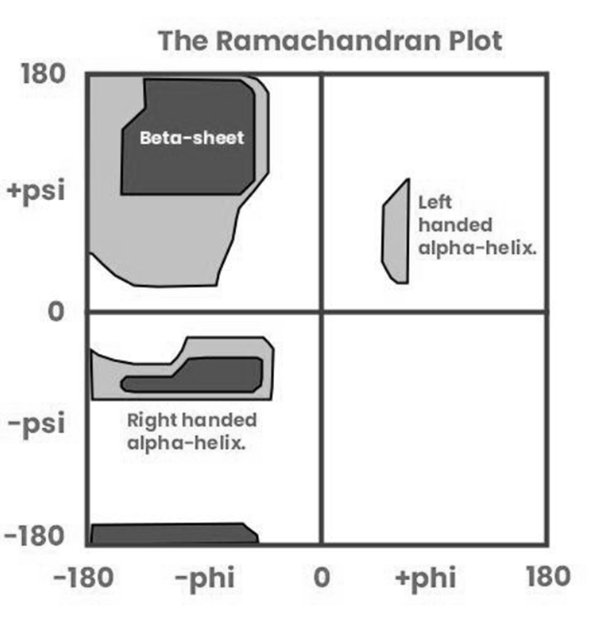
The Ramachandran plot graphically shows which combination of torsional angles phi (φ) and psi (ψ) of amino acid residues contained in a peptide are possible. Examination of the plot below shows that only certain regions of the conformational space are permissible.

Why are all the theoretical combinations of φ and ψ not possible?

A.

Two atoms cannot occupy the same space

B.

The geometry of the peptide bond that links two amino acid residues restricts φ and ψ angles

C.

Beta sheets and alpha helices determine the allowed regions of conformational space

D.

The tertiary fold of polypeptides restricts conformational space

Correct option is A

Explanation-

The Ramachandran plot shows which combinations of backbone torsional angles φ and ψ are allowed for an amino acid residue in a protein.
Correct Reason: Steric Hindrance
"Two atoms cannot occupy the same space" — this is a fundamental principle of chemistry and physics, known as the Pauli exclusion principle and steric hindrance.
Each amino acid in a polypeptide has atoms that take up space. When φ and ψ angles are rotated into certain positions, atoms may clash or come too close to each other. Such combinations are energetically unfavorable or physically impossible.
Therefore, only specific combinations of φ and ψ allow enough space between atoms — and these combinations are shown as allowed regions on the Ramachandran plot (like beta-sheets, right-handed alpha helices, etc.)

Incorrect Option -
Option b: The geometry of the peptide bond is planar, but that alone doesn’t explain why all φ and ψ combinations are restricted — steric clashes are the main reason.
Option c: Beta sheets and alpha helices occupy allowed regions, but they don’t define the allowed space — it's the steric constraints that define it.
Option d: Tertiary folding happens after the local φ and ψ angles are set — it doesn’t determine their basic allowed values.

Final Answer:
Option a — "Two atoms cannot occupy the same space."
Similar Questions

test-prime-package

Access ‘CSIR NET Life Sciences’ Mock Tests with

  • 60000+ Mocks and Previous Year Papers
  • Unlimited Re-Attempts
  • Personalised Report Card
  • 500% Refund on Final Selection
  • Largest Community
students-icon
354k+ students have already unlocked exclusive benefits with Test Prime!
test-prime-package

Access ‘CSIR NET Life Sciences’ Mock Tests with

  • 60000+ Mocks and Previous Year Papers
  • Unlimited Re-Attempts
  • Personalised Report Card
  • 500% Refund on Final Selection
  • Largest Community
students-icon
354k+ students have already unlocked exclusive benefits with Test Prime!
Our Plans
Monthsup-arrow