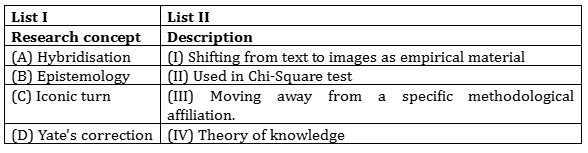
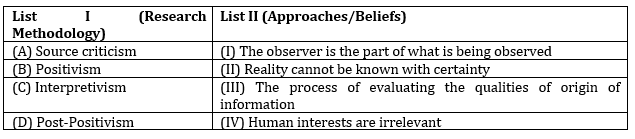
Correct option is B
Snowball sampling is a non-probability sampling technique often used in
ethnographic research. In this method, existing study subjects recruit future subjects from among their acquaintances. This approach is particularly useful when studying hidden, hard-to-reach, or marginalized populations, where it may be difficult to obtain a large sample through conventional means. In
ethnographic research, which seeks to understand cultures and communities, snowball sampling helps researchers gain access to networks of individuals who might otherwise be difficult to reach.
It is not used in
historical research (a),
content analysis (c), or
narrative analysis (d), which generally involve different data collection and analysis methods.
Information Booster: ·
Ethnographic research focuses on studying cultures and communities, often requiring access to specific social groups, which can be facilitated by snowball sampling.
·
Snowball sampling is helpful for researching populations that are difficult to identify, such as refugees, drug users, or specific cultural subgroups.
· It involves finding an initial subject who helps in identifying other potential participants through social networks.
· This sampling technique can introduce bias because participants tend to refer people with similar characteristics or backgrounds.
· Snowball sampling is especially valuable in qualitative research, where researchers aim to explore in-depth, non-generalizable data.
·
Ethnography aims to observe and understand the customs, behaviors, and interactions of people in their natural settings, making this method particularly suited to such studies.
 English
 10 Questions
 20 Marks
 12 Mins