Correct option is C
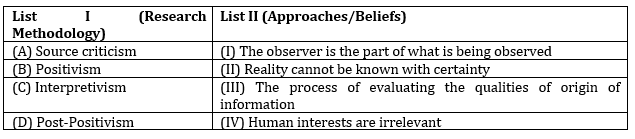
The correct answer is (c) (A)-(III), (B)-(IV), (C)-(I), (D)-(II). Here’s the detailed matching for each term:
· (A) Source criticism - (III) The process of evaluating the qualities of origin of information: Source criticism involves assessing the reliability, authenticity, and origin of information sources. It is a crucial aspect of historical and qualitative research to determine the credibility of information.
· (B) Positivism - (IV) Human interests are irrelevant: Positivism is a scientific approach that holds that knowledge is best derived from observable, objective data, free from human values or interests. It emphasizes empirical evidence and regards human biases as irrelevant to research.
· (C) Interpretivism - (I) The observer is part of what is being observed: Interpretivism focuses on understanding human experiences from the subjective viewpoint of the participants. It accepts that researchers' interpretations and perspectives influence the research, as they are part of the process.
· (D) Post-Positivism - (II) Reality cannot be known with certainty: Post-Positivism challenges the idea that reality can be fully understood. It acknowledges that while research can approximate truth, absolute certainty is unattainable, and researcher bias cannot be entirely eliminated.
Key Points to Remember: 1. Source Criticism: Used in qualitative and historical research to verify the authenticity and reliability of sources.
2. Positivism: Promotes objectivity, focusing on observable facts and empirical data, excluding subjective human interests.
3. Interpretivism: Embraces subjectivity, where researchers acknowledge their role in shaping interpretations.
4. Post-Positivism: Recognizes limitations in understanding reality, accepting that complete objectivity is impossible but striving for rigor.
 English
 10 Questions
 20 Marks
 12 Mins