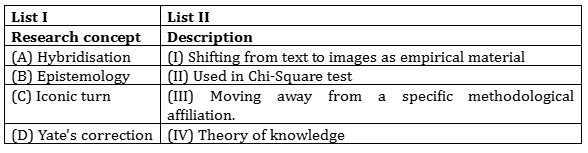
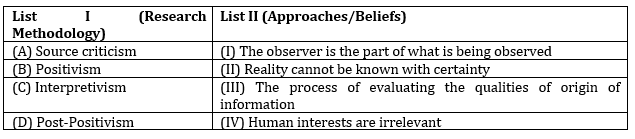
Correct option is C
Statement I is true because visual ethnography is a contemporary research method that extensively uses photo-elicitation—a technique involving photographs, videos, or other visual materials to evoke responses and gain insights during interviews or discussions. It enriches the understanding of cultural practices and social realities by incorporating visual elements.
Statement II is false because visual research has significantly contributed to empowering marginalized communities. By documenting their lives and giving them a platform to narrate their experiences, visual methodologies enable marginalized groups to voice their realities, fostering awareness and advocacy for social justice.
Information Booster: 1.
Visual Ethnography: Combines traditional ethnographic methods with visual tools like photography and videography to document and analyze cultural practices.
2.
Photo-Elicitation: A key technique in visual ethnography, facilitating deeper engagement by linking visuals to participants' lived experiences.
3.
Empowerment through Visual Research: Visual projects help marginalized communities articulate their issues and bring them to a wider audience, often influencing policy and societal perceptions.
4.
Applications: Frequently used in anthropology, sociology, and participatory action research.
5.
Impact: Enhances the richness of data and provides an inclusive approach to studying diverse populations.
6.
Critiques: Some argue that visual methods might be subject to interpretation bias or ethical concerns related to representation.
 English
 10 Questions
 20 Marks
 12 Mins