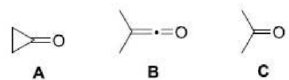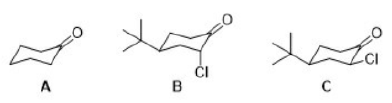
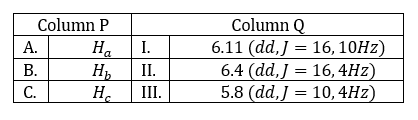
Correct option is B
Nuclear magnetic resonance (NMR) spectroscopy is a resonance technique involving absorption of radiofrequency energy. The magnetic environment of a nucleus affects its resonance frequency and allows structural information to be deduced.
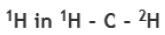
Structural assignment is often helped by the observation of the spin–spin coupling, which gives rise to multiplets in the spectrum due to interactions between nuclear spins. Spin–spin coupling arises when the orientation of the spin of a nearby nucleus affects the energy of another nucleus and causes small changes in the location of the latter’s resonance. A multiplet of 2I+1 lines is obtained when a spin-1/2 nucleus (or a set of symmetry-related spin-1/2 nuclei) is coupled to a nucleus of spin I. The coupling of the nuclear spins of different elements is called heteronuclear coupling. Homonuclear coupling between nuclei of the same element is detectable when the nuclei are in chemically inequivalent locations.
J-couplings are mediated through chemical bonds connecting two spins. It is an indirect interaction between two nuclear spins that arises from hyperfine interactions between the nuclei and local electrons. In NMR spectroscopy, J-coupling contains information about relative bond distances and angles. Most importantly, J-coupling provides information on the connectivity of chemical bonds. The J coupling (always reported in Hz) is field-independent (i.e. J is constant at different external magnetic field strength), and is mutual (i.e. JAX = JXA ).
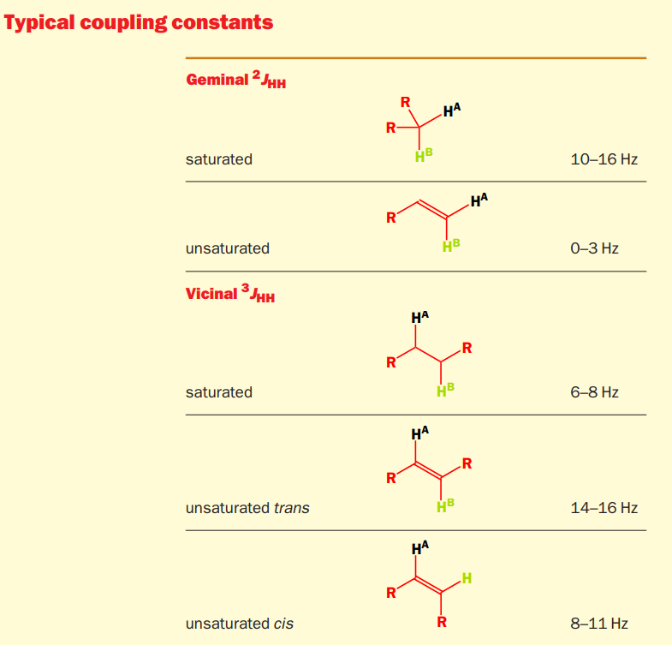
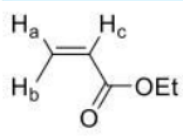
Neighbouring nuclei might interact through space or through the electrons in the bonds. Coupling is in fact a ‘through bond effect’ because of the way coupling constants vary with the shape of the molecule. The most important case occurs when the protons are at either end of a double bond. If the two hydrogens are cis, the coupling constant J is typically about 10 Hz but, if they are trans, J is much larger, usually 15–18 Hz.
Ha will couple with Hb and Hc to give a doublet and a doublet respectively.
Hc will couple with Ha and Hb to give a doublet and a doublet respectively.
Hb will couple with Ha and Hc to give a doublet and a doublet respectively.