Correct option is A
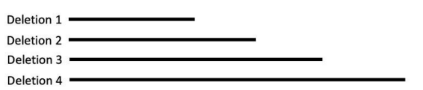
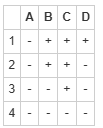
The experiment involved studying four mutants (A, B, C, D) of a bacteriophage, where various deletion regions were tested to see if wild-type recombinants could be recovered. The key points noted in the study include:
- When mutant 1 is tested, it fails to recover wild-type for deletion 1.
- Mutant 2 recovers wild-type with deletion 1 and fails with deletion 2.
- Mutant 3 fails with deletion 1 but recovers with deletion 2.
- Mutant 4 does not recover with any deletions.
Statement Analysis:
Statement A: Mutation A lies within the region of deletion 1.
- This statement is True. Since mutation A does not recover with deletion 1, it implies that mutation A must lie within this deletion. If it were outside, some recovery would be possible.
Statement B: Mutations can be ordered as A-D-B-C.
- This statement is True. If we order based on the inability to recover with deletion 1 (which includes A), and given the recovery patterns, the order must precede D. Since B and C do not complement each other, they can follow D. This ordering fits the evidence.
Statement C: Mutant A could be a deletion.
- This statement is True. The inability to recover wild-type suggests that mutant A might be a deletion in the region tested.
Statement D: Mutants B and C are located on two independent cistrons.
- This statement is False. Since B and C do not complement each other, it indicates they affect the same gene or functional unit, meaning they are on the same cistron.
Therefore, the correct statements are A, B, and C.