Correct option is D
Explanation-
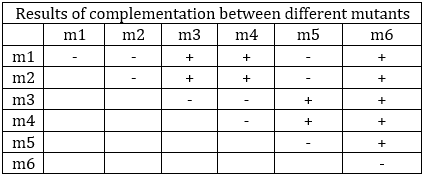
A complementation group (also called a genetic locus) includes mutants that do not complement each other (i.e., when crossed, they fail to restore the wild-type function).
In the table:
“+” means complementation → mutants are in different groups.
“−” means no complementation → mutants are in the same group.
Grouping the mutants:
Group 1: m1, m2, m5
m1 − m2 = − → same group
m1 − m5 = − → same group
m2 − m5 = − → same group
So, m1, m2, m5 form Group 1
Group 2: m3, m4
m3 − m4 = − → same group
So, m3 and m4 form Group 2
Group 3: m6
m6 complements with m1 (+), m2 (+), m5 (+)
Does not complement with m3 and m4 (−)
So, m6 is not in Group 1 or 2, it’s a separate group
Correct Answer: Option D - Three complementation groups