Correct option is B
Explanation-
A maternal-effect gene is a gene where the offspring’s phenotype is controlled by the mother's genotype, not by the offspring's own genotype. This happens because the mother loads gene products (like mRNA or protein) into the egg during oogenesis. So, the zygote's early development depends entirely on what the mother provides. If the mother has at least one functional allele, she can supply enough product, and all her offspring develop normally, even if they themselves carry the mutant allele.
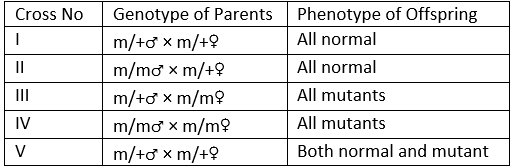
Cross I:
Father is m/+, mother is m/+.
Since mother is heterozygous, she has one working gene and supplies enough product to all eggs.
So, all offspring develop normally, even if they inherit mutant alleles.
This matches maternal-effect behavior.
Cross II:
Father is m/m, mother is m/+ (still heterozygous).
Again, the mother has one working gene.
She can make functional product → all offspring receive enough → all are normal.
Again, maternal-effect is followed.
Cross III:
Father is m/+, mother is m/m.
Now the mother has no functional gene copy.
She cannot supply the gene product → all eggs lack the necessary component.
So, all offspring are mutant, even those that inherit a functional allele from the father.
This is a classic maternal-effect outcome.
Cross IV:
Both parents are m/m.
Obviously, the mother is m/m, so she cannot provide the product in the egg.
Result? Again, all offspring are mutant.
This too fits the maternal-effect model.
Cross V :
Both parents are m/+.
The mother is heterozygous, so she should be able to supply enough gene product into the eggs.
So, all offspring should be normal according to the maternal-effect rule BUT the observed result is both normal and mutant offspring. That’s unexpected.
This means:
The offspring phenotype is not solely determined by the mother’s genotype. This violates the maternal-effect pattern.
Only Cross V shows a pattern not explained by maternal-effect genes.
So, the correct answer is:
Option B: Cross V only