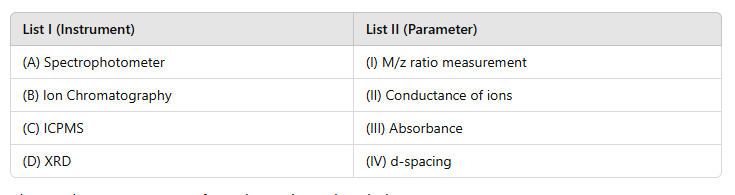
Correct option is B
1.
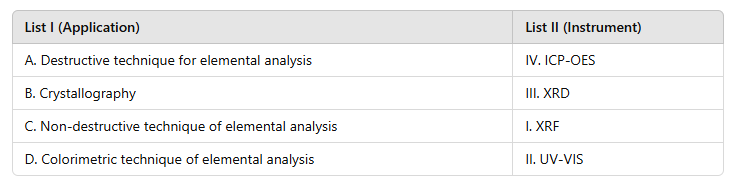
A. Destructive technique for elemental analysis (IV - ICP-OES): Inductively Coupled Plasma Optical Emission Spectroscopy (ICP-OES) is a destructive analytical technique as the sample is destroyed during analysis to determine elemental composition.
2.
B. Crystallography (III - XRD): X-Ray Diffraction (XRD) is a non-destructive technique used for crystallography to study the atomic and molecular structure of crystals.
3.
C. Non-destructive technique of elemental analysis (I - XRF): X-Ray Fluorescence (XRF) is a non-destructive method used to analyze elemental composition by exciting atoms and detecting emitted X-rays.
4.
D. Colorimetric technique of elemental analysis (II - UV-VIS): UV-Visible spectroscopy (UV-VIS) is used to measure the absorbance of light in the visible range, which correlates to the concentration of specific elements or compounds.
Key Explanation: · ICP-OES: Destructive because the sample must be atomized in plasma.
· XRD: Non-destructive and ideal for structural and crystallographic studies.
· XRF: Non-destructive, used for elemental analysis without altering the sample.
· UV-VIS: Colorimetric technique for determining concentrations of specific analytes.
Information Booster: 1. ICP-OES (IV): Used for trace metal analysis with high sensitivity.
2. XRD (III): Determines crystal lattice structures and material phases.
3. XRF (I): Quick, non-invasive technique for elemental analysis.
4. UV-VIS (II): Commonly used in environmental and biological samples for colorimetric analysis.
 English
 10 Questions
 20 Marks
 12 Mins