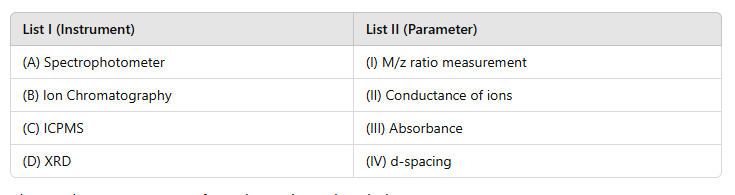
Correct option is D
1. Statement I:
· Incorrect.
· In normal-phase high-pressure liquid chromatography (HPLC):
· The stationary phase is polar (e.g., silica).
· The mobile phase is non-polar (e.g., hexane, chloroform).
· This arrangement separates compounds based on their polarity, with less polar compounds eluting first.
· The description provided in Statement I is incorrect because it reverses the nature of the mobile and stationary phases.
2. Statement II:
· Correct.
· In reverse-phase HPLC (RP-HPLC):
· The stationary phase is non-polar (e.g., C18 hydrocarbon chains bound to silica).
· The mobile phase is polar (e.g., methanol, acetonitrile, or water).
· This setup separates compounds based on hydrophobic interactions, with more hydrophobic compounds eluting later.
· The description provided in Statement II aligns with the principles of reverse-phase HPLC.
Thus, Statement I is incorrect, and Statement II is correct, making Option 4 the correct answer.
Information Booster: 1. Normal-Phase HPLC:
· Stationary Phase: Polar (e.g., silica, alumina).
· Mobile Phase: Non-polar (e.g., hexane, chloroform).
· Used for separating polar compounds.
2. Reverse-Phase HPLC:
· Stationary Phase: Non-polar (e.g., C18 silica).
· Mobile Phase: Polar (e.g., water, methanol).
· Most commonly used for separating non-polar or hydrophobic compounds.
3. Applications:
· Normal Phase: Analysis of polar compounds like sugars, amino acids.
· Reverse Phase: Widely used for pharmaceuticals, proteins, and peptides.
Additional Knowledge: · Key Difference:
· Normal Phase: Polar stationary phase and non-polar mobile phase.
· Reverse Phase: Non-polar stationary phase and polar mobile phase.
· Hydrophobic Interactions in RP-HPLC:
· Reverse-phase HPLC leverages the hydrophobicity of analytes to separate compounds effectively.
· Retention Behavior:
· In normal-phase, less polar compounds elute first.
· In reverse-phase, more polar compounds elute first.
 English
 10 Questions
 20 Marks
 12 Mins