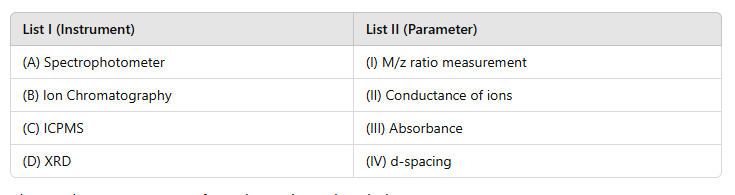
Correct option is B
X-ray Diffraction (XRD) is a technique based on Bragg’s Law (nλ=2dsinθn\lambda = 2d\sin\thetanλ=2dsinθ), which describes the condition for diffraction of X-rays by a crystalline material. The technique uses X-rays to study the structure of crystals by analyzing the angles and intensities of the diffracted beams.
Bragg’s Law Components:
· nnn: Order of reflection (an integer).
· λ\lambdaλ: Wavelength of the X-rays.
· ddd: Interplanar spacing of the crystal lattice.
· θ\thetaθ: Angle of incidence (and reflection).
Why XRD?
· XRD is specifically designed to analyze the arrangement of atoms in crystals, making it the most direct application of Bragg’s equation.
Why Not Other Options?
1. XRF (a):
· X-ray Fluorescence (XRF) measures elemental composition by detecting secondary X-rays emitted by a material when excited by primary X-rays. It is not based on diffraction or Bragg’s law.
2. WD XRF (c):
· Wavelength Dispersive XRF (WD XRF) is a specialized XRF technique that separates emitted X-rays based on their wavelength. While it involves wavelengths, it is not based on diffraction principles like XRD.
3. AAS (d):
· Atomic Absorption Spectroscopy (AAS) analyzes the absorption of light by atoms in a gaseous state. It does not involve X-ray diffraction or Bragg’s law.
Information Booster: 1. Applications of XRD:
· Determination of crystal structure.
· Identification of phases in a material.
· Analysis of interplanar spacing in crystalline substances.
2. Other Techniques and Their Applications:
· XRF: Elemental analysis in geological, environmental, and industrial samples.
· WD XRF: High-precision elemental analysis.
· AAS: Trace metal analysis in biological and environmental samples.
Additional Knowledge: XRD (b):
· Most accurate technique for determining the crystalline structure.
· Commonly used in mineralogy, materials science, and solid-state physics.
XRF (a) and WD XRF (c):
· Analyze elemental composition, unrelated to diffraction principles.
AAS (d):
· Focuses on measuring concentrations of specific elements in a sample.
 English
 10 Questions
 20 Marks
 12 Mins