Correct option is C
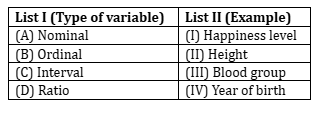
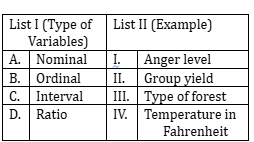
The correct matching of List I (Types of Variables) with List II (Examples) is as follows:
·
Nominal (A-III): Nominal variables categorize data without any specific order. An example is
Type of forest, where forests are categorized by type (e.g., tropical, temperate) but without any inherent ranking.
·
Ordinal (B-I): Ordinal variables have a specific order, but the intervals between them are not equal.
Anger level fits this as emotions can be ranked (e.g., low, medium, high) but the difference between levels is not consistent.
·
Interval (C-IV): Interval variables have equal intervals between values but no true zero point.
Temperature in Fahrenheit is an example because the difference between temperatures is consistent, but there is no true zero (Fahrenheit zero does not mean absence of heat).
·
Ratio (D-II): Ratio variables have both equal intervals and a true zero point.
Group yield fits this as it involves measurements where zero means no yield, and the intervals are meaningful.
Information Booster: 1.
Nominal variable: Categorical data without an order (e.g., gender, type of tree).
2.
Ordinal variable: Ranked data with ordered categories (e.g., satisfaction levels, ranks).
3.
Interval variable: Numeric data with equal intervals but no true zero (e.g., temperature).
4.
Ratio variable: Numeric data with a true zero and equal intervals (e.g., height, weight).
 English
 10 Questions
 20 Marks
 12 Mins