

hamburger menu
All Coursesall course arrow
adda247
reward-icon
adda247
    arrow
    arrow
    arrow
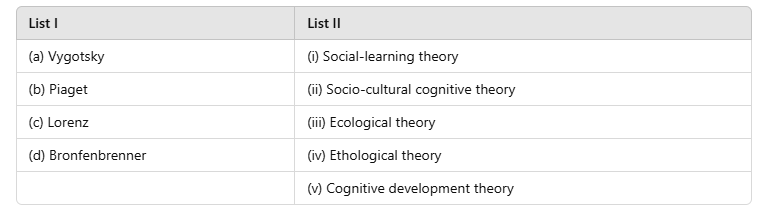
    Match List I with List II. Codes
    Question

    Match the column

    Match List I with List II.

    Codes

    A.

    (a)-(ii), (b)-(v), (c)-(iii), (d)-(i)


    B.

    (a)-(v), (b)-(ii), (c)-(iii), (d)-(i)


    C.

    (a)-(v), (b)-(iii), (c)-(i), (d)-(iv)

    D.

    (a)-(ii), (b)-(v), (c)-(iv), (d)-(iii)

    E.

    ..

    Correct option is D

    1. (a) Vygotsky – (ii) Socio-cultural cognitive theory:
    · Lev Vygotsky emphasized the role of social interaction and culture in cognitive development. His theory highlights scaffolding and zone of proximal development (ZPD).
    2. (b) Piaget – (v) Cognitive development theory:
    · Jean Piaget proposed stages of cognitive development (sensorimotor, pre-operational, concrete operational, and formal operational), focusing on how children actively construct knowledge.
    3. (c) Lorenz – (iv) Ethological theory:
    · Konrad Lorenz is known for ethological theory, which emphasizes the biological basis of behavior, particularly imprinting in early life.
    4. (d) Bronfenbrenner – (iii) Ecological theory:
    · Urie Bronfenbrenner developed the Ecological Systems Theory, explaining how a child’s development is influenced by multiple layers of environmental systems (microsystem, mesosystem, exosystem, macrosystem, and chronosystem).
    Information Booster:
    · Vygotsky: Learning precedes development; cognitive growth occurs through social interaction.
    · Piaget: Cognitive abilities develop in stages; constructivist approach.
    · Lorenz: Studied animal behavior, highlighting critical periods and innate behavior.
    · Bronfenbrenner: Introduced a holistic view of child development influenced by various environmental factors.

    Free Tests

    Free
    Must Attempt

    Basics of Education: Pedagogy, Andragogy, and Hutagogy

    languageIcon English
    • pdpQsnIcon10 Questions
    • pdpsheetsIcon20 Marks
    • timerIcon12 Mins
    languageIcon English
    Free
    Must Attempt

    UGC NET Paper 1 Mock Test 1

    languageIcon English
    • pdpQsnIcon50 Questions
    • pdpsheetsIcon100 Marks
    • timerIcon60 Mins
    languageIcon English
    Free
    Must Attempt

    Basics of Education: Pedagogy, Andragogy, and Hutagogy

    languageIcon English
    • pdpQsnIcon10 Questions
    • pdpsheetsIcon20 Marks
    • timerIcon12 Mins
    languageIcon English
    test-prime-package

    Access ‘UGC NET Home Science’ Mock Tests with

    • 60000+ Mocks and Previous Year Papers
    • Unlimited Re-Attempts
    • Personalised Report Card
    • 500% Refund on Final Selection
    • Largest Community
    students-icon
    345k+ students have already unlocked exclusive benefits with Test Prime!
    Our Plans
    Monthsup-arrow

