






Correct option is A
Erik Erikson’s Psychosocial Development Theory consists of eight stages, each associated with a psychosocial conflict and a corresponding basic virtue that develops if the conflict is successfully resolved.
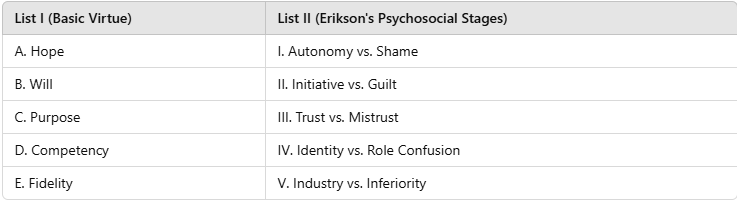
The correct matching of List I (Basic Virtue) with List II (Erikson’s Psychosocial Stages) is:
· Hope (A) - Trust vs. Mistrust (III)
· Occurs in infancy (0-1 year).
· If caregivers provide consistent care, the child develops trust and the virtue of hope.
· Will (B) - Autonomy vs. Shame (I)
· Occurs in early childhood (1-3 years).
· If encouraged, the child gains independence, leading to the virtue of will.
· Purpose (C) - Initiative vs. Guilt (II)
· Occurs in preschool age (3-6 years).
· If children are encouraged to take initiative, they develop purpose.
· Competency (D) - Industry vs. Inferiority (V)
· Occurs in school age (6-12 years).
· Success in learning and social interactions leads to competency.
· Fidelity (E) - Identity vs. Role Confusion (IV)
· Occurs in adolescence (12-18 years).
· Developing a stable self-identity results in fidelity, meaning a strong sense of self and commitment.
Thus, the correct answer is (a) A-III, B-I, C-II, D-V, E-IV.
Information Booster:
Erikson’s Stages and Their Virtues:
1. Trust vs. Mistrust (Infancy, 0-1 year) → Hope
2. Autonomy vs. Shame (Early Childhood, 1-3 years) → Will
3. Initiative vs. Guilt (Preschool, 3-6 years) → Purpose
4. Industry vs. Inferiority (School Age, 6-12 years) → Competency
5. Identity vs. Role Confusion (Adolescence, 12-18 years) → Fidelity
 English
 10 Questions
 20 Marks
 12 Mins



