Correct option is D
The correct matches are:
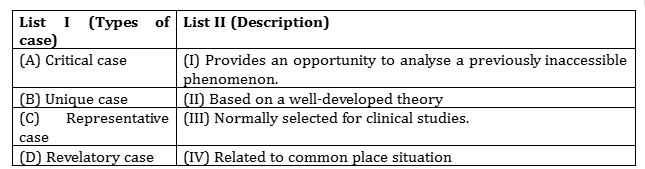
· (A)-(II): Critical case is based on a well-developed theory, making it suitable for testing hypotheses or theories in a focused and rigorous manner.
· (B)-(III): Unique case is often selected for clinical or exceptional studies to examine rare or one-of-a-kind phenomena.
· (C)-(IV): Representative case deals with commonplace situations, exemplifying general patterns or typical conditions.
· (D)-(I): Revelatory case provides the opportunity to analyze phenomena that were previously inaccessible, offering new insights or discoveries.
Information Booster: 1. Critical Case: Tests theories or hypotheses in scenarios where the stakes are high, often yielding significant findings.
2. Unique Case: Investigates rare or extraordinary phenomena to deepen understanding of unusual situations.
3. Representative Case: Focuses on ordinary instances, representing broader trends or typical behaviors.
4. Revelatory Case: Offers a novel glimpse into unexplored phenomena, advancing new areas of research.
5. Application in Research: Case types guide the focus and methodology, ensuring appropriate alignment with research objectives.
6. Purpose: Enhances validity and depth in qualitative research by selecting cases tailored to specific investigative goals.
 English
 10 Questions
 20 Marks
 12 Mins