Correct option is D
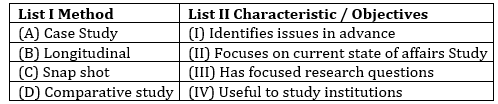
· Case Study (A)-(IV): It is particularly useful for studying institutions as it involves an in-depth analysis of specific cases, providing comprehensive insights into processes, events, or institutions.
· Longitudinal Study (B)-(I): This type of study tracks the same sample over a period of time and is often used to identify trends and issues in advance through ongoing observation.
· Snap Shot Study (C)-(II): Focuses on the current state of affairs, offering a "snapshot" or a cross-sectional view of a situation or phenomenon.
· Comparative Study (D)-(III): Characterized by focused research questions, it compares different cases or contexts to highlight similarities or differences.
Information Booster: 1. Case Studies involve qualitative or mixed-method approaches to deeply analyze a single case or limited number of cases.
2. Longitudinal Studies are valuable for understanding changes over time, making them essential in fields like sociology and epidemiology.
3. Snap Shot Studies are typically cross-sectional and serve as quick assessments without delving into historical or future trends.
4. Comparative Studies require clear criteria and frameworks to effectively compare cases and extract meaningful conclusions.
5. Mixed Methods are often used in case studies for a more robust analysis.
6. Each method's strength lies in the alignment with its objectives and the research questions it aims to address.
 English
 10 Questions
 20 Marks
 12 Mins